


Victor Barahona once felt a sense of relief when soldiers began detaining gang members who had long plagued his working-class city with violence and drug dealing.
However, as the military began arresting neighbors whom Barahona knew were uninvolved with gangs, he criticized these actions on his community radio show.
Not long after, police showed up at his door. Barahona was detained, handcuffed, and imprisoned without legal counsel, family communication, or understanding of his charges.
He witnessed harrowing scenes: inmates tortured, guards removing lifeless bodies, and meals consisting of only sparse portions of noodles and beans. Eventually, he filed a complaint with the United Nations Commission on Human Rights.
After being released almost a year later, significantly thinner and without explanation, Barahona was disturbed to find President Nayib Bukele receiving international acclaim for his stringent security measures, which were lauded by American conservatives such as former President Trump.
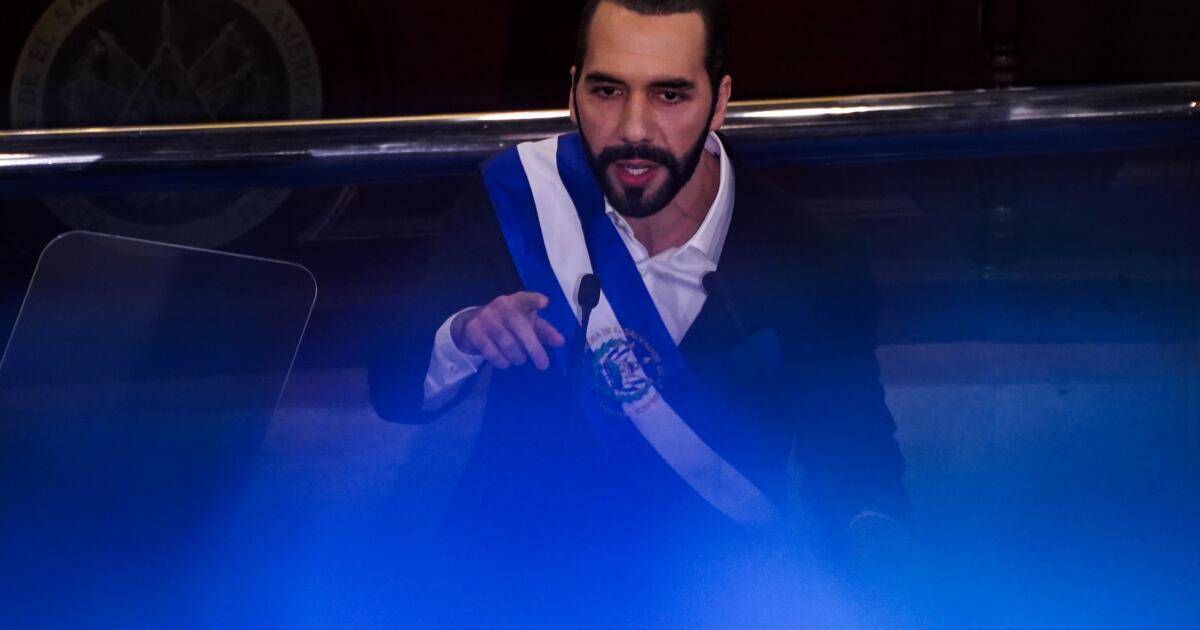
Bukele, initially elected in 2019, has successfully rebranded El Salvador from a gang-ridden nation to a model of security and innovation, using prolific social media interactions to portray himself as a groundbreaking leader.
Yet, despite his modern image, including the adoption of Bitcoin and flashy media, critics argue that Bukele mirrors past authoritarian figures from Latin America's history.
His administration jails adversaries, dismisses judges, and has been entangled in corruption accusations. He also influenced a controversial court ruling allowing his reelection, bypassing the constitutional ban. Last week, he called for a tax on nonprofit donations.
Noah Bullock, director of the human rights organization Cristosal, believes Bukele follows traditional dictatorial practices, using fear and force to govern.
There's little doubt Bukele's mass detentions curtailed gang activity that once suffocated the country. This earns him gratitude from most Salvadorans.
But his crackdown, which encouraged citizen reports of alleged "terrorists" through anonymous tips, also led to numerous wrongful detentions of innocents, according to human rights groups.
Polls suggest widespread support for Bukele among Salvadorans, yet a majority fear repercussions if they voice dissent.
"We used to fear the gangs," Barahona said in Apopa, where soldiers patrol regularly. "Now, it's the government that frightens us."
Admiration from the American Right
Bukele's methods have increasingly become an exemplar for American conservatives.
He was celebrated at a 2024 event near Washington, where attendees chanted his name as he urged U.S. leaders to battle "dark forces."
"The people of El Salvador have awakened," he proclaimed. "And you can too."
Figures like Marco Rubio, Matt Gaetz, and Donald Trump Jr. have visited El Salvador, and commentator Tucker Carlson praised Bukele for providing a "blueprint for world salvation." Elon Musk commented that similar crackdowns are necessary in the U.S.
The Trump administration appears inclined to imitate Bukele's methods. Bukele's state of emergency, curtailing civil rights including process rights, is being considered by the White House for the U.S.
In March, the Trump administration compensated Bukele millions to house deportees in notorious prisons, despite defying a court order regarding the return of deportee Kilmar Abrego Garcia.
Both Trump and Bukele challenge democratic norms, with Bukele calling himself a "philosopher king" while Trump considers a third term, citing a Napoleonic quote about saving the country by any means.
Their camaraderie was evident during a recent Oval Office meeting. Bukele justified widespread rights violations, claiming millions in El Salvador were "liberated," prompting Trump to consider adopting the line.
Investment vs. Domestic Discontent
San Salvador, overshadowed by a dormant volcano, echoes with construction sounds.
Public works, like hospital upgrades and colonial building renovations, are underway. A Chinese-funded library stands tall in the town square, where children play in fountains and music drifts through the trees.
These developments and coastal improvements, showcased by Bukele, are billed as indicators of economic prosperity. The country's tourism figures soared to record heights last year, attracting cryptocurrency enthusiasts.
Yet while large sums are spent on appearances, cuts to health and education have closed numerous schools and clinics.
Ivan Solano Leiva of the national medical association critiques Bukele's focus on image over essentials. Even as he publicizes new hospital technologies, wait times grow and drug shortages persist, with doctors discouraged from writing prescriptions.
"Technology loses its purpose if adequate staffing is absent," Solano remarked.
State-owned media, boosted under Bukele's rule, produces content lauding him.
Beneath TikToks of prosperity lies disenchantment: Poverty swelled from 26.8% in 2019 to 30.3% in 2023, as the country lags in economic growth and foreign investment within Central America.
Despite notable projects like a new Google office, investors are deterred by instability, an adviser to international businesses disclosed anonymously.
Recent transportation disruptions spotlighted risks when Bukele mandated free transportation, leading to arrests of non-compliant bus companies' owners.
Erica Mendoza, while grateful for travel subsidies, doesn't expect overnight solutions to longstanding economic woes. "We survive by taking it day by day."
Corruption Charges
Bukele resides in a lavish home within Los Sueños, a luxury neighborhood, instead of the national palace.
His administration has acquired multiple properties in the area for a new presidential residence.
Critics, like constitutional lawyer Enrique Anaya, see these acts as attempts to prolong power and accumulate wealth.
Investigations reveal substantial property purchases by Bukele and family during his presidency, contradicting his anti-corruption stance.
While Bukele dismisses corruption allegations as foolishness, many observe a chasm between his portrayed and actual El Salvador.
Evidence suggests that crime decrease wasn't solely due to harsh security measures. Allegations have surfaced of Bukele's administration negotiating with gangs for reduced murders and political support.
The U.S. Treasury has sanctioned Bukele's officials for alleged dealings with gangs to lower homicide rates for electoral benefits.
Recently, a video emerged of a gang member alleging receipt of payments for electoral backing from Bukele's party.
Whether Salvadorans care about methods is debatable. Andrés Hernández, a former gang target, appreciates breathing easy for the first time in years.
Hernández anticipates voting for Bukele in a third term. "I'd like him to stay indefinitely."
Juan Meléndez, from the Netherlands Institute for Multiparty Democracy, notes a national willingness to sacrifice rights for security—a mindset rooted in El Salvador's authoritarian history.
Meanwhile, about 2% of Salvadorans endure imprisonment. Among them is René Mauricio Tadeo Serrano, detained in 2022.
His mother, María Serrano, struggles with diabetes, working to afford basic necessities for him. She, like others, seeks answers on her son's case.
María believes it's only a matter of time before others see Bukele's tolls. "Freedom is an illusion here," she declared. "Supporters haven't yet faced loss."
Leave a Reply