


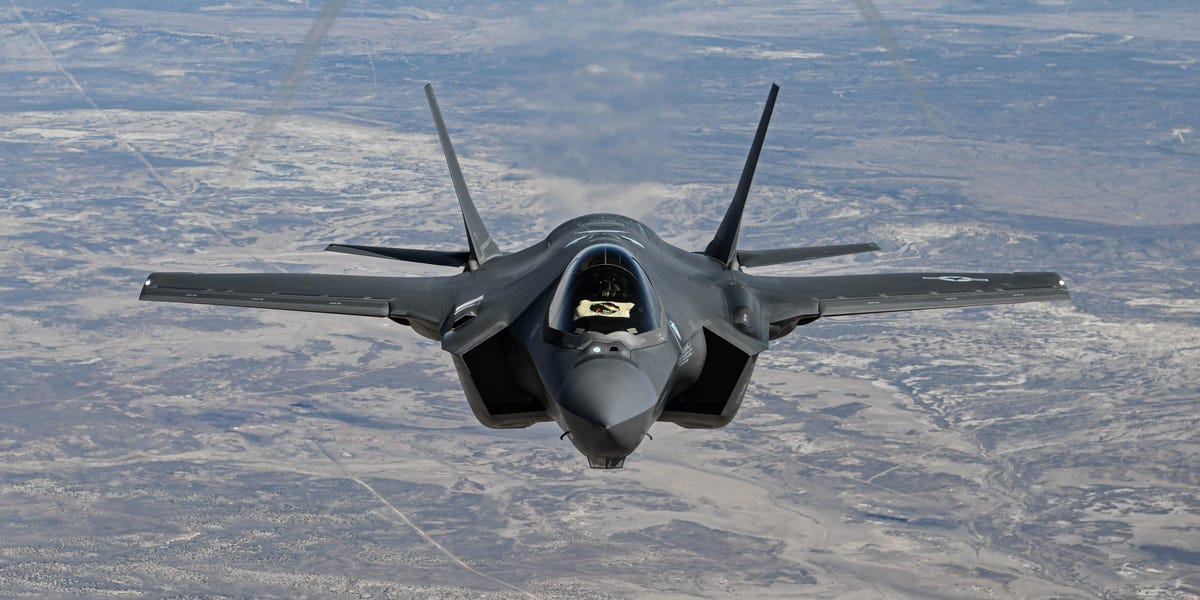
The F-35: Stealthy But Not Invisible
In the defense world, 'stealth' refers to an aircraft's ability to evade detection, not to be mistaken for invisibility or indestructibility.
The Lockheed Martin F-35, a premiere stealth fighter for the United States, has been conducting operations against Iran-supported Houthi forces in Yemen. During an intense two-month operation, U.S. Air Force and Navy versions, the F-35A and F-35C respectively, have been deployed in the region.
Recent reports suggest that during one such mission, an F-35 had to maneuver to avoid a surface-to-air missile launched by Houthi militants, though details remain unclear. The Pentagon and U.S. Central Command, both responsible for operations in the Middle East, have yet to confirm the details of the incident to the media.
Assessing the Threats Facing Stealth Aircraft
The incident with the F-35 is of note because it highlights the aircraft's role in navigating heavily defended airspaces, neutralizing enemy threats, and relaying targeting information. While the Israeli Air Force has used F-35s to attack deep within Iranian borders, the Houthi defense capabilities don't quite match up to the challenges the F-35 is designed to tackle.
The future remains uncertain on how this incident reflects on the F-35’s performance, but it underscores the need to consider how stealth and combat effectiveness intersect.
Understanding Stealth Technology
Billie Flynn, a former combat commander from the Royal Canadian Air Force and a longtime contributor to the F-35 program at Lockheed, explained that a key feature of stealth technology is an aircraft's minimized radar signature—often as small as a ball used in table tennis or golf.
Crafts like the F-35, F-22 Raptor, B-2 Spirit, and upcoming B-21 Raider are formidable for their almost undetectable radar cross-sections, a result of several technological advancements.
Lockheed applies specialized radar-absorbing paint to the F-35, and design choices eliminate easily detectable surfaces. The aircraft's design allows internal storage of weapons and fuel, further reducing detectable signatures.
In combination with those passive measures, the F-35 also employs advanced electronic warfare controls that jam or interfere with opposing radar systems.
The Myth of Invincibility
The enduring belief that the F-35—or indeed any stealth aircraft—is invisible is misleading. During his administration, President Donald Trump often referred to the F-35 as 'invisible,' yet American pilots and planners are acutely aware that no aircraft is ever completely undetectable.
Historical lessons bear this out, such as the Yugoslav military's successful downing of an F-117 Nighthawk, one of the U.S.'s earliest stealth aircraft, during the Kosovo conflict in the 1990s.
Risk and Strategy in Air Defense
Aviation consultant Richard Aboulafia highlights that reduced radar visibility is not the entirety of the F-35's advantage; essential is its sophisticated mission systems, which are adept at identifying targets and threats.
While stealth capability diminishes the likelihood of being tracked, it's not foolproof. If an F-35 carries ammunition externally—referred to as 'beast mode'—its stealth features are somewhat compromised. Moreover, enemy defenses may be activated at opportune moments.
Despite media reports, it is unclear whether the recent encounter involved deliberate targeting or a fortunate proximity in the direction of the jet.
According to Gordon Davis, a former senior official at NATO and a U.S. Army major general, the Houthi defenses, bolstered by Iranian support, pose a notable danger to both military and civilian planes in Yemen.
Though their systems have occasionally taken down unmanned U.S. drone aircraft, piloted craft like the F-35 have so far avoided destruction through advanced evasion and protection systems.
Flynn indicated that it would require the F-35 to be critically exposed for any hostile system, whether Houthi, Russian, or Chinese, to successfully engage it, a scenario that seems unlikely.
Leave a Reply