


The Cost of Building a Fully 'Made in the USA' Car: A Complex Affair
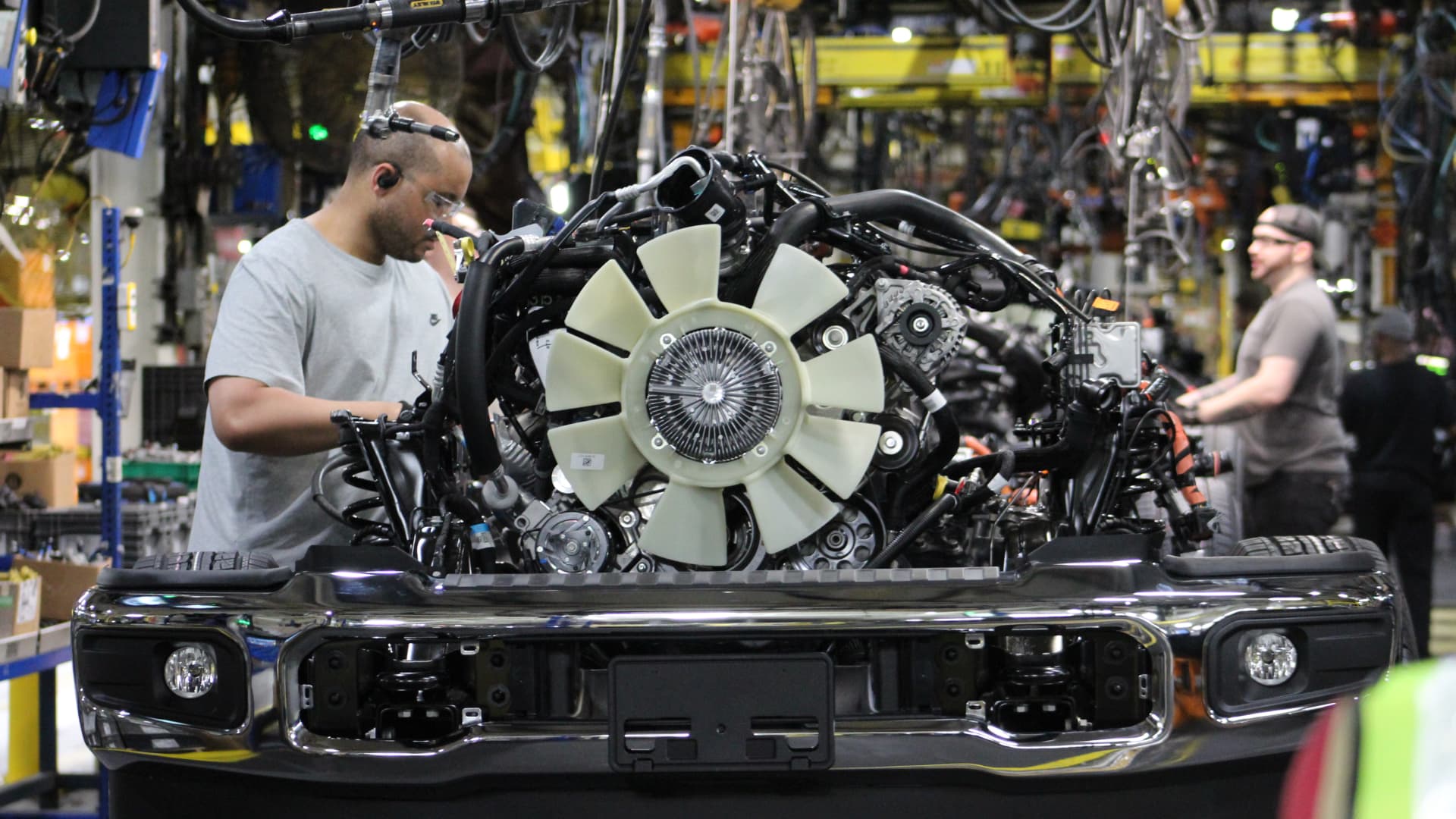
In Louisville, Kentucky, at the Kentucky Truck Plant, a new 2025 Ford Expedition SUV, adorned in a striking white with bronze accents, glides off the production line. Although constructed by American hands in an American factory, it is not entirely 'Made in the USA.'
Ford's window sticker reveals that over half of its significant components – approximately 58% – originate from abroad, with 22% made in Mexico. Even its crucial 3.5-liter twin-turbocharged V-6 Ecoboost engine is foreign-sourced, despite being designed by Ford.
This popular large SUV highlights the intricate nature of the auto-manufacturing landscape and exemplifies how vehicles from even quintessentially American brands heavily rely on imported parts.
President Trump favors facilities like the one producing the Expedition, F-Series, and Lincoln Navigator, as it encapsulates his push for domestic automotive manufacturing through aggressive policies.
With Trump implementing a 25% tariff on imported vehicles and parts, automakers have rushed to emphasize American investments and shorten supply chains. While the U.S. might gain jobs and economic enhancement through domestically manufactured auto parts, experts deem a 100% U.S. sourcing impractical.
Martin French, an expert from Berylls Strategy Advisors USA, points out that manufacturing some overseas components domestically remains cheaper, even with tariffs in place.
Challenges of U.S.-Only Manufacturing
Vital facilities for producing things like steel, semiconductors, and raw materials such as platinum aren’t abundant in the U.S., and developing them would require decades.
The potential hike in vehicle prices for purely American-made cars could shrink consumer demand, negatively impacting production scales.
Ford's CEO, Jim Farley, notes that while shifting full production to the United States is possible, the financial outcome could be detrimental if every vehicle cost $50,000.
A complete U.S. supply chain isn't currently feasible for key parts, like fasteners and wiring harnesses, which are labor-intensive or primarily sourced from Asia due to cost.
S&P Global Mobility highlights that a vehicle typically consists of about 20,000 parts, with origins spanning 50 to 120 countries.
Economic and Logistical Factors
To ease consumer costs, the government could offer tax incentives similar to those once promised by Trump's administration.
Nonetheless, achieving a fully American-made vehicle remains a complex venture, with shared U.S. and Canadian content complicating raw U.S. measurements for auto content.
A handful of experts speculate that achieving higher percentages of American parts would increase manufacturing costs significantly each step towards 100% domestically-sourced components.
Mark Wakefield, a leader at AlixPartners, explains that moving to 100% U.S. content is costly. As sourcing exceeds 90%, expenses rise disproportionately.
To reach the upper echelons of domestic sourcing would require time and substantial investment in infrastructure and raw material acquisitions.
Feasibility and Industry Insight
Attempting a 100% U.S.-made vehicle might currently be unworkable, with production possibly incurring over $7,000 more, even for an American-assembled full-size truck.
A potential model might increase in cost by $10,000 to $20,000 when factoring exclusively in partlydomestic sourced materials, based on prevalent assembly data.
The U.S., regarded as a high-cost production environment, faces challenging comparisons: While a U.S. produced vehicle costs over $53,200, Mexican counterparts hover around $40,700.
In theory, starting a fully domestic car company would require heavy investment and still yield overpriced vehicles, akin to low-volume, prestige brand manufacturing.
Ferrari symbolizes a boutique model: Italian craftsmanship, but with several non-Italian components, illustrating the challenges of solely domestic sourcing for mass vehicles.
A Practical Approach
A more realistic goal is achieving 75% U.S.-Canadian parts with local final assembly, a milestone currently reachable with significant investment.
Some firms have advanced towards this benchmark, but widespread adoption would entail drastic shifts in production policy and location.
Examples like the 2025 Kia EV6 and Model 3 demonstrate the possibility when standards sync with advanced production technology within North America.
Historically, domestic content percentages have declined in response to global supply chain efficiency and technological evolution in car manufacture since the Great Recession.
Imported vehicles, often luxury models from European and Asian origin, maintain minimal U.S. content but illustrate the flexibility and reach of international assembly laws.
Current Industry Trends
Despite being heavily centralized in North America, some models like the Toyota RAV4 still maintain significant Canadian assembly despite high North American parts percentage.
Cars.com's index aims to highlight American-facing models, where much of the industry still struggles to break into the top ranks, noting a consumer interest in American-sourced vehicles.
The recently produced Ford Expedition, primarily assembled in the U.S., might climb the ranks in domestic content score, influenced by shifting nationalist and economic sensibilities.
Consumer attention has increased towards the 'American-Made Index,' a trend reflecting broader economic policies and nationalist drives.
Leave a Reply