


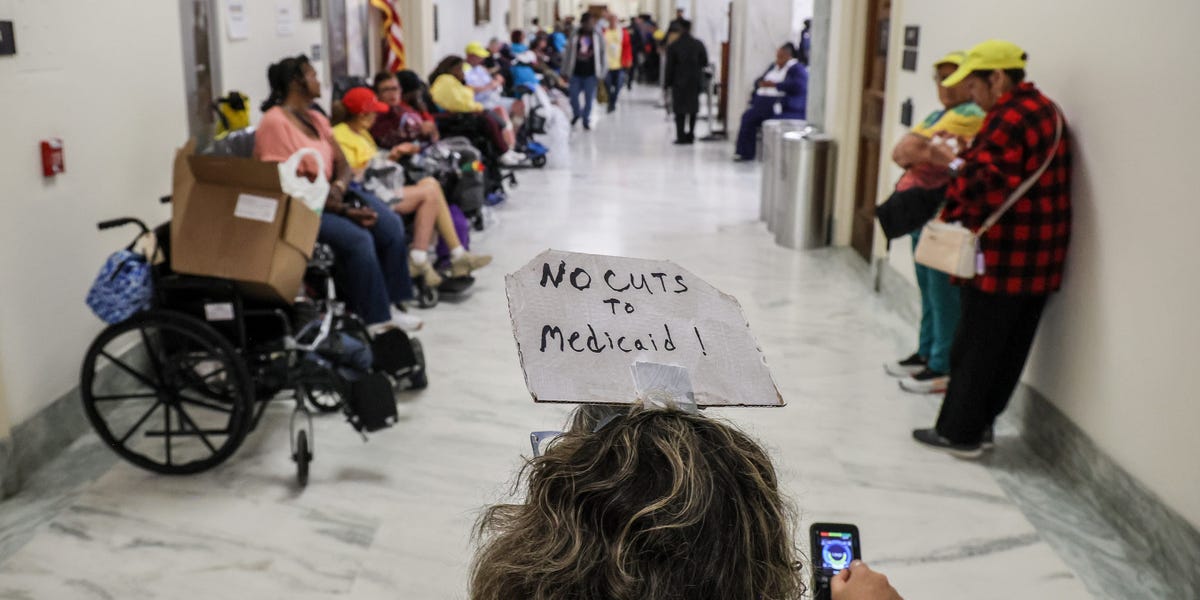
Impact of Proposed Medicaid Revisions on Americans
Recent budget plans from House Republicans indicate potential significant reductions in federal Medicaid funds, which may restrict healthcare access for numerous Americans.
Business Insider analyzed accessible enrollment and demographic information to identify groups who could be most vulnerable. Findings suggest significant impacts on children, low-income millennials, and people in the western and northeastern regions of the U.S.
Currently, Medicaid and the Children’s Health Insurance Program (CHIP) cover over 79 million individuals, equating to almost a quarter of the U.S. population. These programs are funded jointly by federal and state governments.
Details on Medicaid Beneficiaries
Data from October 2024 and the July 2024 Census Bureau estimates highlight that across nearly every state, over 10% of residents depend on Medicaid or CHIP, with the highest numbers in New Mexico and California.
In-depth demographic analysis reveals that children constitute a disproportionately large segment of Medicaid recipients — while they only account for about a fifth of the overall U.S. population, they represent almost 40% of Medicaid enrollees. Conversely, Americans of prime working age (25-54) are less represented compared to the general populace.
Unemployment rates are notably higher among Medicaid members, with only about 40% employed compared to 60% in the wider American workforce. Many Medicaid recipients are also not part of the labor force, possibly due to caregiving responsibilities or abandoning job searching altogether.
Financially, Medicaid recipients earn significantly less, with a typical annual income of $21,654, contrasted with an average income of $55,050 for all adults. This earnings gap results in approximately a third of Medicaid users living beneath the poverty threshold, while this statistic is 13% for the general U.S. population.
Marital status among adult Medicaid beneficiaries also varies, with a lower tendency to be married and higher instances of being separated or divorced than the broader adult population. Additionally, women slightly outnumber men in this group.
Proposed Changes and Their Impacts
Proposals from the House Energy and Commerce Committee, which oversees Medicaid, introduce measures like increased Medicaid service fees, more frequent income checks, and work prerequisites for certain low-income adults, set to start in 2029.
The proposal aims to limit state tax allocations that hospitals use to augment federal funds. Another measure would enforce some co-pays for doctor visits for Medicaid users earning beyond the poverty level.
Further, the plan suggests curtailing Medicaid expansion in states that provide for undocumented residents and prohibits Medicaid from supporting groups like Planned Parenthood that offer abortion services.
While less drastic than anticipated, as it doesn't change the federal matching rates or introduce per capita expenditure limits, some members of the GOP advocate for these more austere measures.
There remains a Republican divide regarding how to address Medicaid cuts due to varying rates of program reliance across their represented districts.
With legislative negotiations imminent, the ultimate Medicaid reduction strategy is uncertain, though it clearly remains a point of intense focus.
Leave a Reply