


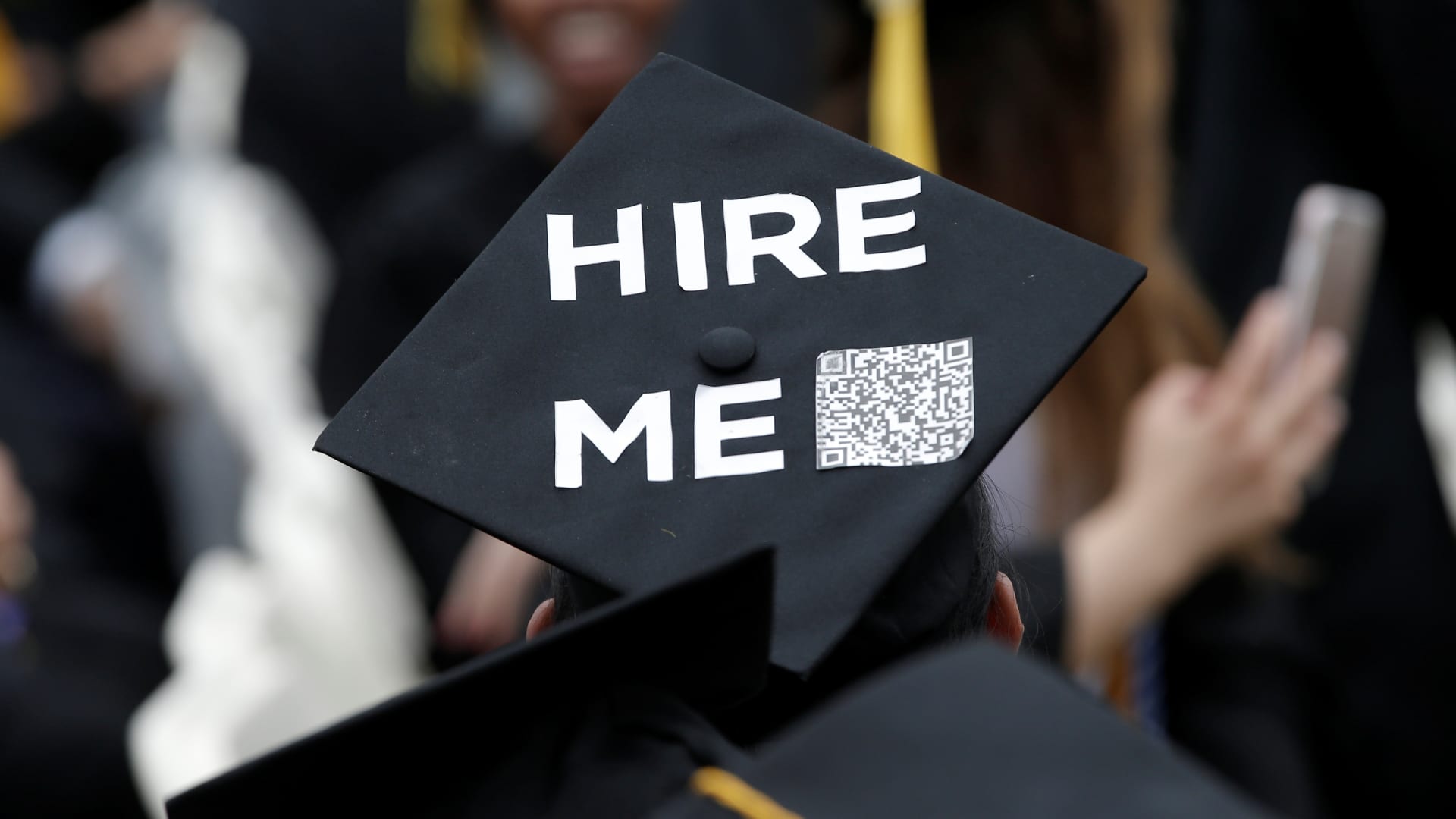
Challenges Awaiting 2025's College Graduates in the Job Market
Graduates looking for jobs this year are encountering more difficulties than they had anticipated just a short time ago.
In March, unemployment among recent college graduates climbed to 5.8%, rising from 4.6% the previous year, according to a report released in April.
Handshake, a recruitment platform for students, reported a 15% decrease in job listings over the past year while witnessing a 30% increase in applications.
Christine Cruzvergara, the chief education strategy officer at Handshake, describes the market as 'challenging and highly competitive' for newcomers.
"There is significant uncertainty, and certainly immense competition among graduates entering the job scene," she noted.
Impact of Federal Reductions on Class of 2025
Despite ongoing job creation in the U.S., policy changes are fueling uncertainty.
Federal hiring freezes and massive governmental worker layoffs have been executed under President Trump's administration. Evercore ISI, an investment bank, estimated this month that around 350,000 federal jobs have been affected by Department of Government Efficiency cutbacks, impacting roughly 15% of federal employees.
"As of early January, the graduating class seemed poised to match or exceed application numbers for federal positions," Cruzvergara indicated. However, following executive orders in January, a 'notable drop-off' occurred, she explained.
"The federal government is a major source of employment in the U.S., playing a significant role for entry-level workers," stated Loujaina Abdelwahed, a senior economist with Revelio Labs.
Job Market Fluctuations and Emerging Concerns
Intermittent tariff impositions have left many businesses uncertain, with a third of CEOs surveyed contemplating job reductions this year due to import duties.
Another growing concern is job displacement driven by artificial intelligence.
A survey revealed that 62% of the Class of 2025 worry about AI's potential effects on their employment, a significant jump from 44% two years back. Graduates from the humanities and computer science fields express the most concern.
"I think we're looking more at a transformation of entry-level roles rather than their disappearance," Cruzvergara remarked.
In March, employment opportunities in hospitality, education, and sales showed an uptick, although most sectors, except a few, experienced a pullback in April, according to Revelio Labs.
Strategizing for Job Success in a Competitive Market
Experts advise graduates to maintain a positive perspective throughout their job searches.
"Employers prefer candidates who come across as hopeful and full of potential rather than those who appear desperate or disgruntled," Cruzvergara advised.
Here are two strategies for navigating job opportunities:
Seek Opportunities with Smaller Enterprises
Companies with less than 250 employees may provide more substantial learning and growth opportunities compared to larger organizations.
Research by Revelio indicates that graduates, irrespective of their initial employer's size, experienced similar salary growth, promotion rates, and management opportunities five years into their careers. Graduates who began at smaller firms were 1.5 times more likely to found their own ventures later on.
Tracking individuals who acquired bachelor’s degrees from 2015 to 2022, the study discovered potential roles in small companies often extend beyond their stated responsibilities, fostering entrepreneurial skills.
"The breadth of roles in smaller companies often sparks an entrepreneurial spirit," commented Abdelwahed.
Leverage Networking and Informational Interviews
Experts recommend recent graduates to engage with professionals in fields of interest.
"Show genuine curiosity about someone else's career journey. Solicit insights about entering the field, emerging trends, and current challenges," Cruzvergara advised.
This method can augment your knowledge and efficacy during the application and interview phases.
Leave a Reply