


The Dual Origin of Intelligence on Earth
Intelligence is often seen as a distinctive feature of human beings, characterized by our capacity for mathematical reasoning, logical thought, and abstract problem-solving. Yet, humans are not the only species to exhibit such cognitive capabilities—birds have frequently demonstrated significant cognitive skills. For instance, they anticipate future needs, use innovative strategies to protect food, and remember the exact location of thousands of hidden seeds. Birds accomplish these tasks with brain structures markedly different from those of humans: smaller in size and lacking the highly organized formations associated with mammalian intellect.
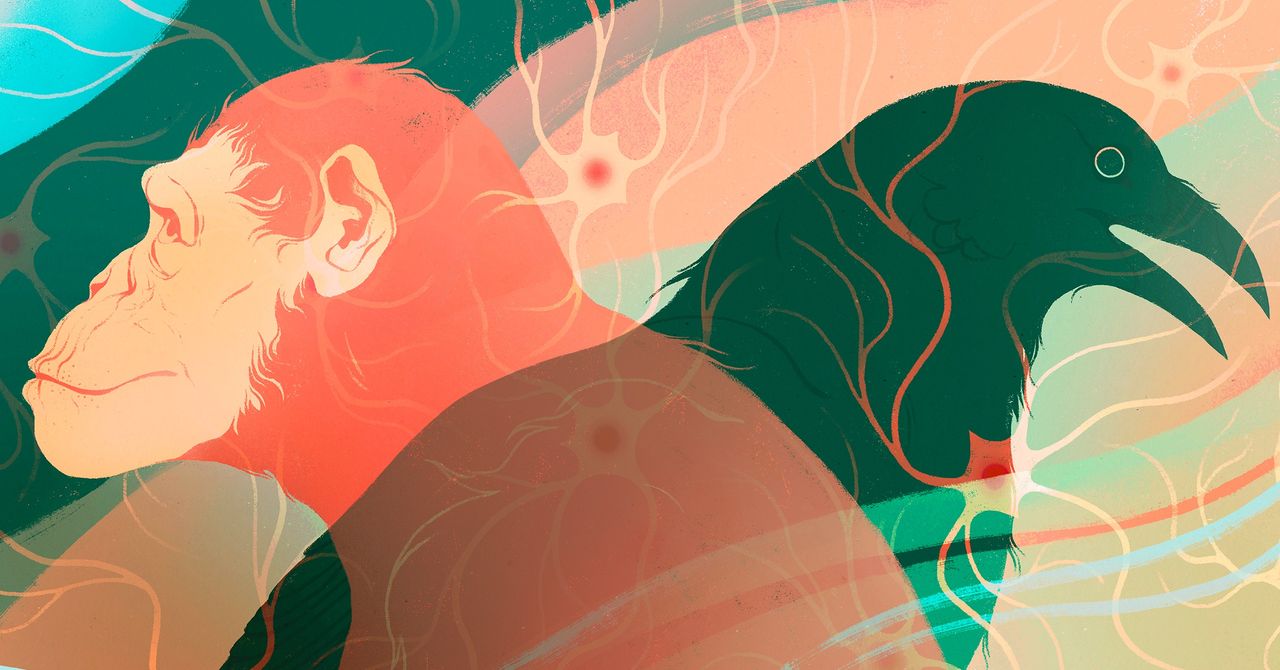
A neuroscientist described the phenomenon by comparing a bird’s 10-gram brain to that of a chimpanzee with a 400-gram brain, questioning the mechanisms behind such parallel cognitive performances. This similarity raises an intriguing possibility: that intelligence in vertebrates might have emerged more than once.
The evolutionary paths leading to the advanced neural architecture needed for intelligence remain obscure due to the extinction of ancestral species and biological remnants. Nevertheless, by comparing present-day animal brains and tracking their development, scientists have made strides in understanding how such complexity evolved independently.
Recent research from 2025 provides compelling evidence suggesting that birds and mammals developed their cognitive abilities through independent evolutionary processes. Despite evolving separately, both avian and mammalian brains exhibit unexpectedly similar neural circuitry, hinting at convergent evolutionary solutions to intelligence.
Reassessing Bird Brains
For much of the 20th century, birds were considered simple-minded due to the absence of a neocortex, considered central to higher reasoning in mammals. Unlike the six-layered mammalian neocortex, bird brains were thought to consist of undifferentiated neuron clusters, making researchers question their capacity for complex learning.
This perception changed when Harvey Karten, a neuroanatomist, began mapping avian brains in the 1960s. To his surprise, networks analogous to mammalian cortex structures were found within bird brains, particularly in the dorsal ventricular ridge (DVR), suggesting that avian intelligence might operate through similar but structurally different frameworks.
Luis Puelles later found through comparative embryology that these components had distinct developmental paths, offering evidence that such brain structures evolved independently in birds and mammals.
Unraveling Convergent Paths
Advanced genetic techniques, like single-cell RNA sequencing, have allowed researchers to trace neuronal development from embryonic stages to maturity across species, such as chickens, mice, and geckos. These investigations reveal that while birds and mammals share neural circuitry features, these were constructed at different times and via different processes.
In some instances, the diversity in neuron origin within birds contradicts earlier views on neuron specialization in embryonic development, suggesting more flexible pathways to achieving complex neural structures.
The parallels in brain evolution resonate not only across vertebrates but also highlight broader patterns, akin to how camera-like eyes evolved separately in squids and mammals. Such cases underscore the concept of convergent evolution, where diverse paths reach similar outcomes.
Exploring the Fundamentals of Intelligence
The evolution of intelligence doesn't adhere to a single template; rather, it reflects a spectrum of innovations across biological systems. From distinctive neuron evolution to novel brain circuits, such diversity of paths points to the adaptability and resourcefulness of evolutionary mechanisms.
Studying how disparate lineages, such as octopuses with profoundly different brain structures than vertebrates, achieve complex cognitive tasks can reveal defining characteristics of intelligent neural systems. This knowledge could bear implications for understanding extraterrestrial life forms and advancing artificial intelligence, potentially leading to innovations inspired not just by human cognition but by an array of animal intelligences.
Leave a Reply