


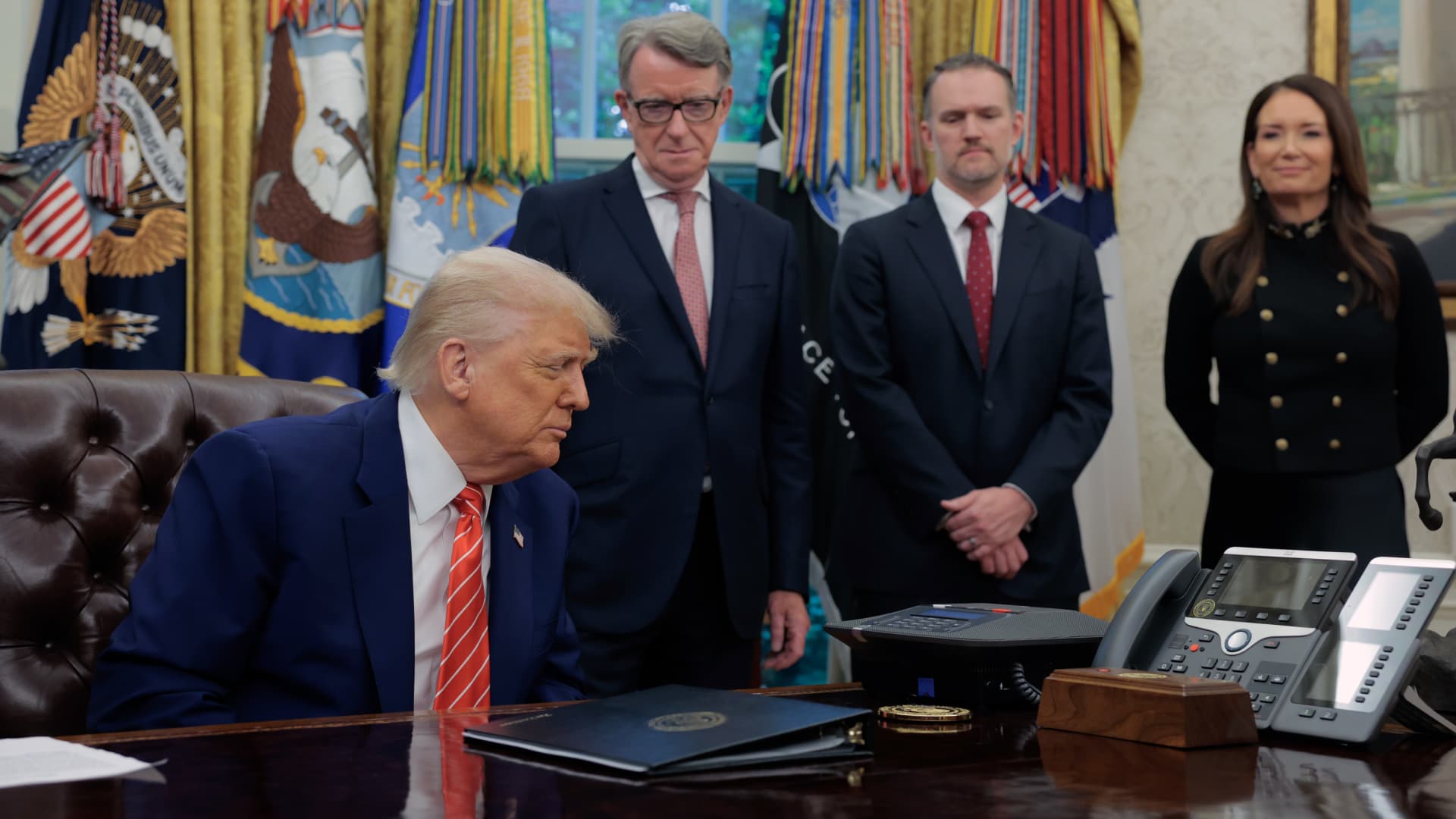
Trump's UK Trade Agreement Signals Persistence of 10% Tariffs
On Thursday, the United States and the United Kingdom came to terms on a trade agreement which, nevertheless, comes under the shadow of continued tariffs.
This marks the inaugural trade pact the U.S. has secured since President Donald Trump introduced his controversial stance on global reciprocal tariffs the previous month.
The UK holds a unique position as one of the few nations where the U.S. enjoys a goods trade surplus, meaning it exports more to the UK than it imports. This status placed the nation prominently in the queue for negotiating a deal with Trump's administration.
Yet, despite the 'special relationship' between the U.S. and the UK, the British negotiators were unable to convince Trump to abolish all tariffs during their discussions.
As per the agreement, the UK has secured a clause allowing the export of up to 100,000 vehicles annually at a tariff rate of 10%. Any vehicles beyond this number will incur a 25% duty. This is contrasted with British producers of steel and aluminum who can now ship their products without tariffs, lowered from a previous rate of 25%.
However, the U.S. still holds firm on implementing a base 10% tariff on all other imports from the UK. According to Trump, this is the minimum tariff other nations can expect.
Trump noted that due to the balanced trade and strong political ties, this deal is uncommon, hinting that zero-tariff agreements are unlikely during his tenure.
When asked if this tariff rate set a benchmark for future agreements, Trump referred to the 10% as being relatively low.
"They secured quite a favorable deal," he remarked. "However, for countries with significant trade surpluses, the rates could be substantially higher."
Analysts interpret this as suggesting that a 10% baseline will likely form the best-case scenario for future trade negotiations involving other nations.
Jan Hatzius, chief economist and head of global investment research at Goldman Sachs, mentioned that the details support the view that the U.S. will maintain a baseline tariff of 10% towards trading partners with little room for exceptions, though there appears to be more flexibility than anticipated on specific sector tariffs.
US Economist Abiel Reinhart from JPMorgan highlighted to clients that it is likely a rate of at least 10% on the majority of goods from most countries would persist throughout the year.
Reinhart added that the UK's success in negotiating exceptions for auto, steel, and aluminum showcases U.S. openness to special but limited agreements with other countries.
"This has been a challenging point in recent discussions with Japan due to its vital automotive industry," Reinhart elaborated. "And the U.S. might have been more accommodating with the UK on autos because the UK represents just 2.5% of U.S. imports of vehicles and parts, compared to Japan's roughly 12%."
Rella Suskin, from Morningstar, observed that the limitation to 100,000 vehicles means major British carmakers like Jaguar Land Rover, owned by Tata Motors, are restricted from gaining more market share through a preferential tariff compared to European competitors.
Instead, this scenario supports automakers who import components tariff-free and assemble the vehicles in the U.S., Suskin noted.
This constraint implies Jaguar cannot utilize the market advantage of a favored tariff arrangement over its European rivals, as Suskin stated.
Andrew Hood, from European law firm Fieldfisher, who previously advised David Cameron, stated the agreement bolsters the broader UK-U.S. relationship more than it facilitates trading.
"The agreement is notably narrower than most free trade deals," Hood explained. "It fails to retract the 10% tariffs recently put forth by Trump's Administration. Instead, it aims to support certain sectors like automotive, ethanol, and metal producers, where tariffs have been significantly lowered or lifted."
While the sustained 10% tariffs may negatively affect the UK, others warn it might also impede U.S. economic growth.
"Even with some carve-outs diluting the effective tariff rate, the maintenance of at least a 10% base keeps average U.S. tariffs in double figures," warned Michael Pearce of Oxford Economics. "This will have a severe impact on real income levels in the U.S. and is expected to decelerate growth sharply in the latter part of the year."
Leave a Reply