


Trump's Claim on the U.S.-Canada Border's Validity
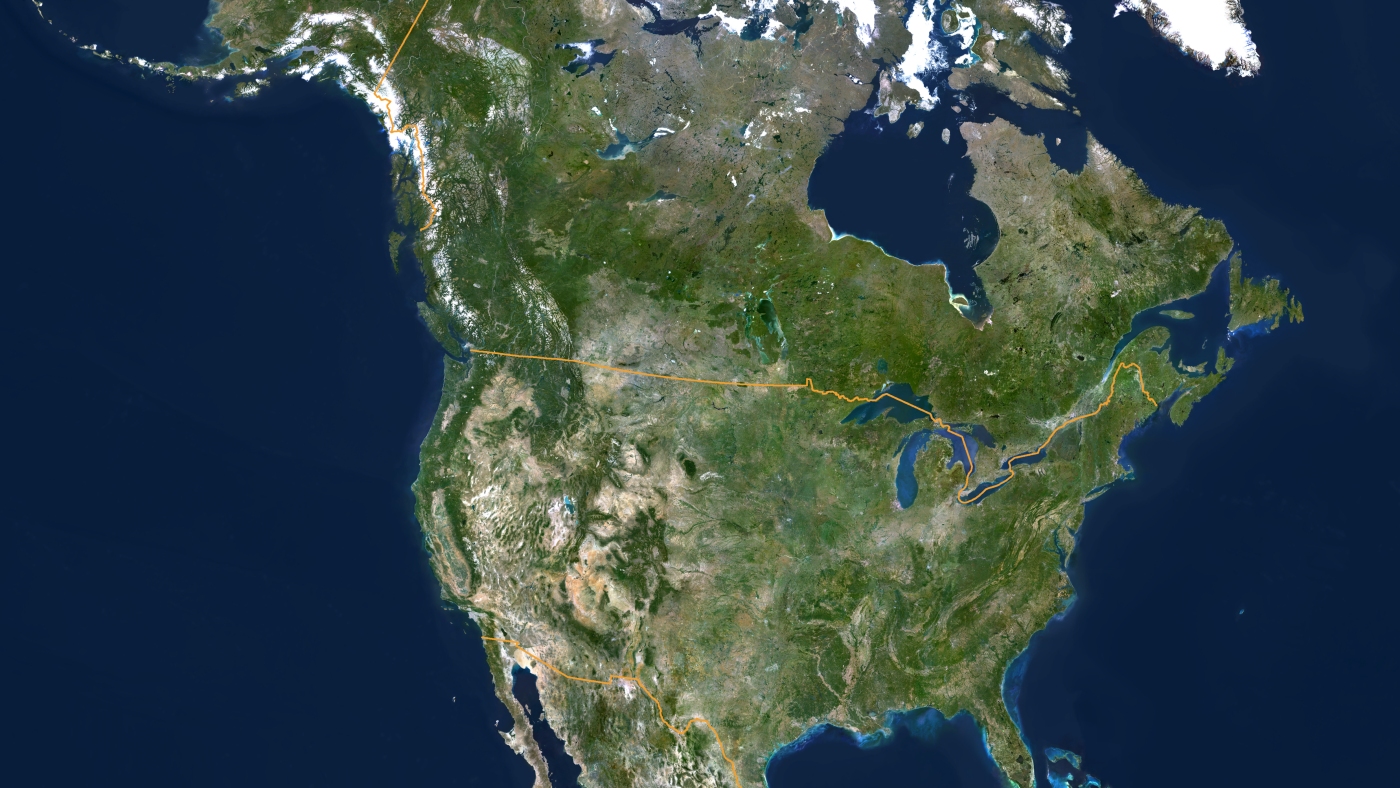
The demarcation between the U.S. and Canada largely coincides with the 49th parallel, having been selected with specific considerations.
During discussions with Canadian Prime Minister Mark Carney at the White House, President Trump shifted focus to the border in addition to diplomatic ties between the two nations.
President Trump, reiterating a familiar line, described the boundary as merely an "artificially drawn line" and implied its redundancy.
Trump remarked, "A long time ago, someone drew a line over that vast expanse almost as if with a ruler," expressing his vision of a borderless expanse. "I'm quite the aesthetic individual, and when I observed that map, I thought, 'That's the natural order.'"
"Frankly, Canada as a state would thrive," Trump asserted. "It offers nothing we can't manage without. If integrated as a state, it would be a remarkable addition, reshaping our nation's visual grandeur. It's just a line someone arbitrarily drew."
Since assuming office, Trump has frequently alluded to absorbing Canada, criticizing one of America's key trading counterparts and imposing tariffs that strained trade relations, thereby energizing Carney’s recent political victory after campaigning on defiance against such policies.
Prime Minister Carney strongly communicated that Canada is neither on the market nor will it be, underlining its sovereignty.
In referring to this boundary as artificial, Trump seems to undermine its significance, according to Jon Parmenter, a historian from Cornell University. He suggests that Trump's viewpoint diminishes the border’s intricate past and its vital role in North American life.
"It genuinely exists," affirms Parmenter, who studies the border extensively. "As a historian, it's troubling to hear it dismissed as overly simplistic or incorrect."
Carney later reflected he was pleased his thoughts during the interaction remained private.
The Origin of the Boundary
The border emerged through negotiations occurring from the late 18th to the early 20th century.
Initiating with the 1783 Treaty of Paris, the sovereignty of America and the delineation along the Mississippi were established, evolving the frontier over time.
Subsequent agreements like the 1818 convention designated the border along the 49th parallel between American territories and British North American lands, which later became Canada, and was extended by the 1846 Oregon Treaty reaching the Pacific.
Utilitarian decisions dictated that using latitudinal lines was the optimal dispute resolution, says Parmenter.
Stephen Hornsby, a geographer from the University of Maine, identifies the decision for the 49th parallel as deliberate, with British interests in protecting northern trade routes and American expansion into fertile valleys.
The line conveniently divided watershed regions; northern rivers drained via the St. Lawrence and Hudson Bay, while southern waterways fed into the Mississippi.
Though seemingly straightforward, this border disregarded both natural geography and Indigenous lands, often bisecting them involuntarily.
Demarcating the Line
Through a century of evolving treaties and discussions among the United States, the United Kingdom, Canada, and Russia, the border's form was solidified, with the International Boundary Commission (IBC) initiated in 1908 for monitoring.
The IBC meticulously maintains over 8,000 landmarks, ensuring the border remains visible, even cutting through forests and mountainous regions.
While heavily patrolled areas exist, other sections are scarcely marked except by simple monuments or geographic markers.
Current Dynamics
Awareness of the border is heightened in Canada due to the proximity of major population centers, less so in the U.S. where focus has often been the southern border.
Though historical renegotiation isn't uncommon, Parmenter suggests a modern shift is improbable given strained relations.
He advocates for nuanced dialogue over charged rhetoric to enhance relationships, cautioning against antagonizing Canada through unrealistic notions of annexation.
Leave a Reply