


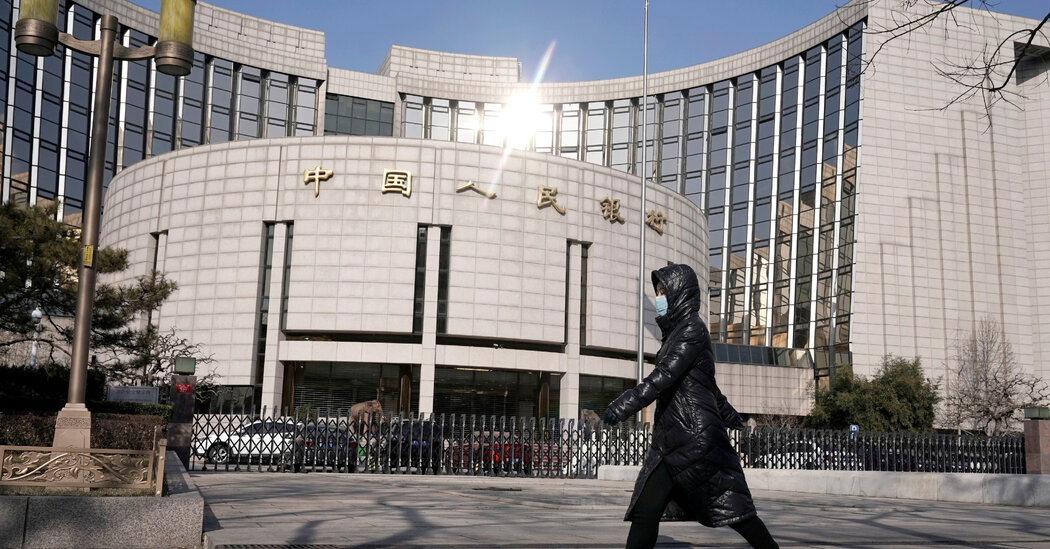
China Lowers Interest Rates to Stimulate Economy Amid Trade Disputes
In response to upcoming discussions between China and the Trump administration regarding trade conflicts, China’s central bank has swiftly taken action.
In an attempt to mitigate the harm caused by the escalating trade tensions with the United States, the People’s Bank of China significantly reduced interest rates and has facilitated increased lending by banks. This pivotal policy shift is designed to bolster economic stability.
Through a gamut of ten strategic changes, the central bank decreased short-term interest rates and lowered reserve requirements for banks, thereby enabling more financial institutions to extend credit. Simultaneously, restrictions on car loan companies were lifted, empowering banks to provide financial support for key government initiatives, such as research and innovation in technology.
According to Pan Gongsheng, the central bank governor, this adjustment reflects a ‘moderately flexible’ monetary approach in reaction to the global economic environment, which remains unpredictable due to intensifying trade disputes affecting worldwide production and supply chains.
Announced as a series of stable market policies, the initiative coincided with scheduled meetings in Geneva between high-ranking officials from Washington and Beijing—marking the most substantial trade discussions since tariffs on Chinese goods were dramatically increased by President Trump, pushing them to as high as 145 percent.
China retaliated by imposing equivalent tariffs on American goods, raising them to 125 percent. As a result, these exchanges have critically hampered global trade, casting a shadow over economic forecasts for not only China and the US but also other interconnected economies.
The previous week, a downturn in Chinese production activities came to light, largely due to a sharp decline in new export orders.
Following the policy announcement, the CSI 300—a benchmark index for major firms in Shanghai and Shenzhen—saw a modest increase of 0.5 percent. Hong Kong's Hang Seng Index enjoyed a more robust climb of 1.4 percent.
The reduction in the reserve requirement ratio—a term that refers to the proportion of deposits banks must hold and not lend out—by 0.5 percent is expected to release additional funds into the lending pool. This adjustment follows a similar reduction in September aimed at rekindling economic growth.
Previously indicated by Mr. Pan in March, this policy was anticipated to infuse approximately $139 billion of prolonged liquidity into financial markets.
In tandem, the central bank lowered its principal seven-day interest rate to 1.4 percent, previously set at 1.5 percent.
Leave a Reply