


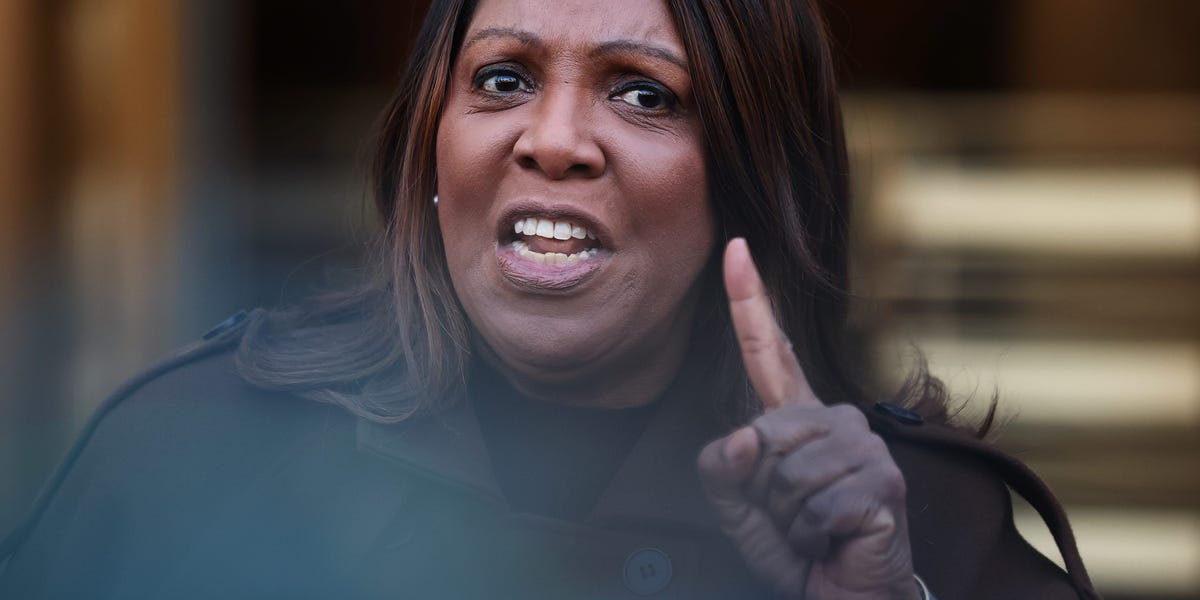
Letitia James Pursues Trump Inner Circle for Potential Insider Trading in Tariff Strategies
New York Attorney General Letitia James is regarded as a frontrunner among state attorneys general when it comes to legally challenging President Donald Trump.
Involved in numerous legal challenges orchestrated by Democratic Attorneys General, all targeting Trump's executive decisions, James stays on the offensive. Her significant court victory yielding a $454 million fraud ruling against Trump, still under appeal in Manhattan, solidifies her aggressive stance.
James' bold investigation into Trump’s inner circle is carving new ground. Though not officially announced, her inquiry ties closely to recent market upheavals due to Trump's tariff decisions.
For two months now, her office has been probing into possible insider trading scenarios, though revealing few specifics, simply acknowledging their focus on potential conflicts.
Business Insider sought expert opinions on the structure and potential of such an inquiry from six legal authorities, including former top-level financial fraud prosecutors.
The views varied significantly. While some see it as a necessary check on power, others dismiss it as politically charged with little chance of success.
New York's Martin Act: A Legal Powerhouse
The linchpin of James’ inquiry is the Martin Act, a venerable statute of over 100 years granting sweeping authority to regulate Wall Street operations. It is revered for being one of the nation's most formidable state securities laws.
Allowing unprecedented tools like issuing subpoenas and pursuing civil or criminal cases, the Martin Act enables investigation into securities and real estate transgressions, although rarely used for insider trading based on insider information.
Insiders from the AG’s office can't recall using the Martin Act in this way. However, the uniqueness of each case leaves room for James' untested path to potentially yield results.
Understanding the Nature of an AG Inquiry
New York’s Attorney General’s Office refers to the initial step of investigation as an 'inquiry.' This stage occurs before any formal subpoena or investigation ensues and analyzes initial insights.
Driven often by tip-offs or public allegations, these inquiries are handled by specialized bureaus assessing trading data for anomalies. Noteworthy trading spikes prior to significant market-impacting events can trigger deeper scrutiny.
Preliminary inquiry letters may be issued, seeking voluntary cooperation from the recipients. Should this escalate, it could transition into an official investigation requiring compliance via subpoenas.
Challenges in Gathering Trading Data
Compiling comprehensive trading data has become increasingly challenging in recent years. Analysts suggest that political dynamics, such as the alignment of the SEC under the Trump Administration could hinder data acquisition.
Identifying dubious trading trends forms merely the baseline. Ensuring these patterns arise from covert insider knowledge demands corroborative testimony, a complex hurdle due to the possible involvement of high-ranking political affiliates.
Resistance to any formal investigation from Trump's inner circle is expected to be robust, potentially leading to vocal legal defenses on permissible jurisdiction.
Any legal action implicating Trump encounters significant barriers, such as legal immunities given his executive status, which poses additional legal contention in such pursuits.
Legal and Political Repercussions
Beyond legal intricacies, James faces scrutiny concerning potential political motivations behind her actions. Critics, including Trump, have repeatedly rebuked her inquiries as baseless and driven by vendetta.
With market volatility adding layers of complexity, distinguishing legitimate trade from insider dealings presents a formidable challenge. The task is further complicated by the widespread nature of trades occurring for myriad legitimate reasons.
Leave a Reply