


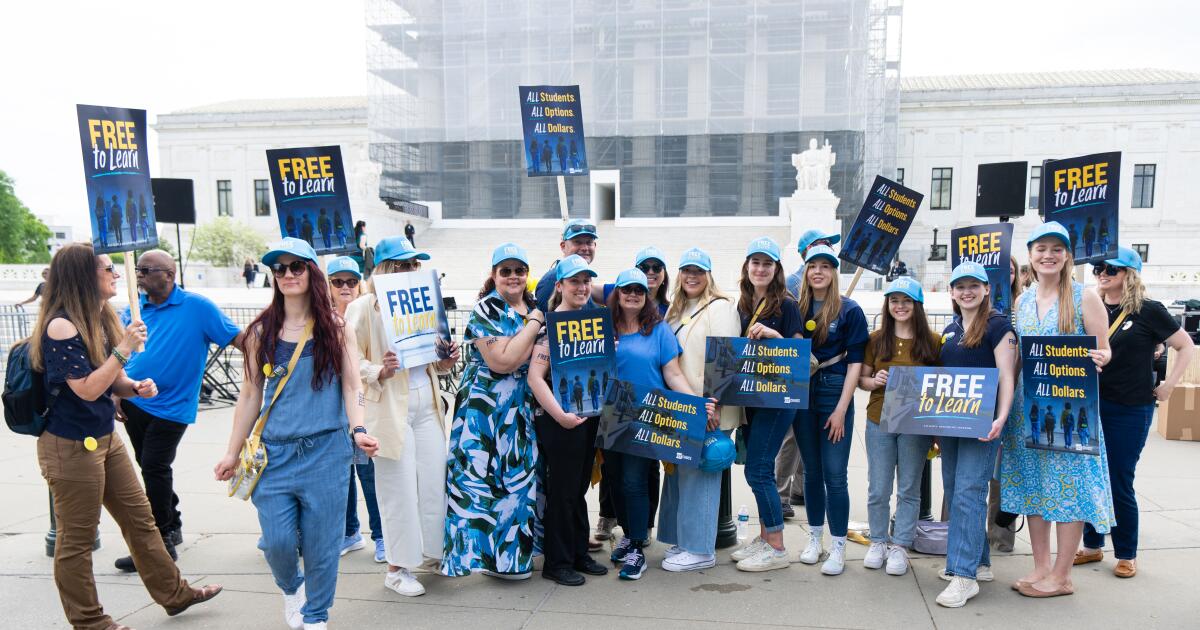
Supreme Court's Potential Impact on Charter Schools Nationwide
The conservative leanings of the United States Supreme Court seemed to indicate a readiness to support the operation of publicly funded charter schools by religious organizations.
Should this position be solidified, it could significantly alter the landscape of K-12 education across the nation.
Since the 1990s, charter schools—known for being publicly funded but independently run—have become a widespread educational choice across 47 states, catering to 3.5 million students.
Originally, lawmakers and education authorities made it mandatory for these schools to be public and non-religious, based on constitutional ideals like the separation of church and state and the prohibition on public funding for religious activities.
However, on Wednesday, the court's conservative justices argued that excluding religious schools from receiving public funds was both unfair and a constitutional infringement.
Justice Brett M. Kavanaugh highlighted the argument that religious institutions demand equal treatment under the Constitution.
In recent years, constitutional interpretation by the current court has focused heavily on historical and traditional contexts, backed by over two centuries of related history.
Washington attorney Greg Garre expressed concern, suggesting it would be extraordinary for the court to overturn the legal stance adopted by Congress and 47 states, necessitating state funding for religious charter schools.
Yet, this stance did not seem to alter the perspective of the court's conservative majority.
The arguments heard Wednesday demonstrated a significant evolution in religious legal principles under Chief Justice John G. Roberts Jr.'s guidance over the past decade.
Roberts has consistently argued that refusing public funds to religious bodies infringes on the First Amendment's guarantee of religious freedom, portraying such exclusions as discriminatory.
The court's conservative members, with Catholic backgrounds, recognize the historical roots of resistance to
"sectarian" education in the 19th century as anti-Catholic prejudice.
Declining fund allocation based on religious affiliation is described as intolerable under the Constitution.
A previous ruling addressed a Missouri Lutheran church's request for state financial aid to enhance its playground facility, applying this legal principle to enable religious school participation in state grant or voucher programs.
Currently, the court appears inclined to extend this application nationwide, potentially allowing religiously-affiliated institutions to manage state-sponsored charter schools with religious curricula.
During Wednesday's session, the justices debated the ramifications of religious schools receiving public charter status, focusing on whether states can or must include them.
The more liberal justices appeared critical of integrating religious schools into public charter school frameworks.
The Oklahoma Precedent Case
Two years ago, Catholic leaders in Tulsa and Oklahoma City sought to open a religiously-affiliated charter school, purposed to operate under Catholic principles while remaining accessible to all students.
However, Oklahoma's Attorney General Gentner Drummond contended that public support for such a school conflicted with both state and federal laws.
Last year, the Oklahoma Supreme Court sided against the proposed charter school, citing constitutional restrictions against state funding for religious entities.
Subsequently, the Supreme Court elected to review the case, posing a pivotal decision that could redefine public educational funding across much of the U.S.
The Alliance Defending Freedom, a Christian legal advocacy group, appealed citing the court's previous rulings as justification for religious charter schools.
They argued that denying funding damages religious schools and families seeking education aligned with their beliefs, in defiance of the First Amendment's free exercise clause.
The outcome will be decided by eight justices, as Justice Amy Coney Barrett recused herself due to prior affiliations.
Justice Barrett's associations with Notre Dame law professor Nicole Garnett, a supporter of religious charter schools, raised ethical considerations.
The decision rests with the other five conservative justices, whose questions suggested a likely favorable ruling for the religious charter school.
The Supreme Court is expected to announce its decision by late June, which could reshape religious involvement in public education nationwide.
Leave a Reply