


Reflecting on the Fall of Saigon
In the closing chapter of the Vietnam War, desperate South Vietnamese soldiers scrambled onto a Pan Am aircraft to escape as the North Vietnamese army approached at an alarming pace. CBS News correspondent Bruce Dunning recounted the chaos: soldiers abandoned their families at the airport in their panicked rush to board, while the plane dodged obstacles on the tarmac, deliberately avoiding or possibly impacting people.
This chaotic scene was emblematic across South Vietnam as the northern communist forces propelled their final assault southward.
"It wasn't a question of whether there would be an attack, but precisely when," reflected Stuart Herrington, now in his eighties and among the few American military personnel left in the country. His map showed a worrying increase in red arrows, each indicating advancing forces.
President Gerald Ford described South Vietnam's imminent defeat as a "profound tragedy," ordering an immediate airlift evacuation of vulnerable Vietnamese orphans, many only recently born.
Tragedy struck when a plane carrying these children crashed shortly after takeoff, killing 78 orphans and 35 Americans, recalled CBS correspondent Murray Fromson. "One can only question when the suffering in this nation will cease," he lamented.
Faced with a dire situation, Secretary of State Henry Kissinger sent an urgent message to Ambassador Graham Martin, stressing the need for a swift evacuation of American personnel.
Tan Son Nhut Airport became a focal point for evacuation as Americans and Vietnamese thronged there amidst enemy bombardment. Tragically, two Marines, Darwin Judge and Charles MacMahon, were killed—the last U.S. casualties of the war.
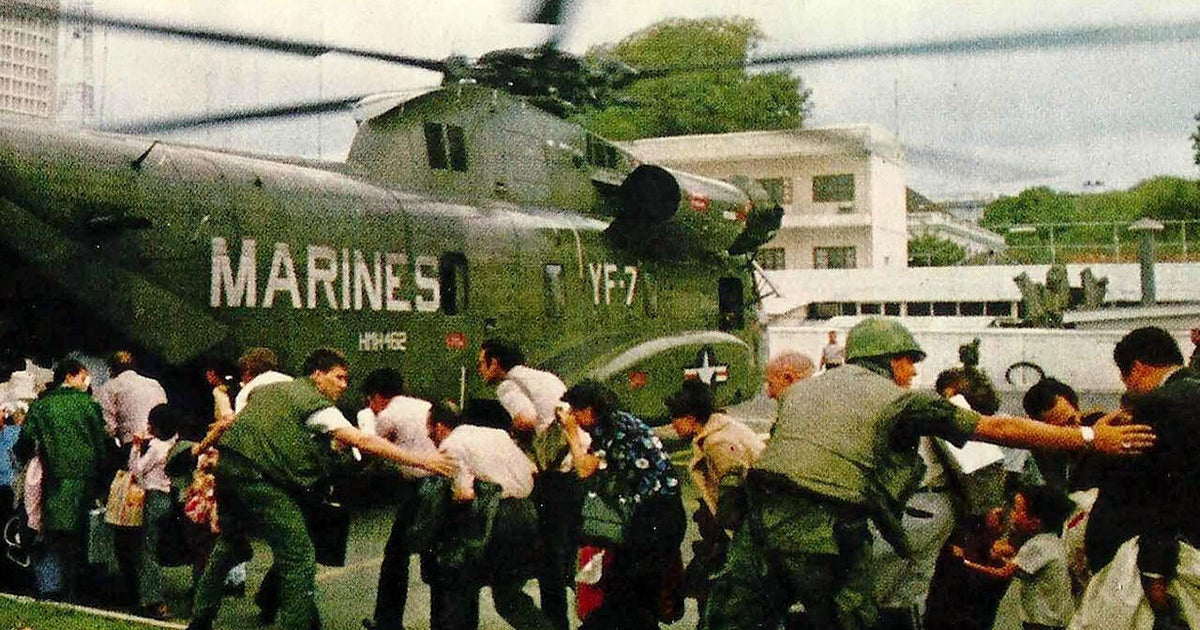
Retired Marine Gerry Berry, piloting a helicopter from an offshore fleet, noted that enemy attacks had rendered the Tan Son Nhut runway inoperable. Helicopters were the sole alternative, leading to Operation Frequent Wind, the largest helicopter evacuation in history, initiated on the morning of April 29, 1975.
As panic gripped those left behind, civilians surged towards the U.S. Embassy, their last hope for evacuation. Herrington described the embassy as the final refuge for those desperate for a helicopter escape.
Marine guard Jerome Thomas recalled the heartrending pleas from mothers at the gate, begging for their children to be taken to safety, unable to accommodate their pleas due to the overwhelming crowds.
The embassy grounds were overrun as Berry described an unnaturally large crowd that only seemed to grow, reflecting the unpredictable nature of events.
While landing his helicopter at the embassy, Berry was informed that Ambassador Martin was not yet ready to leave. Instead, Berry and his fellow crews began airlifting Americans and Vietnamese citizens.
As night fell, a young Marine, Thomas, tasked with lowering the American flag for the final time, mourned this poignant symbol of ending U.S. involvement in Vietnam.
In the pre-dawn hours, Berry could see enemy tanks, their headlights illuminating their approach towards Saigon. "The fear was palpable," recounted Herrington as Saigon lay vulnerable.
With dwindling time, orders from the Airborne Commander urged helicopter crews to evacuate the maximum number possible.
Herrington reassured the anxious crowd at the embassy that everyone would be evacuated, repeating this promise which he sincerely believed.
When orders came that all Americans must evacuate immediately, Herrington faced a heartbreaking dilemma, misleading Vietnamese evacuees to escape himself, feeling deeply betrayed by the situation.
Berry, after landing at the embassy at dawn on April 30, 1975, asserted a fabricated presidential order to hasten Ambassador Martin's departure, demonstrating the desperate need to conclude the evacuation.
Ambassador Martin finally left with the American flag, signaling the operation’s near completion as he was airlifted off and his departure broadcasted as "Tiger, Tiger, Tiger."
Though officially the evacuation was deemed complete, Kissinger later reflected in 1996 about the marines inadvertently left at the embassy—the last American defenders in Vietnam—waiting as Saigon fell.
Their sergeant, now elderly, recalls the fear of being stranded as enemy forces moved in, forced to confront the reality of their isolation.
Doug Potratz, who shared their rooftop predicament, expressed the uncertainty of survival and the perceived parallels to historic last stands.
Facing the dire choice of fighting or surrendering, Marine Thomas insisted that surrender was never an option for them, embodying the resilience of the Corps.
Eventually, two helicopters returned for the marines, relieving them of their fateful waiting as the last of the Americans boarded and left Saigon behind.
Sergeant Juan Valdez, overseeing their evacuation, was the ultimately last man to leave, embodying the soldier’s code of ensuring his men’s safety above all.
Additional Insights from CBS News
David Martin, a long-time national security correspondent for CBS News, has covered the Pentagon and State Department since 1993, offering extensive insights into military operations and diplomatic affairs.
Leave a Reply