


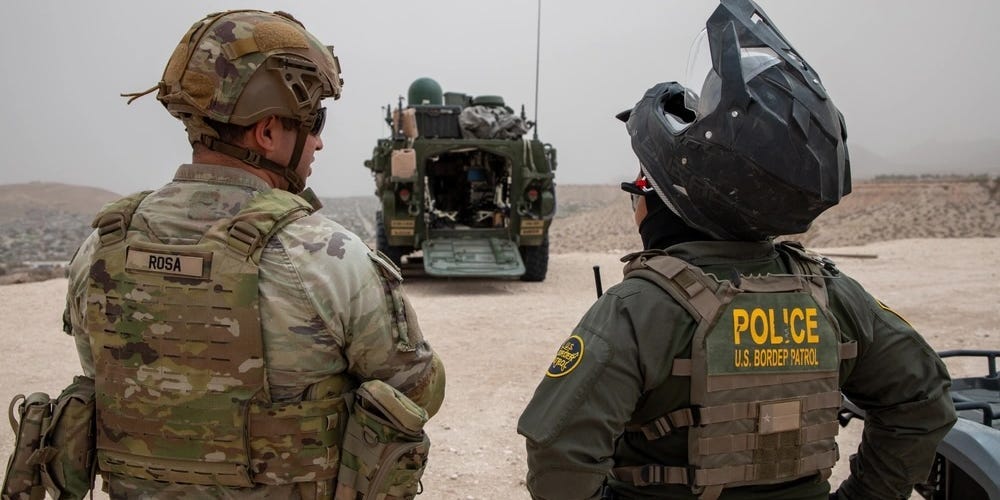
Exploring the Military-Designated Zone at the US-Mexico Border
A slim stretch of federally owned land along the southwest border of the United States has been transformed into a section of the Army's jurisdiction. This move potentially empowers military forces to play a more active role in President Trump's immigration strategy.
President Trump recently shifted control to the military, paving the way for troops to identify and hold migrants classified as trespassers in this fortified sector.
With numerous active-duty military already stationed at the US-Mexico boundary, this new status may bypass federal limitations on soldiers performing domestic law enforcement roles.
Such a measure bolsters the likelihood that troops will tackle the task of capturing migrants and managing their detention, roles traditionally handled by police forces.
Establishing a Military Barrier
In a recent development, President Trump authorized an executive decision granting the Department of Defense authority over the Roosevelt Reservation, a 60-foot-wide parcel spanning New Mexico, Arizona, and California.
Previously managed by the Department of the Interior, this vast expanse covering about 110,000 acres underwent an 'emergency withdrawal,' transferring control on April 15. The move explicitly excludes Federal Indian Reservations from this order.
The Army sought the transfer to enhance monitoring by federal agents and implement defensive measures to curb illegal immigration, narcotics, and human trafficking, as noted in a Department of the Interior announcement.
Transforming to a Defense-Centric Zone
An initial phase of the April 11 directive involves initiating a controlled perimeter setup in select portions of federal land in New Mexico.
Over the subsequent 45-day period, military personnel will engage in route surveillance and capture trespassers. Temporary fencing and signage will define this military domain.
Upon initial evaluation and a formal jurisdiction takeover by the Army, this land will officially be categorized as a national defense area, granting the Pentagon authority to impose security protocols around it.
Despite lacking a contiguous connection, this 170-square-mile territory will be affiliated as an outpost of Fort Huachuca, Arizona, with Army dominance projected for three years, as per the Department of the Interior.
Trump highlighted the multifaceted threats at the border and the necessity for a more hands-on military stance in ensuring its security.
Military Extension
Under Army authority, the militarized district, referred to as the 'New Mexico National Defense Area,' functions akin to a standard military stronghold. Troops are sanctioned to conduct inspections and provisional detentions before civilian or other federal authorities take charge.
Soldiers will also collaborate with customs and border personnel at the south frontier to prevent mass illegal entry, drug smuggling, and other cross-border infractions, as stated by the Pentagon.
Circumventing the Posse Comitatus Constraint
Despite thousands of troops being stationed at the border, the Posse Comitatus Act restricts active-duty and federalized National Guard units from performing law enforcement roles within US territory.
Exclusion from this act might be possible under the Insurrection Act of 1807 in response to civil unrest or insurrection, but deploying it to stop migrants would be an unusual application.
With civilian agents restricted to detaining migrants, most of the military contingent focuses on reinforced monitoring tasks, as noted by Gen. Gregory Guillot of the US Northern Command.
Some forces positioned close to the boundary are equipped with firearms, and requests have been made for clearance to neutralize potential drones linked to cartels monitoring the area.
Intensifying the Border's Fortification
In addition to deploying numerous active-duty troops, the Trump administration has dispatched two naval vessels, assorted aircraft, and more than 100 armored vehicles to bolster operations at the southern border.
In early April, officials from the Department of Defense gauged the financial impact of militarizing the border since Trump's tenure began at approximately $376 million, averaging a cost of $5.3 million daily.
Environmental Concerns Raised
Part of its role as a traditional guardian of federal lands, the Department of the Interior has flagged an 'environmental crisis' due to migrant activities rather than military presence or delay in mitigation efforts.
It highlights 'repeated foot traffic, unregulated vehicle access, and the formation of unofficial paths or camps' as detrimental to the delicate ecosystems along the border's edge.
Doug Burgum, the Secretary of the Interior, stressed during a New Mexico visit that securing territorial boundaries goes hand in hand with conserving natural resources, reflecting the department's dual commitment to national security and environmental guardianship.
Leave a Reply