


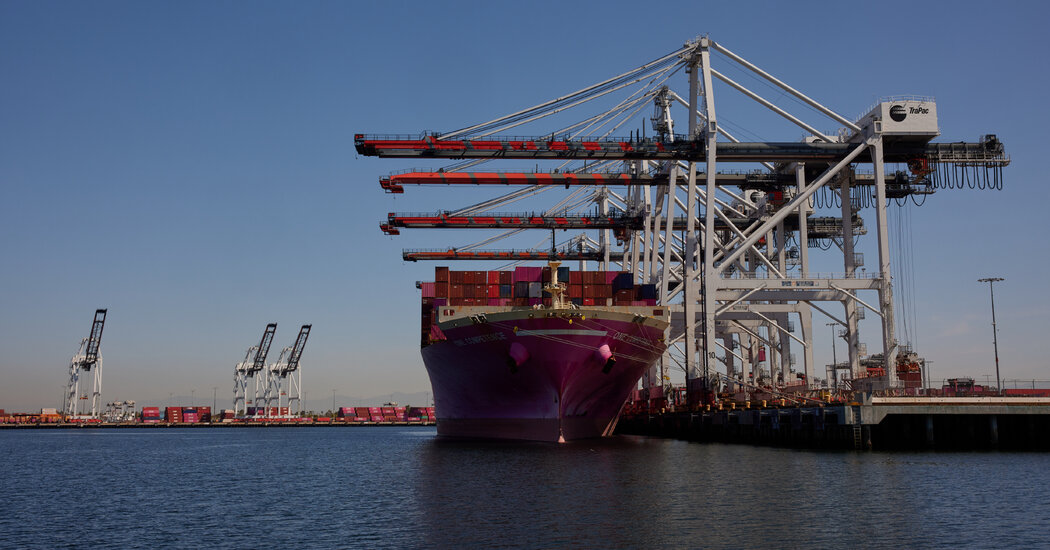
Concerns Over Global Growth as Trade Tensions Rise
The International Monetary Fund forecasts a deceleration in economic expansion and an increase in inflationary pressures within the United States, owing largely to President Trump's trade strategy.
Trade Tensions and Economic Projections
Economic experts project that President Trump's trade conflicts, particularly his extensive use of tariffs, will contribute to a slowdown in global economic activity this year. These measures, mainly aimed at China and affecting numerous global partners, are a substantial factor in the outlook for the U.S., the leading global economic power.
The latest assessments from the International Monetary Fund, issued after Trump’s decision to significantly heighten tariffs—reaching levels reminiscent of the Great Depression—underscore these concerns.
Impact of Tariff Strategies
A notable 10 percent duty has been placed on almost all imports into the U.S., alongside particularly steep tariffs of at least 145 percent on goods originating from China. Reciprocal tariffs targeting the European Union, Japan, South Korea, and Taiwan have been put on hold until July, as the U.S. negotiates bilateral agreements.
Global Retaliation and Uncertainties
This tariff strategy has created substantial unpredictability for American businesses involved in exporting or dependent on international supply chains, thereby restraining production at a time when global economies were starting to recover from prolonged inflationary periods. In retaliation, both China and Canada have introduced their own barriers, and the European Union is poised to implement further tariffs should the U.S. levy its proposed 20 percent tax.
Revised Economic Outlook
The World Economic Outlook predicts a reduction in the global growth rate to 2.8 percent this year, descending from last year's 3.3 percent, with projections in January suggesting stability in 2025.
Additionally, the I.M.F. anticipates slower growth in the upcoming year compared to previous forecasts. Much of this dampening can be attributed directly to the repercussions of tariffs on the already anticipated declining U.S. economy.
This year, U.S. economic output is expected to decelerate to 1.8 percent by 2025, a drop from the previous 2.8 percent. This significant reduction starkly contrasts the 2.7 percent growth predicted for the U.S. earlier in January, when the nation was recognized as the fastest-growing economy globally.
Leave a Reply