


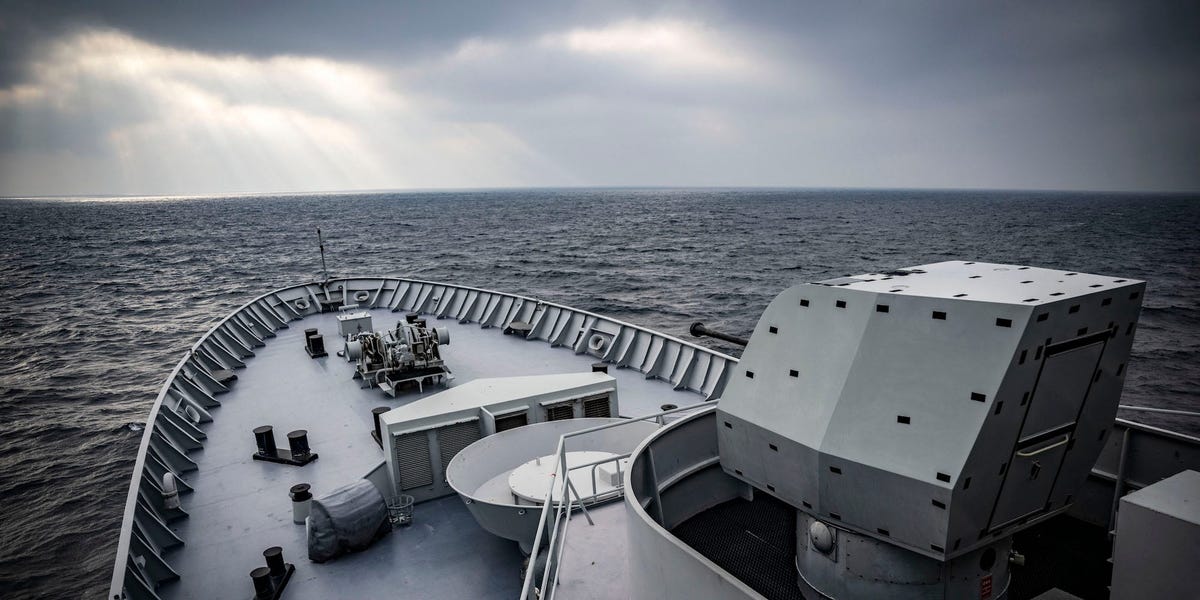
Expansion of NATO's Activities in a Key Maritime Area Near Russia
NATO members adjacent to a vital sea shared with Russia are enhancing their naval forces and increasing their warship fleets, adopting a cautious stance towards Russian activities.
Denmark, positioned at the entrance to the Baltic Sea, has declared its intentions to expand its naval fleet significantly in response to growing threats in both the Baltic and Arctic regions.
The Baltic Sea acts as a crucial corridor for trade and communications, with a surge in naval patrols and concerns of underwater cable disruptions since Russia's large-scale invasion of Ukraine in early 2022. European authorities largely attribute these cable disruptions to Russian actions.
Lithuania, sharing borders with both Russia and the sea, has recently committed to acquiring a pair of new attack vessels. Poland is progressing with the construction of new frigates and intends to purchase additional submarines. Meanwhile, Estonia, home to a small navy of just eight vessels, plans to increase its fleet by adding up to twelve new ships.
Following its NATO membership in the aftermath of the Russian invasion of Ukraine, Sweden is procuring four additional surface ships.
Sweden's military strategy, with a focus on potential conflicts with Russia, even involves distributing guidance to its population on wartime preparation.
Advancements in Swedish Naval Capabilities
Pål Jonson, Sweden's Defense Minister, mentioned in February that the country is procuring four substantial surface vessels, slated to exceed the size of their current Visby class corvettes.
According to Bryan Clark, a naval strategy authority at the Hudson Institute and former U.S. Navy staff, Sweden’s combination of surface ships and submarines could effectively block the Baltic Sea if necessary.
The Swedish Defense Material Administration projected the commissioning of two of these vessels into the Swedish military by the year 2030.
Sweden's entrance into NATO has strengthened the alliance's naval presence, especially in the Baltic Sea, bordered by key nations such as Sweden, Finland, Russia, Estonia, Latvia, Lithuania, and Poland.
Current State of Russian Naval Forces in the Baltic Sea
As of late 2023, Russia's naval composition in the Baltic Sea includes one attack submarine, several guided missile destroyers, one guided missile frigate, and 35 smaller vessels as reported by the Carnegie Endowment for International Peace. However, the Russian Navy frequently reorganizes its deployments to different ports.
Following Sweden and Finland's NATO accession, the Baltic Sea has been colloquially termed the 'NATO Sea' by some alliance members.
Sweden's submarine fleet, a rarity among regional NATO navies, is particularly adapted to the sea's geography, characterized by narrower channels and shallow waters.
Strategic Importance of Baltic Sea Naval Operations
Steven Horrell, once a U.S. naval intelligence officer and currently with the Center for European Policy Analysis, highlighted that Sweden’s compact and quiet submarines are especially suited for the Baltic’s complex maritime topography, which includes limited inlets and shallow waters.
Minister Jonson emphasized Sweden's unique naval contributions to NATO operations in the Baltic, both above and below the water's surface.
He reiterated Sweden's extensive experience in Baltic navigation, asserting an intimate knowledge of the sea earned over centuries. The country is actively safeguarding vital underwater infrastructure, utilizing both its naval and coastguard resources alongside NATO's enhanced initiatives.
Although part of NATO's Baltic Sentry mission has increased naval oversight in the sea, Jonson called for further actions.
Regional Security Concerns and Support for Ukraine
Last year, the Swedish defense minister cautioned that, despite Russian military engagements in Ukraine, a direct threat to Sweden remains possible.
In addition to boosting defense budgets, Sweden has unveiled its largest support package for Ukraine so far, valued at approximately $1.6 billion. Jonson articulated this as a rallying message for NATO allies to amplify their support for Ukraine, framing it as a crucial investment in regional and global security amidst significant geopolitical challenges.
Leave a Reply