


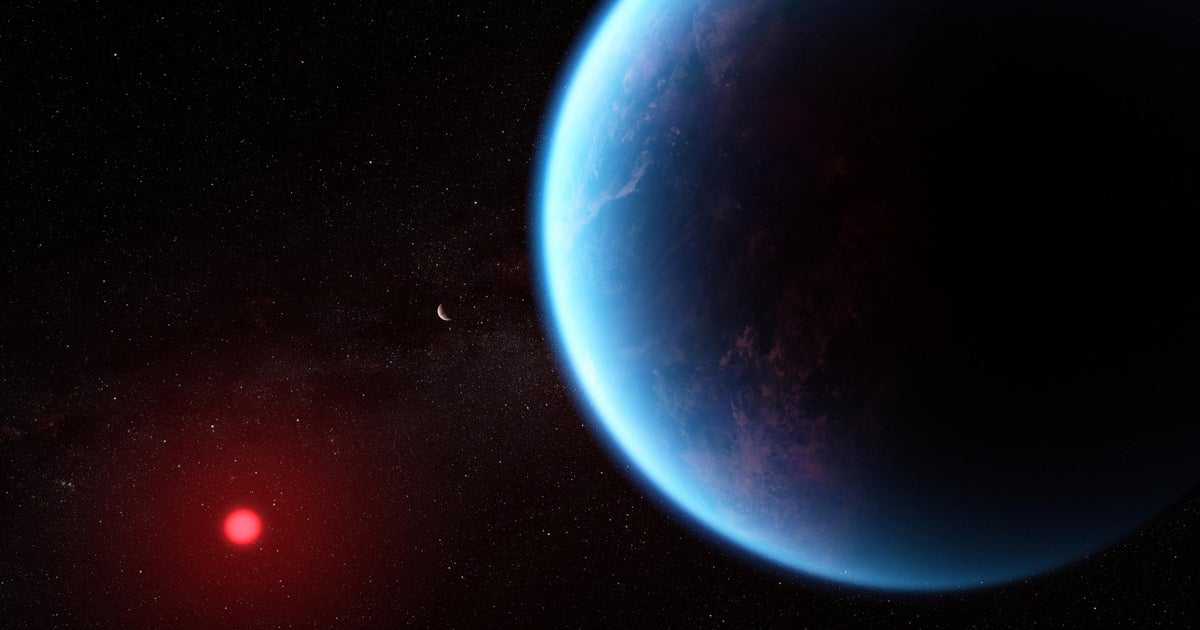
Discovery of Potential Signs of Life on Remote World K2-18b: "A New Milestone in Space Exploration"
Astronomers shared sensational news on Thursday, revealing potential indicators of life on a distant exoplanet beyond our solar system. However, a divide remains among scientists regarding these findings.
There has been a dynamic discourse among scientists about this exoplanet, located 124 light-years away in the Leo constellation, being a potentially ocean-covered world with conditions suitable for microbial life.
Employing advanced techniques, an Anglo-American research team detected atmospheric signs of dimethyl sulfide (DMS) and dimethyl disulfide, molecules heralded as potential indicators of life.
On our planet, these compounds are typically generated by microscopic marine life such as phytoplankton.
The researchers called for caution, emphasizing the need for further observations to corroborate these preliminary findings, underscoring that no definitive discovery had been made.
The implications of these findings could be monumental, according to Nikku Madhusudhan, lead researcher from Cambridge University, who expressed optimism about acquiring conclusive evidence soon.
"This represents the strongest clues yet that there may be life beyond Earth," Madhusudhan noted.
"In the Perfect Zone for Liquid Water"
K2-18b, with its mass over eight times that of Earth, is one of the rare exoplanets situated in a 'habitable zone,' where conditions might permit liquid water.
The planet's position ensures temperatures neither too scorching nor too icy, thereby offering a potential abode for life.
Astronomers analyze light passing through the atmospheres of these worlds as they transit their stars, allowing them to pinpoint the presence of various molecules.
Latest findings from the Webb telescope suggest the presence of organic molecules in K2-18b's atmosphere, a first for exoplanets in habitable regions, also indicating a faint presence of DMS.
Although the newly gathered signals hinting at life are substantial, they have yet to reach the definitive 'five sigma' level of confidence in scientific analysis.
A confirmation of these signals wouldn't mean life necessarily exists there, as similar molecules have been discovered on comets, hinting at non-biological origins.
Yet, Madhusudhan points out that the concentrations found on K2-18b are significantly higher than those on Earth, indicating a possible biological source.
"Surprisingly Hostile Conditions"
K2-18b is thought to be a prime candidate for a 'hycean world,' characterized by vast oceans and hydrogen-rich atmospheres.
These planets, larger and warmer than Earth, with atmospheric temperatures soaring as high as 200 degrees Celsius, are considered unsuitable for intelligent life but could harbor primitive microorganisms.
"Hycean worlds could significantly expand our search for extraterrestrial life," Madhusudhan remarked.
However, doubts persist regarding whether such worlds can actually sustain water, with K2-18b completing an orbit around its star in just 33 days.
Professor Raymond Pierrehumbert of Oxford University suggests conditions on K2-18b might be inhospitable, potentially housing lava oceans instead.
MIT's planetary sciences professor Sara Seager advises caution, reflecting on past claims of water vapor on K2-18b that ultimately proved unfounded.
Madhusudhan predicts additional observations might establish a more concrete finding, comparing the current confidence to a statistical needle-in-a-haystack scenario.
Ultimately, Madhusudhan is optimistic about future telescopes uncovering life elsewhere, potentially resolving the age-old question of solitude in the cosmos.
Leave a Reply