


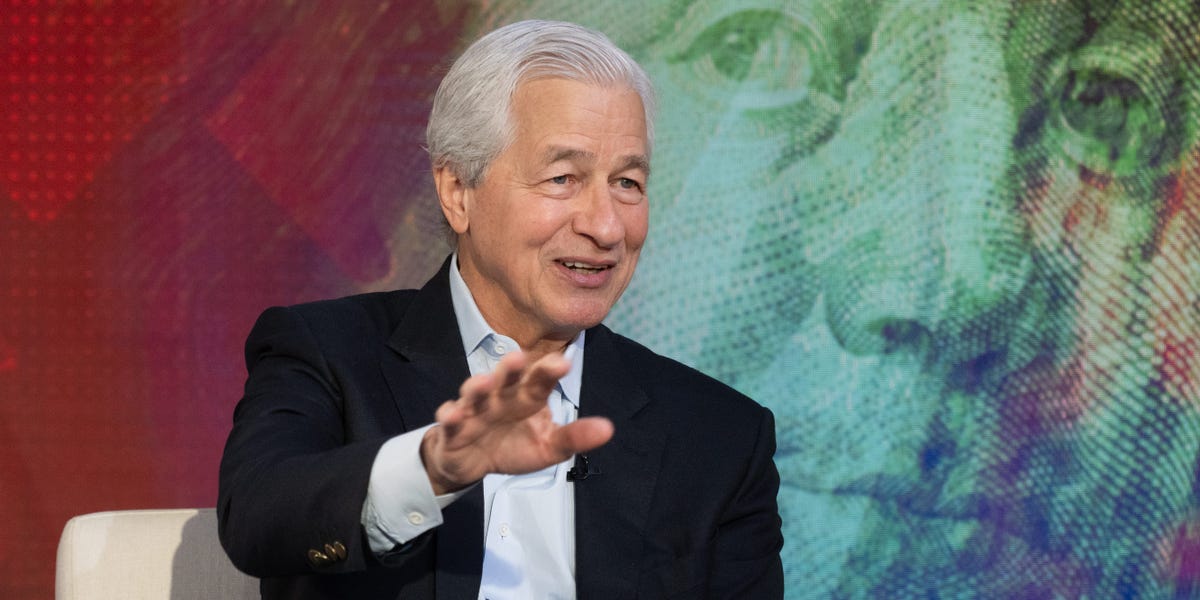
Insights from JPMorgan Chase's Q1 Earnings Call with Jamie Dimon on Economic Trends
One notable observation from the earnings call was that consumers are attempting to pre-empt tariff impacts, while companies are taking a 'wait-and-see' approach amidst persistent market volatility.
During the first-quarter earnings call, fervent inquiry from analysts and investors highlighted the desire for understanding the broader economic implications of Trump's tariff policies that began in early April. While the bank posted positive results for the first quarter ending March 31, attention was focused on insights into post-tariff economic dynamics shared by bank executives.
CEO Jamie Dimon, along with CFO Jeremy Barnum, painted a picture of an economy still stable but facing possible challenges. Consumer spending continues, albeit with some front-loading to dodge tariff costs, as explained by Barnum. Meanwhile, companies have held back on spending and investment until the tariff outcome becomes clearer, and lenders are increasing cash reserves as a buffer against potential delinquencies. However, an uptick in activity at trading desks cheered the bank, attributed to investor maneuvers amidst fluctuating stock, bond, and interest rate markets.
According to JPMorgan's chief economist, Michael Feroli, there exists a balanced probability of either avoiding or entering a recession, as stated by Dimon. This outcome hinges on several factors, not least of which are tariffs, but also includes how the country manages the national deficit, regulatory changes, and evolving global political dynamics.
In his role as a leading figure in the financial industry amid tariff-related turmoil, Dimon urged for swift action by the Trump administration in executing trade deals to bring global economic stability. "I believe many issues will be resolved—whether positively or negatively—in the coming four months," Dimon remarked. "By our next quarterly call, we might have definitive insights into these effects," he added.
Shifting Consumer Spending Patterns
Chief financial officer Jeremy Barnum elaborated on shifts in consumer expenditure using company credit card data, but emphasized that forming conclusions at this stage would be premature.
Barnum pointed out a slight trend of consumers advancing purchasing, mainly in items with projected price hikes due to tariffs. Despite an observed reduction in spending among lower-income demographics, no signs of distress were evident. Interestingly, some upticks in April spending were fueled by this group.
Additionally, Barnum noted a decrease in travel spending but remained hesitant to interpret this as an indication of a wider spending constraint. "It's not clear if this dip in airline expenses indicates broader trends," he commented, highlighting the multitude of possible explanations for this observation.
Loans and Liquidity Reserves
JPMorgan increased its credit loss provisions by $973 million, reaching $3.3 billion, citing an unfavorable macroeconomic outlook.
Barnum reassured that lending quality hasn't deteriorated, with loans being repaid as anticipated. Nonetheless, the bank is enhancing its reserves with $441 million allocated for consumer lending and $549 million for corporate lending, anticipating defaults in payments.
Barnum mentioned that clients haven't notably withdrawn or maxed out credit lines, indicating stable consumption. Discussions among large institutional clients about increasing liquidity were mentioned, yet there's no surge in loan drawings for this purpose, apart from a rise in market-related loans.
Trading and Banking Sector Dynamics
Both JPMorgan and Morgan Stanley reported a financially strong first quarter, underscoring their success in trade execution for significant investors—a trend apparently accentuated since the tariff-induced volatility beginning in early April.
"This period brought particularly favorable conditions that we've navigated successfully," noted Barnum.
Barnum commented that market conditions necessitated a careful investment banking approach, observing corporate clients' cautious stance. "Clients exhibit patience and await clarity," Barnum stated, noting stark sectorial variances, with some industries facing greater vulnerability amid complex challenges.
Urgency in Trade Negotiation
Dimon implored the Trump administration to swiftly conclude trade negotiations. "The optimal strategy is for the Treasury Secretary and his team to expedite necessary tariff-related agreements with trading partners," he articulated, acknowledging that some ramifications are inevitable.
When queried about historical parallels to the present economic and political climate, Dimon indicated that direct comparisons are uncertain. While tariffs and economic health are pivotal, the overriding concern is sustaining geopolitical partnerships. "Today's global economy is unlike before," he responded to an analyst's inquiry. "The utmost priority is unity among Western countries—economically and militarily—to uphold global peace and democracy. That is paramount."
Leave a Reply