


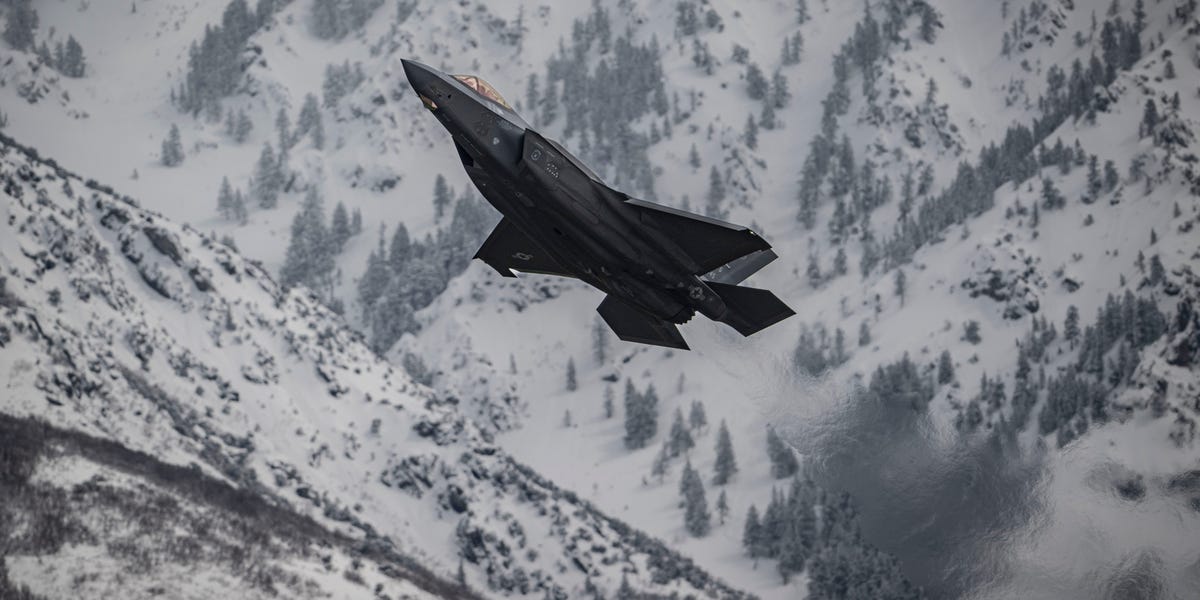
The Unsettling Impact of Trump's Policies on Lockheed's F-35 Ventures
The thriving market for Lockheed Martin's F-35 stealth jet finds itself facing unsettling challenges due to the changing stance of the Trump administration. However, this isn't the sole concern for the company.
At least a couple of NATO countries are exploring different options to the F-35 Lightning II as US communications, both public and accidentally revealed private ones, suggest a waning commitment to Europe's security needs. Key figures in the Trump administration have dismissed Europe as ineffectively dependent.
The ongoing trade disputes and public disagreements with leaders of nations purchasing F-35 jets add a layer of risk for Lockheed. Aviation specialists indicate that the F-35, crucially built for the US defense as well as international allies, could suffer if foreign acquisitions decline, leading to higher unit costs.
Rising Concerns About US Commitment
The recent decisions from European allies, exacerbated by Trump's favoring of Boeing to construct the F-47, have somewhat shaken confidence in Lockheed's future plans. This led to a swift drop in the defense firm's stocks, with the F-47 contract being a significant factor for downgrade assessments from financial analysts.
A representative from Lockheed emphasized that international military sales are fundamentally intergovernmental matters and should be managed accordingly. As for the F-47 project, the firm reiterated its commitment to advancing capabilities with the Air Force.
While no comment was offered from the White House regarding these upheavals, the administration's softened stance toward Russia and pointed criticism of NATO nations have impacted international defense dynamics.
Earlier this month, Portugal expressed it might rethink upgrading its fleet of F-16s to F-35s due to US policy stances, and Canada stated it would reassess its future with the F-35 amidst trade frictions instigated by Trump directives.
A Shift in Confidence Among Allies
Denmark voiced regret over its F-35 acquisition, highlighting the threat that critical aircraft parts could be withheld by the US government. The Danish defense department maintains open considerations for future purchases, despite security reservations.
Despite these reservations, countries like the UK, Australia, and the Netherlands have reaffirmed their trust in the F-35 program, suggesting the continuation of positive collaboration with US defense initiatives.
Countries including Germany and Poland have echoed stable support for the F-35, illustrating a commitment to existing agreements regardless of potential uncertainties surrounding US alliance strategies.
Strategic Defense Concerns
NATO members are yet to make decisive shifts concerning F-35 procurement; however, current unease about the Trump administration's leverage persists. Key logistics and tactical support provided by the US are indispensable for the operational efficacy of these aircraft.
Modifications to weapons offered by the US have been controversial, with the new Boeing NGAD fighter's potential 'toned-down' export version raising questions about long-term international defense pacts.
Analysts, including Richard Aboulafia, underscore the risk that diminished foreign engagement could inflate US expenses for the F-35. This exacerbates fears about budget vulnerabilities for the fighter program, compounded by critiques over design efficiencies and sustainable costs.
Future Prospects and Challenges
Lockheed's projection to dispatch nearly 190 F-35 units by 2025 to both the US and its allies remains ambitious despite these challenges. Former NATO deputy assistant secretary-general Gordon Davis noted that disproportionate reliance on F-35 support by US officials could invite severe strategic and political setbacks.
Davis highlighted that nations without indigenous production capabilities or components integral to the F-35 remain most susceptible to the strong-arm tactics of international negotiation.
While European planes like the Eurofighter Typhoon present alternatives, they struggle to rival the multifaceted combat and networking capabilities offered by the F-35. The ongoing discourse over defense investments continues amidst evolving political landscapes.
Leave a Reply