


Examining a Budget 600W Charger: Is the Interior Goo a Warning Sign?
While marking a product as '600W' is simple enough, does the product truly deliver what it promises?
Every year, I put a multitude of tech products through rigorous testing. While some impress, others fail to meet expectations. On ZDNET, only top-tier gear gets showcased. Yet, I often receive inquiries from readers seeking my take on various gadgets.
Recently, a 600W GaN charger has been generating quite a bit of interest.
Picking up a few for analysis, each was priced at about $99. Although not inexpensive, they seemed reasonable compared to another 5-port, 300W model retailing at $140. I was curious about this 8-port powerhouse.
Eight ports? Surely impressive, or so it seemed, but that wasn't the case.
A major red flag appeared when I noticed the brand name was entirely unknown—a generic label, unfamiliar and untrustworthy. This makes one wonder why renowned companies like Anker and Belkin, known for dependability, aren't offering a powerful 600W model.
Things took a turn for the worse once I began testing.
The charger displayed inconsistent power delivery. One USB-C port supplied 140W, but its equivalent struggled to exceed 65W. Additionally, one 100W port was completely inoperative.
The device frequently malfunctioned when connecting or disconnecting devices, often necessitating a complete reset by unplugging the power source.
This is far from desirable functionality.
The need for constant rebooting was a significant annoyance.
Despite my efforts, the charger fell severely short of its 600W claim, exhibiting erratic behavior.
Determined to inspect further, I dismantled the unit.
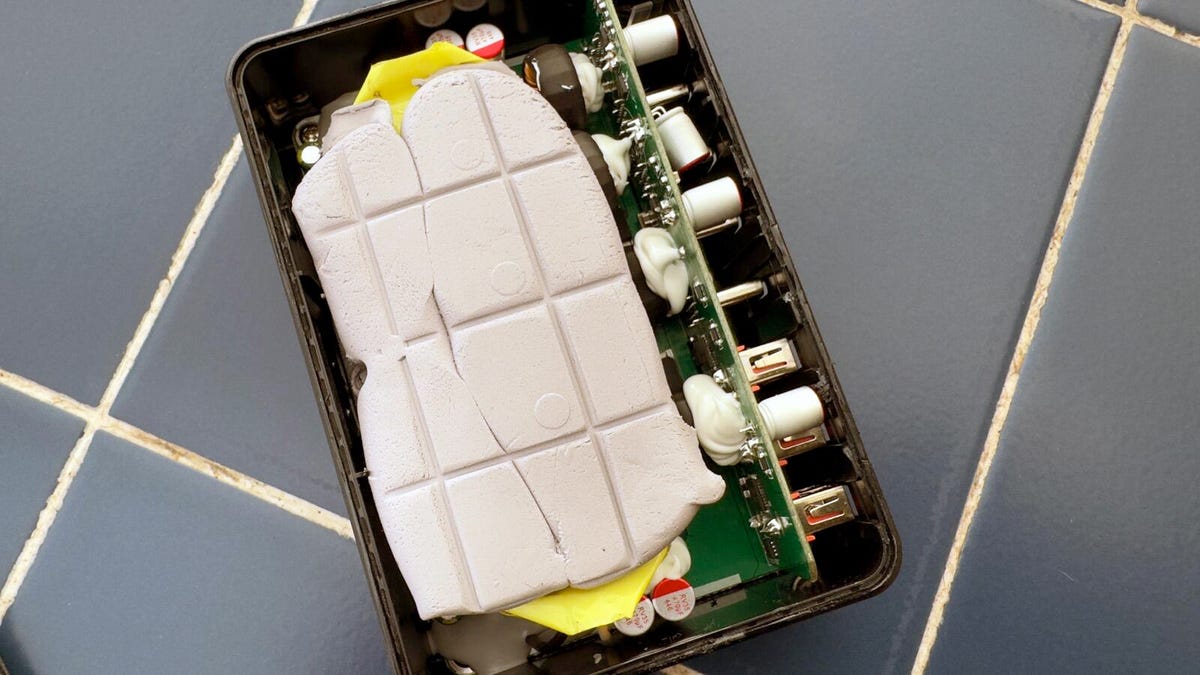
Inside, I found a substance resembling thermal paste. Its oily texture and smell suggested it was more akin to window putty, possibly added for weight, as the charger was surprisingly light without it.
Could it just be ballast?
The scent was distinctly off-putting.
This wasn't what you'd expect from a product advertised as 600W.
An inspection of the electrical components revealed a substandard build. Without delving deeply into technicalities, there was insufficient separation between high and low voltage areas.
This flawed design could risk outputting main voltage in the event of a failure—a dire safety concern. Furthermore, the transformers and regulators appeared incapable of achieving the advertised output.
Certainly not the hallmark of superior craftsmanship.
Another alarming aspect was how the casing easily detached, exposing inner parts. Should it fall while plugged in, the risk of touching live components increased significantly.
In conclusion, this charger fails to meet essential standards and expectations.
This is why rigorous testing is crucial, from power banks to chargers—to filter real capability from mere on-paper specs. Manufacturers can be bold with assertions, but proof lies in genuine performance.
Need a reliable charger? Consider brands with histories of trustworthy delivery.
Leave a Reply