


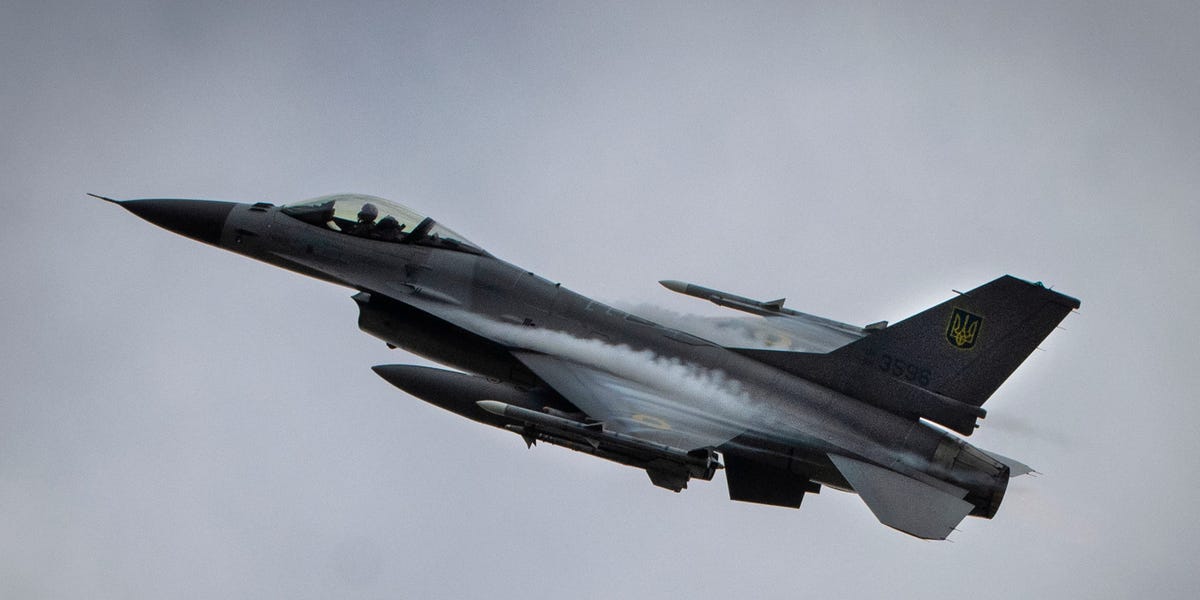
Ukrainian Pilot Reports Russian Fear of NATO Jets
A Ukrainian F-16 aviator relayed that Russian forces appear to particularly avoid Western fighter jets due to their lethal capabilities.
The Ukrainian Air Force shared remarks from this pilot in a pioneering video interview, ensuring his identity was protected by concealing his face and withholding his name.
"With the addition of Western aircraft, executing protective air operations has become significantly easier," the pilot explained. "We now have advanced weaponry, which the Russians are well aware of."
He highlighted that Ukraine has been strategically deploying F-16s and Mirage 2000-5s for closer engagements.
"Observing their reactions, it is clear they are beginning to pull back. They fear confronting us," he elaborated. "After all, their pilots value life as well."
Utilizing the Ukrainian F-16s for surgical air strikes like "a scalpel," contrasted with their Soviet MiG-29s, Su-24s, and Su-27s, which operate more like "blunt instruments" to suppress enemy targets.
These Soviet jets are employed in dangerous low-range bombings, necessitating perilously close missions near combat zones, the pilot noted. Thus, F-16s and Mirages often provide defensive coverage.
This shift in tactics has notably altered the conduct of Russian troops, he continued.
"They have knowledge of our weaponry's capabilities and thus understand the strategic points for advancement or retreat," he remarked, noting Ukraine's effort to capitalize on these insights.
He accentuated that the F-16 and Mirage afford Ukraine the means for "extremely accurate" targeting.
"Currently, our capability for striking is limited to tactical range," he stated about their NATO-aligned air operations. "However, these are pinpoint attacks."
"Our bombs can be delivered with such precision that they might as well fly through an open window," he added with confidence.
Advantages of the F-16 Over Soviet Aircraft
Despite being decades old by Western military standards, the F-16 is integral to Ukraine's arsenal due to its versatility in deploying NATO’s precision-targeted munitions for both aerial and terrestrial offensives.
Notable armaments include the extended-range Joint Direct Attack Munition and AIM-120 medium-range missile for neutralizing adversarial aircraft. Ukraine confidently utilizes both.
This makes the F-16 a flexible asset, adept at engaging enemy aircraft, performing ground assaults, or neutralizing air defenses.
While Soviet models like the MiG-29 serve dual roles, the F-16 excels with superior radar, electronic countermeasures, and overall reach.
Additionally, the Mirage, another battle-tested aircraft adapted by Ukraine, is usually armed with French missiles. It can employ the long-range Storm Shadow, yet relies on the shorter-ranged MICA for aerial threats.
Since mid-2024, Kyiv has received waves of F-16s from European partners and introduced its initial Mirages earlier in the year.
The precise count of newly acquired jets hasn’t been disclosed, though Belgium, the Netherlands, and Denmark intend to supply upwards of 100 F-16s, albeit execution takes substantial time.
Nonetheless, Ukraine exercises caution with these invaluable assets owing to formidable Russian surface-to-air systems, including the S-400, which prompts tactical altitude and range adjustments.
Tragically, a prominent pilot perished in an F-16 incident in August while countering missile threats near Kyiv.
Conversely, Russian-aligned channels falsely claimed another F-16 downed over Sumy, a narrative dismissed by President Volodymyr Zelenskyy on March 19, labeling it deceptive.
Zelenskyy has asserted that to combat Russia effectively, Ukraine requires a fleet of 128 F-16s.
Compounding challenges, aid was temporarily halted by the US in March under President Donald Trump but resumed post-ceasefire negotiations, emphasizing the critical nature of ongoing military support.
Leave a Reply