


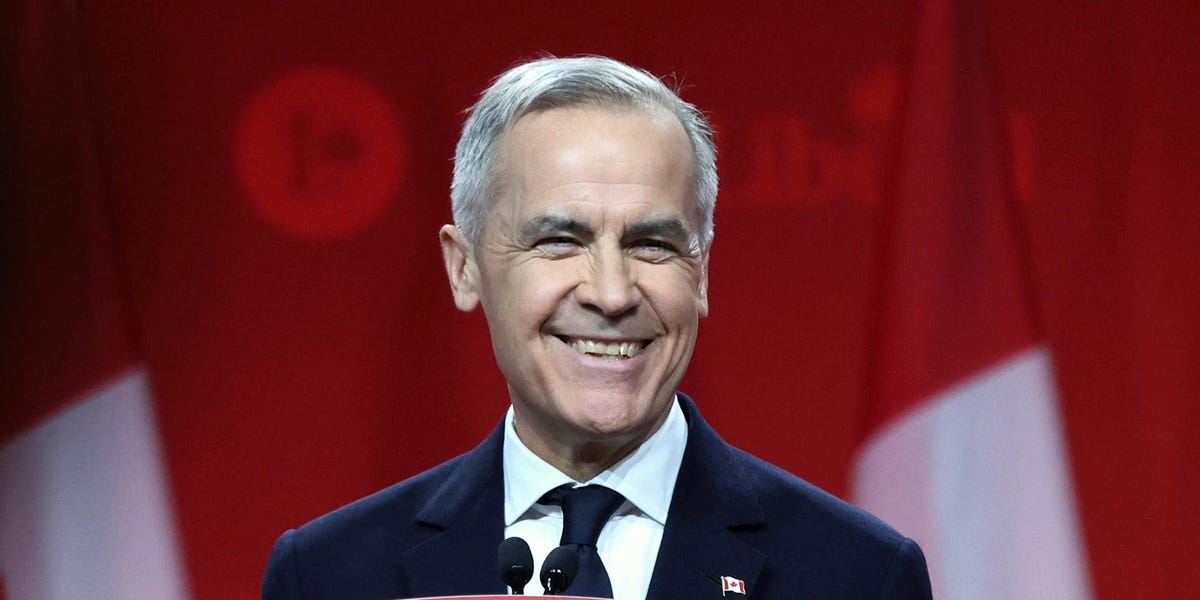
Introducing Mark Carney: From Central Banking to Canadian Leadership
Mark Carney, poised to usher in a new era as Canada’s prime minister, stands at a political crossroads as the nation grapples with economic uncertainties arising from tariffs enforced by US President Donald Trump.
On Sunday, Carney, a graduate of Harvard and an alumnus of Goldman Sachs, was appointed the head of Canada's Liberal Party, succeeding Justin Trudeau who had previously declared his resignation effective January.
At 59, Carney is preparing to be officially instated as the country's leader shortly. An electoral decision to potentially select a new prime minister is mandated by October, but such an event might occur sooner.
In the interim, Canada faces the challenge of navigating punitive 25% tariffs announced in early March by Trump, although their activation was deferred until April.
The predicament, intensified by Trump’s remarks about integrating Canada as a U.S. state, has stirred a nationalistic response across Canada.
In his victory speech on Sunday, Carney spoke candidly about Canada's strained relationship with the United States: "We find ourselves in difficult days, overshadowed by a nation hard to place our trust in."
Financial Expertise and Career Milestones of Carney
Though Carney lacks prior political roles, his extensive background in finance sets a formidable foundation.
Born in Fort Smith, Northwest Territories, Carney attended Harvard University, engaging in ice hockey during his studies. His 13-year tenure at Goldman Sachs saw him in key locations like London, Tokyo, New York, and Toronto.
Carney directed central banks through crucial periods.
Departing from Goldman Sachs in 2003, Carney took the role of Deputy Governor at Canada's central bank, eventually leading it in 2008 amid the global financial crisis. Notably, he was the first non-native to head the Bank of England from 2013 to 2020, managing its strategies during Brexit.
Post-Bank of England, Carney diversified his expertise through roles in both commercial and global sectors, including his position as Vice Chair at Brookfield Asset Management in 2020, later becoming Chair when the division evolved into a separate entity in 2022.
In 2021, he joined the board of Stripe, a fintech company, and was appointed Board Chair of Bloomberg in 2023.
His work with international organizations is noteworthy; Carney was named a UN special envoy for climate action and finance in 2019. He also initiated the Glasgow Financial Alliance for Net Zero in 2021, promoting global climate-finance agendas.
Announcing his political ambitions in January, Carney formally severed ties with all his prior commercial and international responsibilities.
Stance on US Tariff Policies
Carney’s recent speech took aim at Trump's tariff tactics. Speaking strongly, he seemed to address Trump more directly than Pierre Poilievre, his expected Conservative opponent.
Carney vowed to implement reciprocal tariffs designed to maximize disruption within the United States.
"Our tariffs will remain firmly in place until we receive respect and assurance from the US that they are committed to fair trade practices," Carney asserted.
In an assertive address, Carney lambasted Trump, echoing Trudeau’s sentiment: "Unwarranted tariffs target our industries, our exports, and our livelihood. We face an assault on Canadian families, the workforce, and enterprises, and we will not yield."
Leave a Reply