


Nearby Cosmic Neighbor Hides Enormous Black Hole
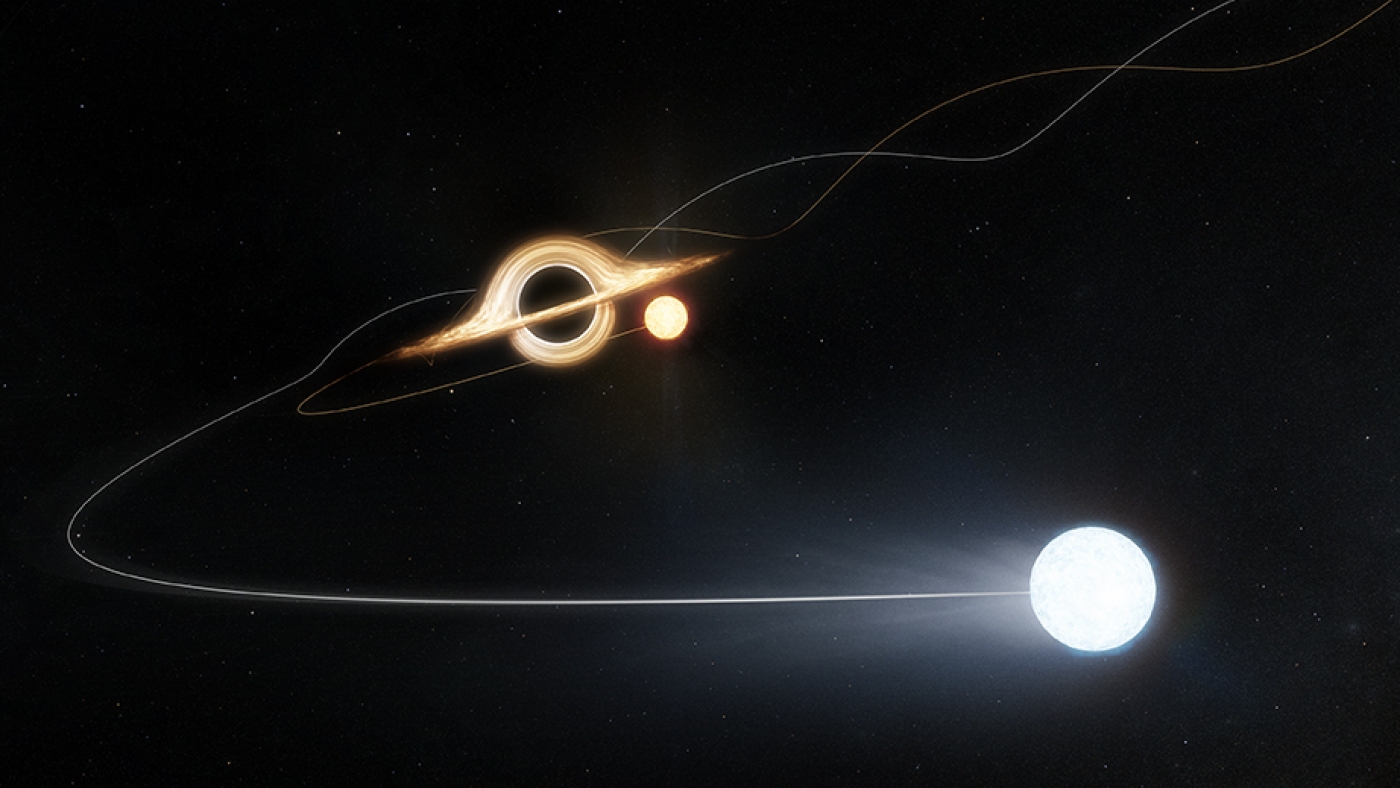
An artistic concept showcases a black hole flinging a star at incredible speeds from the Large Magellanic Cloud.
Revelations from Racing Stars
Recent research on stars hurtling through space at extraordinary velocities reveals their acceleration likely stems from an enormous, hidden black hole in a neighboring galaxy.
This giant black hole appears to be the nearest supermassive one outside the Milky Way, according to a study poised for publication.
A Dwarf Galaxy's Hidden Giant
Astrophysicists generally suspect most galaxies harbor a supermassive black hole at their core, yet it was previously unknown that such an entity resides in the Large Magellanic Cloud.
Following compelling evidence suggesting its presence, astronomers are eagerly deploying every available telescope to verify its existence, says a lead researcher from the Harvard & Smithsonian Center for Astrophysics.
High-speed Star Observations
The discovery came as scientists examined hypervelocity stars, which streak across space at speeds reaching several million miles per hour.
In contrast, our Sun moves through the galaxy at a modest 500,000 miles per hour, unable to match the incredible speed of these stars.
Due to their high speed, these stars are escaping the gravitational pull of their galaxy, embarking on a one-way journey away from it.
Origins and Trajectories
The high-speed stars likely began as typical stars, part of binary systems before their fateful encounter with a supermassive black hole.
When such a binary pair gets too close, the black hole captures one star and rips it from its companion, launching the other into space at tremendous speed.
Mapping the Stellar Exiles
Han and his team analyzed data from the European Space Agency to chart the paths of 21 hypervelocity stars at the Milky Way's edge, identifying their possible origins.
Contrary to previous beliefs, only half of these stars had been catapulted by the Milky Way's central black hole, with the remainder linked to the Large Magellanic Cloud.
Large Magellanic Cloud's Potential
Calculations suggest this dwarf galaxy might host a black hole about 600,000 times the Sun's mass, although smaller than the Milky Way's central black hole.
Though it was anticipated that the Large Magellanic Cloud could contain a significant black hole, concrete evidence had been elusive until now.
Detective Work Ahead
The center of the Large Magellanic Cloud remains ill-defined due to its ongoing merger with the Milky Way and interactions with the Small Magellanic Cloud, complicating the search.
Astronomers now have a clearer sense of where to seek signs of a ravenous, invisible black hole, such as X-ray, radio, or optical emissions.
Han muses that the black hole might already be detectable through these methods; researchers simply haven't pinpointed the correct location yet.
Leave a Reply