


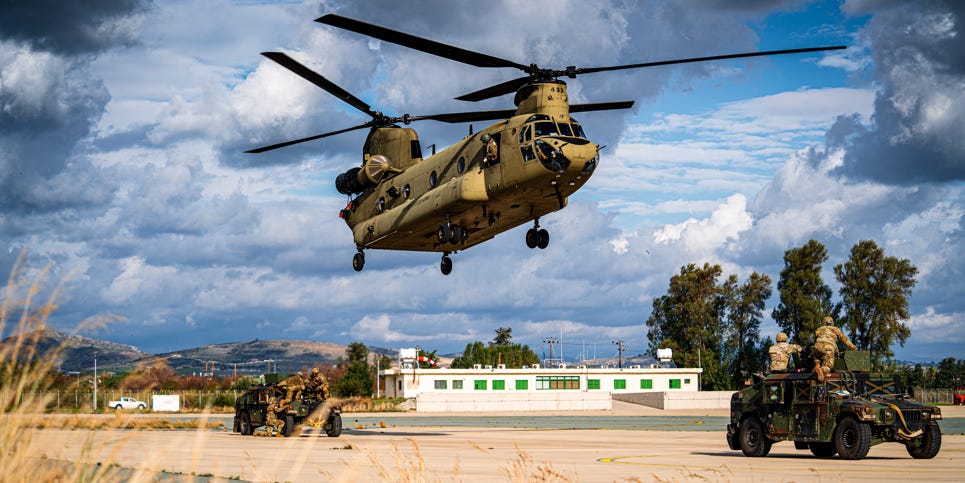
Cyprus's Strategic Shift: Transitioning from Russian to American Military Equipment
Cyprus, previously a close ally of Russia and known as a significant strategic location in the Mediterranean, has in recent years increased its partnership with the United States, simplifying its acquisition of American weaponry.
Through an initiative launched under the prior US administration, Cyprus has been included in both the Foreign Military Sales (FMS) and Excess Defense Articles (EDA) programs, which facilitates thorough military cooperation and enhancements with the US.
This development signifies a pivotal shift for Cyprus as it continues to pivot towards Western alliances, moving away from its dependency on Russian military hardware.
The Foreign Military Sales initiative is streamlined as it permits the Department of Defense to negotiate purchases directly with American arms manufacturers on behalf of allied nations. Meanwhile, the Excess Defense Articles initiative provides surplus US military gear at discounted prices or free, assisting these nations in modernizing their militaries.
Historically constrained by a 1987 US arms embargo, Cyprus had relied heavily on Russian armaments, forging robust ties with Moscow.
Nevertheless, following Russia's 2022 military actions in Ukraine, Cyprus has gradually distanced itself from Moscow, working to replace its arsenal with non-Russian alternatives.
The arms embargo was partially relieved in 2020, followed by a complete lift in 2022, though subjected to annual reviews.
Most recently, in 2023, Cyprus transitioned from Russian Mil Mi-35P helicopters to French Airbus models and replaced its Russian-made TOR M-1 and Buk SAM systems with Israeli Barak 8 surface-to-air missiles. Future acquisitions may include armored units and additional naval equipment.
Potential Future Acquisitions
Professor Andrew Novo of the National Defense University highlights Cyprus's ongoing move away from Russian equipment, suggesting main battle tanks and armored vehicles as logical, forthcoming procurements.
Cyprus’s military currently utilizes Russian T-80 tanks and BMP-3 vehicles, with American M1 Abrams tanks and Bradley M2 vehicles as prospective replacements. Other priorities might include patrol vessels, small arms, and communication tools.
Both the M1 Abrams and Bradley vehicles have earned a strong reputation, demonstrated by their effective deployment in Ukraine’s conflicts.
There is also potential for Cyprus's surplus military items to be transferred to Ukraine, a decision initially resisted due to security concerns stemming from the 1974 Turkish invasion, which occupies the island’s northern region.
Former President Nicos Anastasiades indicated such transfers might be plausible if Cyprus’s needs are met with equal or superior replacements.
Future Prospects
The trajectory under the new US administration is not yet fully determined; however, Cyprus's presence in these military programs suggests further easing of embargo terms and an enhancement of bilateral relations with the US.
Long-term commitment to a new military system poses challenges due to maintenance and procurement dependencies, as noted by Novo.
Beyond weaponry, Cyprus and the US are pursuing broader defense cooperation, marked by a recent agreement aimed at enhancing joint capabilities to address humanitarian and security challenges.
Significant shared training initiatives have occurred, and in 2023, a US nuclear submarine made its debut visit to Limassol.
In anticipation of potential regional crises, the US relocated Marines and aircraft to Cyprus and is considering upgrading the country’s primary airbase for humanitarian use.
Strategically positioned about 100 miles from the Levant, Cyprus serves as a critical access point to North Africa and Asia Minor, underscoring its designation as an 'unsinkable aircraft carrier.'
The Cypriot leadership recognizes the mutual benefits of enhanced US-Cyprus defense cooperation, reinforced by American investments in the island’s military infrastructure.
Leave a Reply