


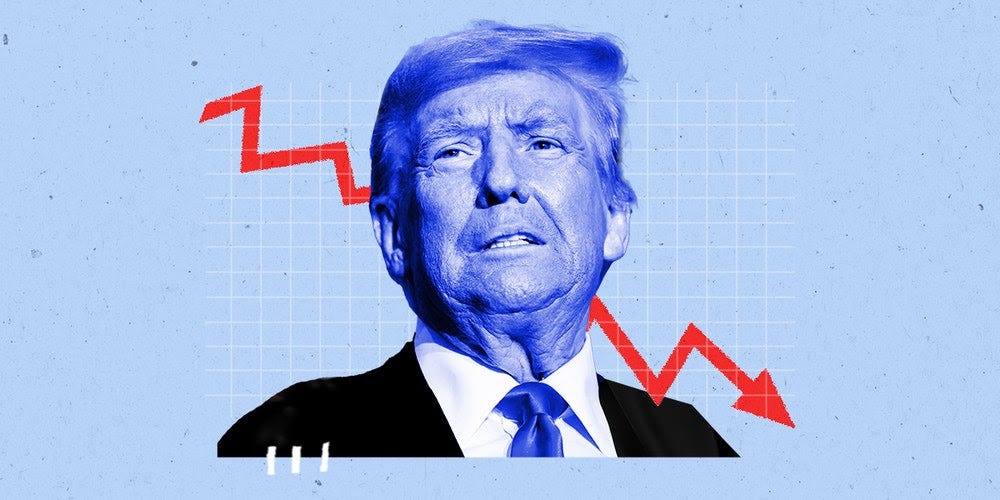
Wall Street Executive Warns of Potential Recession Due to Tariff Fallout
The possibility of an economic recession looming in the latter part of the year has become a topic of discussion on Wall Street, as voiced by an executive recently. The predictive insights come as tariffs are poised to generate a cascade of repercussions that may decelerate economic momentum.
Jeffrey Solomon, leading TD Cowen, is signaling cautious anticipation among some Wall Street analysts about a downturn potentially manifesting by 2025. While the broader economic forecasters still largely anticipate a gentle economic deceleration, Solomon draws attention to substantial risks lurking in the economic backdrop.
He highlights the latest tariff round initiated by Trump targeting nations like Canada, China, and Mexico. These countries, being primary trading allies of the US, have retaliated against these tariffs. Recently, Canada imposed a 25% tariff on American imports, and China responded with tariffs ranging between 10% and 15% on numerous US products.
Solomon shared with CNBC that the escalation into a full-scale trade conflict could trigger widespread disruptions within American supply chains. The resulting uncertainty could prompt wary business leaders to pause mergers and defer new investment initiatives due to heightened apprehensions.
"While a recession isn't my baseline expectation, I wouldn't be shocked to see one emerge later this year," Solomon articulated, emphasizing that financial markets have yet to fully integrate the tariff implications into asset valuations.
"Currently, the business atmosphere feels like a holding pattern as enterprises assess the tariff situation and decide on future capital investments," he continued. "Stakeholders are adopting a 'wait and see' tactic to grasp the unfolding economic landscape."
Recent economic indicators forewarn of a burgeoning slowdown. According to the Atlanta Fed's GDPNow estimate, GDP may shrink by 2.8% during the first quarter of 2025. If it materializes, it would mark the first economic decline since 2022, a period characterized by a brief technical recession.
The job market offers further signs of cooling, as January saw the economy generate only 143,000 new jobs, short of the projected 169,000. Private sector hiring has also softened, with only 77,000 roles added, vastly underperforming the forecasted 148,000, as detailed in the latest ADP employment data.
Possible Economic Implications of Intensifying Trade Tensions
Projections by Brookings suggest that an intensifying trade war could exacerbate economic vulnerabilities, with US GDP potentially decreasing by approximately 0.32 percentage points. Similarly, employment figures could drop by around 0.25 percentage points, depending on whether Canada and Mexico enact further retaliations.
Apollo’s chief economist, Torsten Sløk, recently observed an uptrend in looming recession concerns and cautioned about a potential stagflation phenomenon—an unfriendly mix of elevated inflation coupled with stagnant growth.
In a discussion with Bloomberg, Sløk remarked, "Currently, the market discourse is shaped by rising inflation amidst diminishing growth—a classic stagflationary shock." This volatile scenario adds complexity to ongoing financial market deliberations.
Dhaval Joshi from BCA Research highlighted parallel views while speaking with Business Insider. He anticipates the onset of a 'mini-stagflation' by mid-year should growth continue to lose momentum.
Joshi commented, "We are already witnessing inflation close to or exceeding the 3% mark. The true test remains the impending slowdown in growth, which may transpire sooner than expected."
Leave a Reply