


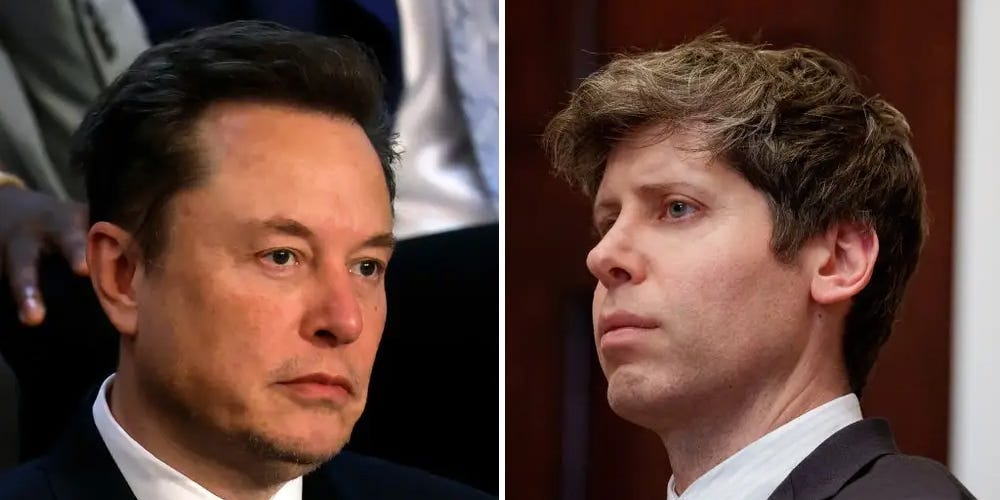
Court Denies Musk's Attempt to Halt OpenAI's Profit Transition, Yet Trial Looms
Elon Musk's legal maneuver to obstruct Sam Altman from transforming OpenAI into a profit-driven company was turned down by a judge, although certain aspects of the lawsuit might proceed swiftly to trial.
In a judgment issued on Tuesday, U.S. District Judge Yvonne Gonzalez Rogers described Musk's plea for an injunction against OpenAI's restructuring as 'extraordinary and seldom approved.'
While the injunction was denied, the court agreed to hasten proceedings related to 'connected contract-related claims' with a possible trial beginning in 2025, considering the 'significant public interest.'
Consequently, Musk and his co-claimants, including his firm xAI and former OpenAI board member Shivon Zilis, should be able to present their case in court, though Judge Gonzalez Rogers indicated that a trial is unlikely before 2027 or 2028.
Back in November, Musk's legal team updated their lawsuit against OpenAI to seek an interim injunction, responding to indications that the developer of ChatGPT intended to switch to a conventional business model.
Altman aims to separate OpenAI's profit-generating division from its nonprofit origins, an intricate task even without Musk's involvement.
The revised November lawsuit also brought forward new accusations, like those of antitrust behavior, adding heavyweight Microsoft to the case.
Musk's attorneys claimed that OpenAI's strong ties to Microsoft provide it with an unfair edge that suppresses competition in the artificial intelligence sector.
In response, an OpenAI representative told Business Insider, 'We embrace the court's ruling. This case is about competition. Elon's communications suggest he wanted a for-profit OpenAI to merge with Tesla—which would be self-serving but not in alignment with our mission or national interests.'
This development marks another chapter in the ongoing friction between Musk and Altman, who collaboratively established OpenAI in 2015. Musk departed three years later due to disputes over its vision, later accusing OpenAI of straying from its initial nonprofit purpose.
In just the past month, Musk led a colossal $97.4 billion offer to acquire OpenAI, which was promptly declined by the organization's board.
Further Context
Sam Altman teased, 'No thanks, but we're up for purchasing Twitter for $9.74 billion if you're interested.'
Following the bid, Musk's attorney Marc Toberoff remarked, 'OpenAI needs to revert to being the open-source, safety-centric force it once stood for.'
Altman noted in an interview that he perceives Musk's legal actions as a strategy to decelerate OpenAI—and as a potential threat to Musk's own xAI.
Currently, Musk's representatives have not issued a comment to Business Insider's inquiries.
Leave a Reply