


China's Parliament Asserts Economic Optimism Amid Tariff Challenges
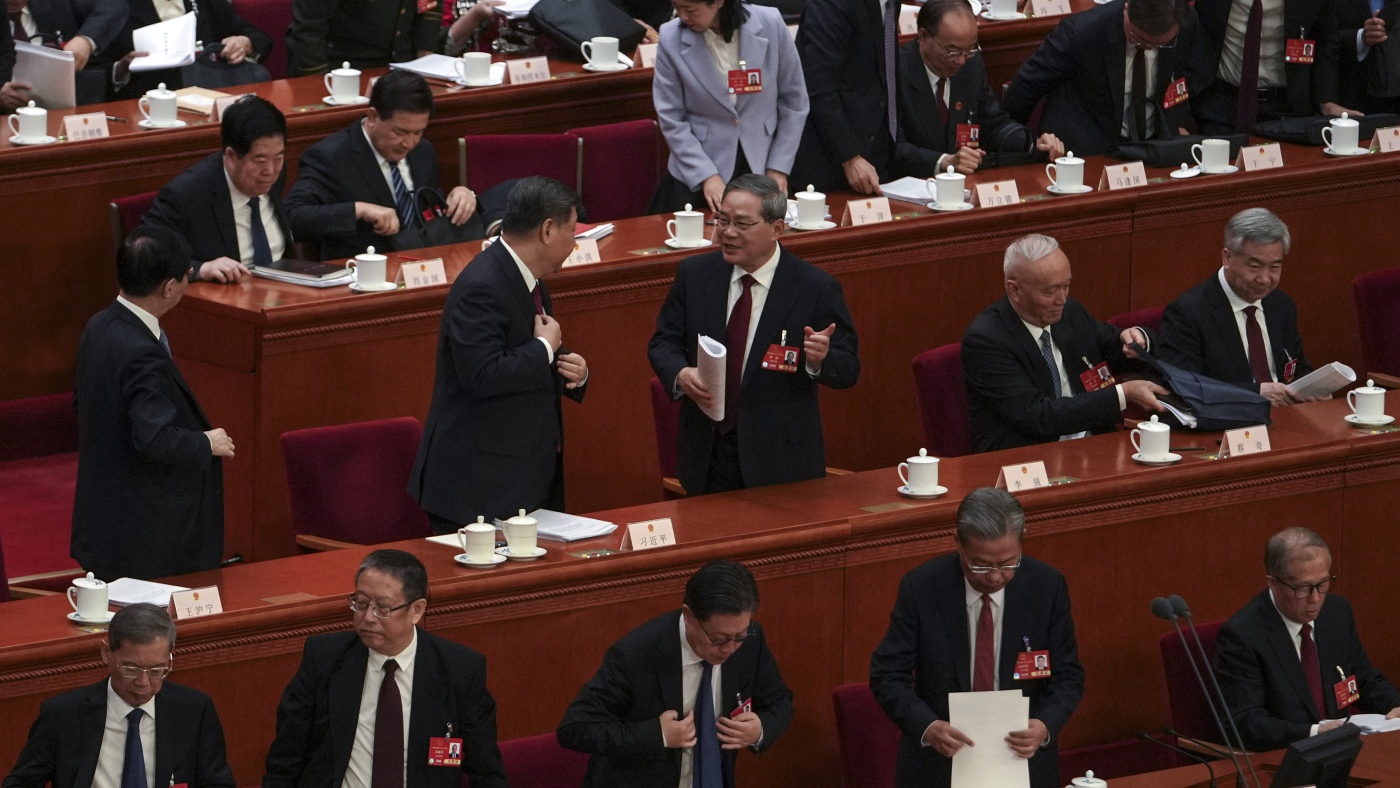
At the Great Hall of the People in Beijing, Chinese President Xi Jinping, alongside Premier Li Qiang, engaged with fellow leaders and delegates during the inaugural session of the National People's Congress.
The parliamentary session kicked off on Wednesday in Beijing, with China's officials expressing bold confidence about the economic prospects while acknowledging threats to stability. Delegates appeared unfazed by looming challenges.
Premier Li Qiang announced the goal of achieving approximately 5% economic growth for the current year, mirroring last year’s target despite enduring domestic hurdles and fresh U.S. tariffs introduced a day before.
Li emphasized the importance of confronting difficulties directly and reinforcing belief in China's developmental path.
In a speech resembling a state of the union address, Li stated, "A more intricate and severe global landscape could significantly affect China, particularly in commerce, technology, and beyond."
Li addressed economic challenges by admitting that the internal pillars supporting China's economic revival are insufficiently strong, pointing out weak demand, especially in consumer spending.
Following the easing of COVID-19 restrictions by late 2022, China grappled with issues such as a real estate downturn caused by policy, low consumer morale, deflationary trends, increasing debt, and foreign critiques of excessive industrial production.
Li proposed comprehensive measures to galvanize economic growth, highlighting a shift to a more proactive fiscal approach, the issuance of new bonds, adopting a lenient monetary stance, and prioritizing economic policies that enhance living standards and stimulate consumer expenditure.
However, some analysts doubt whether these initiatives will suffice. "We are hesitant to believe these moves will adequately prevent a slowdown, given external pressures and insufficient government spending on boosting consumption," commented Julian Evans-Pritchard of Capital Economics.
Recently, President Trump imposed additional tariffs on Chinese goods, raising them by another 10% on Tuesday. He argued that China needs to act more decisively to curb the influx of fentanyl, a synthetic opioid, into the U.S.
Despite not explicitly naming the U.S., analysts infer that the "complex and severe external environment" cited by Chinese officials likely refers to the increasing competition with the U.S. in recent years.
As people assembled in the Great Hall, near Tiananmen Square, several delegates expressed determination that China could withstand the tariff impacts.
"There's none of the 2018 sense of 'oh no, a trade war' as we feel more composed," noted Tian Xuan from Shanghai's delegation. "China's market is robust, complete supply chains are in place, and we are focusing on boosting domestic consumption."
"U.S. tariffs serve as encouragement for innovation in technology, cultivating global relationships, and implementing strategies to fortify the economy," Tian continued.
Shandong Province's delegate Zhang Qiaoliang resonated with official sentiments, recognizing there are no victors in trade conflicts.
"I doubt the American administration wants to extend this path further," stated Zhang. "I hope both nations can eventually resolve this concern."
Leave a Reply