


Debate within the CFPB: Are Employees Free to Perform Their Duties?
Sworn statements from both sides are being labeled as misleading as they face off in court.
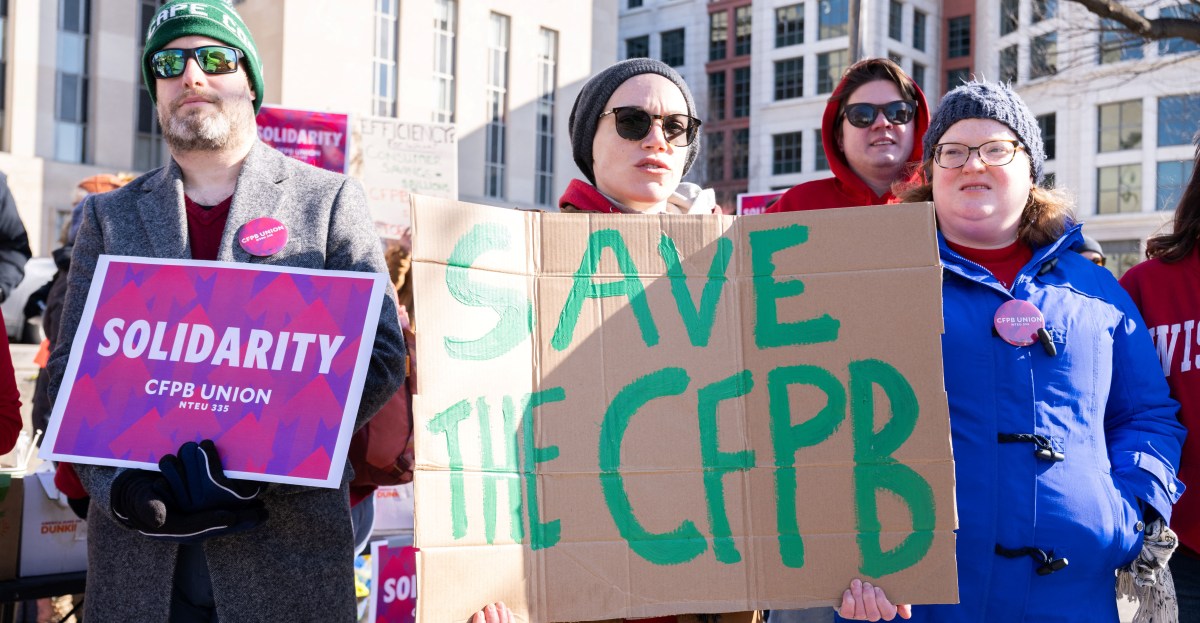
The leadership and workforce of the Consumer Financial Protection Bureau (CFPB) are embroiled in a legal battle over allegations that the Trump administration aims to gradually terminate the agency. There is ongoing uncertainty about whether employees are permitted to fulfill their official responsibilities. An executive from the agency is set to testify in the upcoming week, following concerns from a judge about a potential agency shutdown before her intervention.
The agency has come under scrutiny from the Department of Government Efficiency (DOGE). Elon Musk made a foreboding reference to the agency on social media in early February, and the National Treasury Employees Union (NTEU) has filed a lawsuit to prevent its demolition. In recent developments, several CFPB employees—some anonymous and willing to reveal their identities to the judge confidentially—submitted affidavits alleging the Trump administration intends to dismiss most of the workforce, reducing the CFPB to a mere title.
Over the recent weekend, chief operating officer Adam Martinez countered accusations that he misled the court in determining workers' ongoing roles. He provided a new statement asserting that the true intention of CFPB leadership is to appropriately adjust the agency's scale.
In a discussion on Monday regarding a temporary restraint on layoffs, Judge Amy Berman Jackson expressed apprehension that CFPB heads were making decisions with hidden motives, according to a report from Evan Weinberger of Bloomberg Law. She explored various strategies to ensure the agency's survival until she could pass a judgment.
The CFPB's mandate includes enforcing laws and setting rules for the finance sector, which increasingly involves both conventional and tech company digital financial services. Typically, its function includes addressing consumer grievances about financial products and overseeing digital payment applications, such as those envisaged by Musk’s ventures.
According to the NTEU, actions taken by the Trump administration breach the separation of powers principle in the U.S. by dismantling an agency established and funded by Congress. Initially, directives from interim director Russell Vought informed staff to pause their activities. Martinez's recent court submission aimed to demonstrate that employees were still engaging in required statutory tasks. However, current and past CFPB employees have contested this, providing evidence that both the agency's dismantling and cessation of mandated activities were indeed underway, citing statements Martinez made about the agency's pending closure.
In his statement issued on Sunday, Martinez addressed these alleged inconsistencies, noting that his comments mirrored leadership's view at that time. He further stated that significant developments have occurred within the CFPB since then.
After Vought took over as interim leader of the CFPB on February 7, Martinez mentioned a shift in focus towards more appropriately scaling the agency. He explained that although his mentioned remarks followed Vought’s appointment, the realities at that period were fluid, necessitating time for the new leadership to direct its focus. The new leadership adopts a deliberate approach towards managing operations and interfacing with top executives advising or seeking direction to execute crucial CFPB statutory duties.
Martinez questioned one staffer's claim that senior leaders suggested the agency's nonexistence, contesting it as contradictory to leadership guidance. Also, he disputed the depiction by Matthew Pfaff, head of the Office of Consumer Response, which suggested urgent consumer complaints handled by the Escalated Case Management team were being ignored. Martinez stated that as of February 27, the team was operational.
According to Pfaff’s latest statement, allegations from Martinez regarding assistance for urgent cases—like foreclosure complaints—are incorrect. Pfaff conveyed that, contrary to Martinez's claims, support structures within the CFPB, particularly for pressing issues like possible home foreclosures, were inactive. An affidavit from a Case Management team supervisor, using anonymity due to fear of retribution, confirmed their inactivity since Vought's February 10 directive to completely halt workings, which did not exempt legally required duties.
Martinez attests to his efforts to aid staff in understanding permissible statutory tasks, but Pfaff claims guidance requests sent to Martinez, including his memo about essential statutory work two weeks on, remain unaddressed.
Before the Monday hearing, the agency sought to clarify its stance, suggesting misinterpretations of prior commands to stop statutory work. An email, obtained by The Verge and sent by CFPB’s legal chief officer Mark Paoletta, clarified that employees must perform legally required work without needing prior consent.
Leave a Reply