


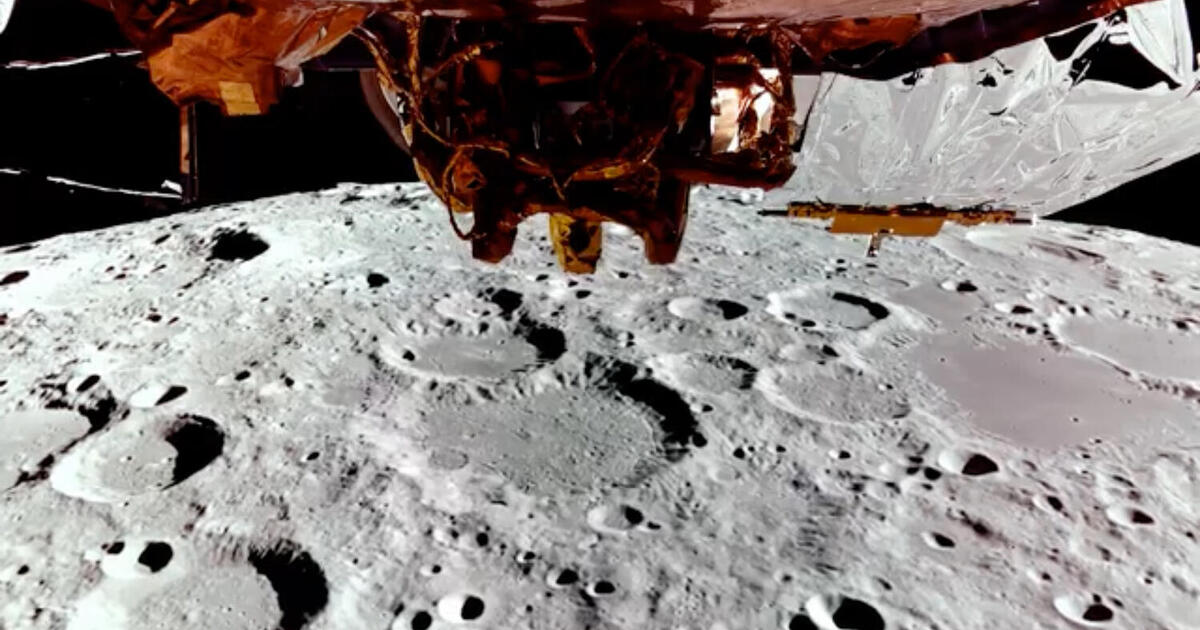
Anticipation Builds for Blue Ghost's Lunar Landing on Sunday
Firefly Aerospace's ambitious endeavor, the Blue Ghost lunar lander, targets the moon's surface this Sunday as the first private robot lander of this year to attempt such a feat.
Since its launch, the lander spent about a month in Earth's orbit, with engineers based in Austin, Texas, meticulously testing every aspect of its operations and scientific payloads. The spacecraft soon transitioned to a lunar orbit, spending 16 days perfecting its flight path and sending incredible pictures of Earth back from afar.
Now approaching its ultimate descent phase, the Blue Ghost aims for a controlled landing on the lunar terrain at Mare Crisium, near an ancient formation known as Mons Latreille. The touchdown is expected around 3:34 a.m. Eastern Time, with the lander relying on its advanced thrusters to reach the predetermined landing spot.
Powered by sunlight, the lander is designed to function for a complete lunar time span of 14 Earth days. There is hope that it can operate even slightly longer on stored battery power as the moon plunges into nightfall.
Firefly Aerospace's CEO, Jason Kim, expressed pride in cutting-edge commercial technology's role in making space exploration more accessible economically. He suggested similarities between their ambitious lunar goals and remarkable gymnastic landings, signifying hope for success.
NASA entrusted Firefly Aerospace with a $101 million contract to deliver ten scientific instruments to the moon, as part of the agency's Commercial Lunar Payload Services (CLPS) program. These instruments carry an additional development cost of $44 million, emphasizing the collaborative effort between NASA and private enterprise to advance lunar research before human exploration resumes.
Designed to encourage commercial industry involvement, the CLPS initiative is a vital precursor to the Artemis missions, which aim to establish a sustainable human presence on the moon.
Along with the Blue Ghost, a secondary passenger on the same launch vehicle, Tokyo-based ispace's lander named Resilience, is taking a strategic, energy-efficient path to the moon, aiming for a landing in May.
The mission's primary aim includes deploying varied instruments—ranging from imaging devices and drills to advanced computational hardware. These tools will conduct critical experiments, like simulating Earth-based GPS signals reception and studying lunar dust management and displacement.
Ray Allensworth of Firefly Aerospace emphasized that these efforts provide insights essential for future human moon missions, shedding light on the tangible challenges and conditions of operating on lunar soil.
Leave a Reply