


The Overwhelmed Kremlin Medical Facilities as Crippled Russian Troops Reappear on Battlefields According to UK Reports
The recurring presence of Russian soldiers utilizing crutches at the battlefront indicates that the Russian medical services are struggling to cope, as pointed out by the UK's Ministry of Defense.
Drawing from publicly accessible data, the ministry's intelligence briefing on Sunday stated that Russian soldiers, likely still suffering from unrecovered injuries, are being sent back to perform military duties in Ukraine, frequently while using crutches.
Details emerged about the 20th Combined Arms Army, which, according to the intelligence briefing, may have created 'assault teams' composed of wounded soldiers.
The ministry noted that Russian military leaders might be allowing this to ensure that these soldiers don't get lost within the congested medical system.
Ukraine calculates that around 830,000 Russian troops have suffered injuries or died in the ongoing conflict, with nearly 400,000 needing care in medical environments removed from the combat zones.
British intelligence highlighted that injured personnel are possibly sent back to their units early, upon their commanders' insistence, to alleviate the burden on the overstressed medical infrastructure and monitor the deployment of these injured individuals.
Additionally, inadequate medical services away from the frontline necessitate the return of both bureaucratic and healthcare responsibilities to the soldiers' original units.
The UK's insights followed as pro-Ukrainian social media shared videos showing Russian soldiers on crutches navigating through wooded environments near Pokrovsk, where many were seen speaking against their deployment.
Mid-January reports from Ukrainian sources displayed footage of two individuals on crutches traversing a field reportedly close to Pokrovsk. A drone dropped munitions that seemed to incapacitate them.
Despite the visuals, it's unclear what injuries the men endured before the drone assault. It also remains ambiguous whether they were confronting Ukrainian forces or merely moving between Russian strongholds.
This imagery has sparked discussions within Russia as well. Military analyst Svyatoslav Golikov condemned the practice of deploying wounded soldiers, labeling it as a 'total absurdity' in a late January communication.
Golikov mentioned that in the most extreme scenarios, obviously impaired individuals might be assigned to assaults, while more commonly, they're tasked with reinforcing retaken positions.
In his comments, Golikov suggested that the men in the video, absent weapons, could reflect a typical expectation for Russian soldiers to procure supplies at the front lines independently.
The uproar also coincided with a viral incident showing a military-clad individual attacking injured Russian soldiers with a baton and stun gun in mid-January, prompting backlash on social platforms.
Officials in Kyzyl, within Russia's Tuva region, informed Interfax, a Moscow news agency, that they were examining the recorded altercation.
The Russian Ministry of Defense did not offer a response to Business Insider's inquiry sent outside the typical business hours.
These visible strains on Russia's capacity to supply troops are noteworthy, as the ongoing conflict could depend heavily on which side—Moscow or Kyiv—can endure longer with manpower and resources.
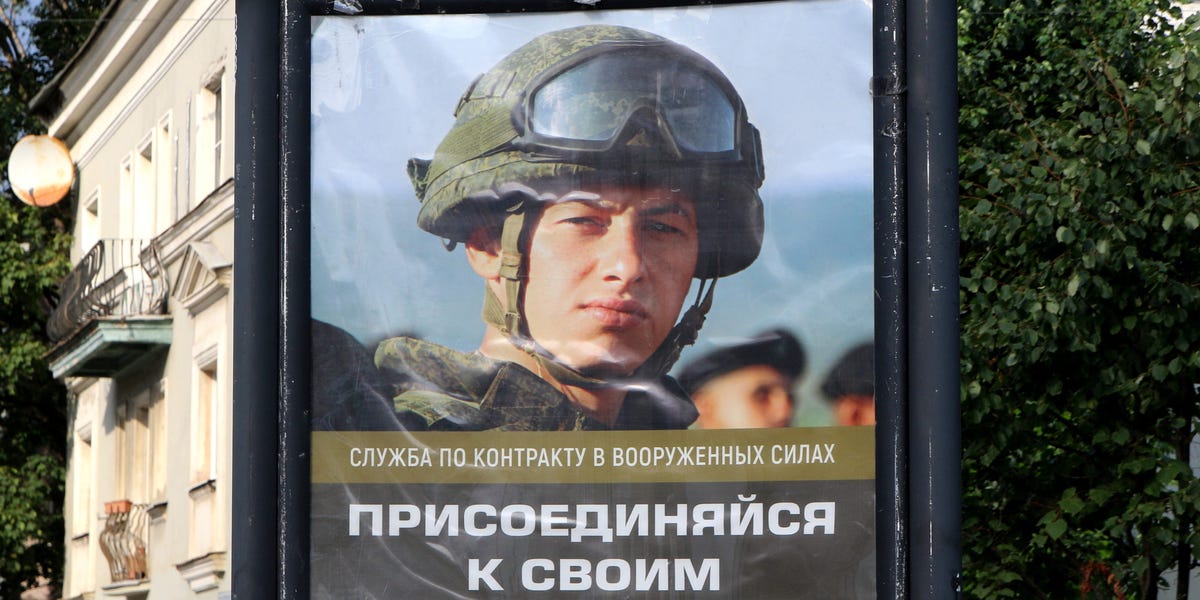
To attract fresh soldiers, the Kremlin has been enhancing enlistment incentives, with regions in Russia presenting economic rewards almost comparable to those of the US military.
With an increasingly isolated economy due to Western sanctions, Russia is anticipated to allocate nearly a third of its national budget towards defense by 2025, equivalent to 13.5 trillion rubles or $135 billion at current rates.
Leave a Reply