


Ancient Remains of Pregnant Woman Suggest Ritual Sacrifice in Ecuador
The remnants of a pregnant woman, likely from over a millennium ago, unearthed in the coastal territory of Ecuador, indicate a possibility of her being part of a ritualistic sacrifice or a punitive action, according to archaeologists from a 2022 excavation.
Recently, a report published by Cambridge University Press shed light on findings regarding the individual known as Burial 10. Estimated to have lived between 771 AD and 953 AD, the woman was around 17 to 20 years of age when she died. The stark discovery that her hands and left leg were severed around the time of her death has intrigued researchers.
Notably, the significance of her interment is heightened by her pregnancy status at the time of death. The archaeologists noted a fracture in her skull and incisions on her hand bones, suggesting possible sacrificial rites.
"Signs of trauma occurring around the time of death, like the skull fracture and incisions on bones, along with the removal of limbs, strongly argue for sacrifice, a phenomenon seldom seen among coastal Ecuadorian cultures," the study authors noted.
Sacrificial customs on the Ecuadorian coast are unusual, yet the body's positioning and missing parts denote a potential ritual context.
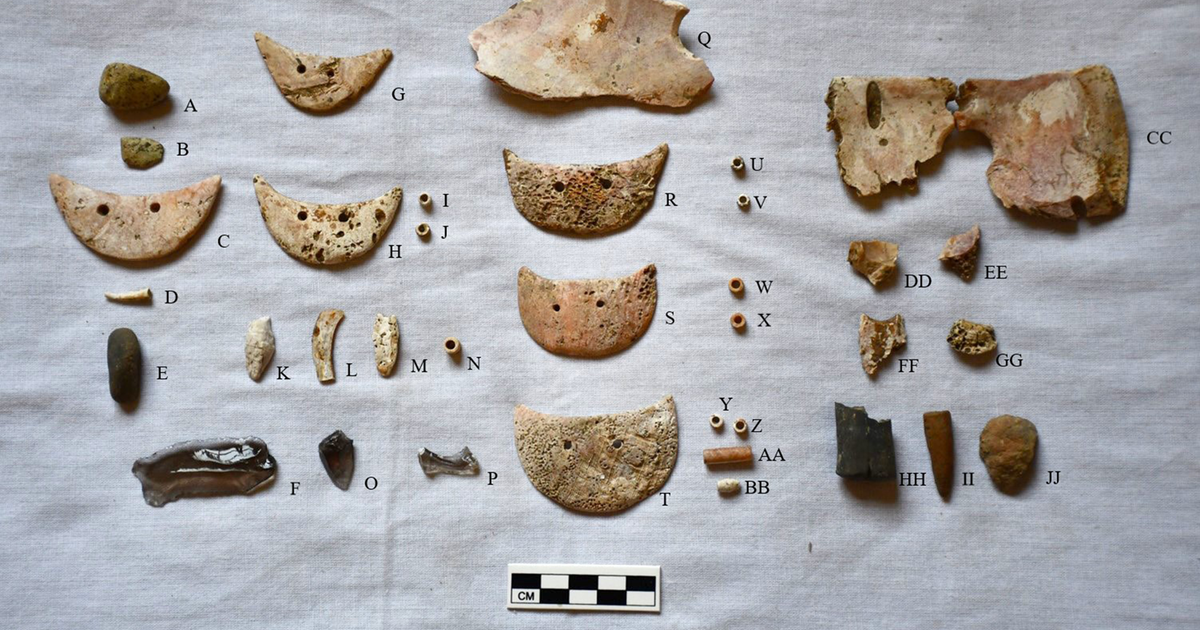
The deceased woman's eyes had been obscured by two ark clam shells. Adjacent to her was a large green clay stone, and fragments of pottery had been placed on her forehead. Additionally, crescent-shaped mollusk shells, known as spondylus mascaras, were arranged around her remains.
Her burial also included spondylus pendants and beads, or chaquira, sourced from a mixture of cultural origins.
Although believed to belong to the Manteño, an indigenous group along the Ecuadorian coast with agricultural and maritime livelihoods, the eye covering did not align with conventional Manteño burial customs. Researchers identified the green stone's use in connecting death with fertility in Valdivian burials, predating the Manteño by centuries, suggesting cultural crossover. The use of mascars was traditionally associated with Valdivians.
"The gathering and curation of such artifacts imply deliberate preparation for this burial," the study stated. "To decipher the reasons behind this particularly rare burial, acknowledging these historical links is essential."
Researchers identified a charred offering within her thoracic area. It appears the site was revisited for additional ritual activities, as similar practices date to a later period, specifically between 991 AD and 1025 AD.
Leave a Reply