


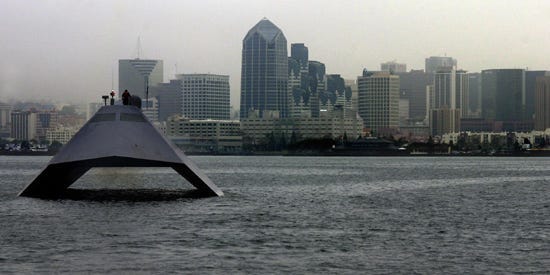
Lockheed's $50 million Stealth Ship That Never Set Sail
During the era of the Cold War, a period marked by strategic innovation, the US invested heavily in advanced military technologies to rival the Soviet Union's growing capabilities.
Motivated by Soviet progress in radar and missile technology, the US moved beyond just minimizing radar detection, developing aircraft like the F-117 Nighthawk which evaded radar completely.
The US Navy, eager to bring this cutting-edge technology to naval vessels, aimed to create a stealth ship invisible to radar and sonar. Despite its groundbreaking design, the experimental Sea Shadow didn't find a home in active service.
From Submarine Concept to Surface Marvel
Stealth pioneer Ben Rich, head of Lockheed's Skunk Works, extended the stealthy principles of the F-117 to a new underwater craft concept.
Rich and his top team crafted a scale model, known as the Sea Shadow, testing its sonar-deflecting shape that minimized detectable noise from both engines and crew.
Navigating Challenges
The Defense Department saw little use for submarine stealth at the time, prompting a shift to adapt the design into a surface vessel with dual hulls for greater stability and speed.
Intrigued by this transformation, the Pentagon greenlit Lockheed's project under a $50 million contract, paving the path for experimental trials on how stealth adaptations could withstand ocean dynamics.
Under Wraps and Strict Secrecy
With its juggernaut's radar-scattering surfaces, the Sea Shadow aimed to sidestep Soviet satellite surveillance. Tests utilized mock-ups in a controlled pool environment in California, simulating enemy radars and proving effective.
Built in sections, final assembly occurred on a submerged barge, keeping the entire project under tight wraps.
Designed to house a compact four-member crew, the vessel featured a diesel-electric system propelling it to 15 knots, approximately 17 mph.
A Missed Opportunity
The Sea Shadow, meant to test naval stealth technology, was constrained by its unique and specialized design that did not accommodate the broad needs of the Navy.
Spending nearly 30 years dormant in storage, the vessel was eventually liquidated at an immense loss, selling for only $2.5 million, before being dismantled for parts.
Enduring Influence
Despite its incomplete transition to active duty, the Sea Shadow's invaluable lessons in stealth principles were later realized in the more sophisticated Zumwalt-class destroyers.
These costly warships adopted the Sea Shadow’s stealth-enhancing features, testing the waters of modern naval warfare with their reduced radar visibility.
Into the Future: The GHOST Vessel
General Dynamics' GHOST vessel, a testament to the Sea Shadow’s legacy, is a remote-operated ship designed for adaptive missions from coastal defense to anti-piracy.
This innovative drone-like craft features adjustable wings and can reach speeds of 37 mph, signifying the continued evolution and application of stealth designs in modern-day maritime technology.
Leave a Reply