


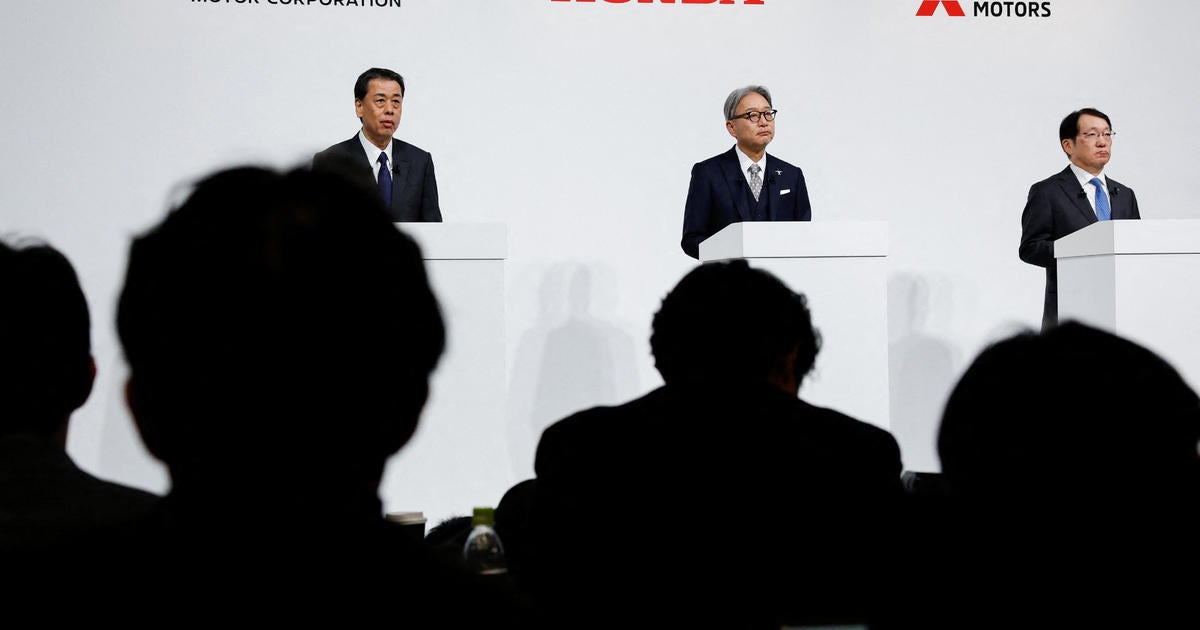
Honda and Nissan to Join Forces in Merger
/ AP
— The two major Japanese carmakers, Honda and Nissan, have unveiled their plans to unify operations, aiming to establish the world's third largest auto-manufacturer by sales, as the automotive sector shifts towards sustainable energy solutions.
Both companies have signed a preliminary agreement and have invited Mitsubishi Motors, a smaller alliance member of Nissan, to engage in discussions regarding business integration.
Nissan's leader, Makoto Uchida, expressed optimism, stating that should this merger succeed, it could enhance their value proposition to a broader consumer demographic.
Japan's automotive industry has been slow to embrace electric vehicles compared to major competitors and is now eager to cut expenses and catch up technologically.
The possibility of a merger was first mentioned earlier in the month amidst speculations that it was spurred, in part, by interest from Foxconn—a Taiwanese firm that manufactures iPhones—in collaborating with Nissan, which also partners with the French Renault SA and Mitsubishi.
If this merger is realized, the combined value of the companies could exceed $50 billion, based on their current stock market valuations. Collectively, Honda, along with Nissan's alliance with Renault and Mitsubishi, would gain significant scale to vie against Toyota Motor Corp. and Volkswagen AG from Germany.
Despite merging, Toyota would still maintain its position as Japan's preeminent carmaker, having produced 11.5 million units in 2023. Meanwhile, the combined output of Honda, Nissan, and Mitsubishi would reach roughly 8 million vehicles. Last year, Honda's production stood at 4 million, Nissan's at 3.4 million, and Mitsubishi at over 1 million.
Back in August, Nissan, Honda, and Mitsubishi revealed plans to pool resources for electric vehicle components, such as batteries, and to jointly conduct research on self-driving technology as part of their adaptation to the market's electrification focus.
Honda, recognized as Japan's runner-up in automotive manufacturing capacity, is widely regarded as the only feasible domestic partner capable of aiding Nissan, which has faced challenges following the arrest of former chairman Carlos Ghosn in 2018 over allegations of financial misconduct—charges he disputes. After securing bail, Ghosn fled to Lebanon.
From a virtual press conference in Tokyo, Ghosn criticized the merger plans, dubbing them a 'last-resort maneuver.'
Strategic Asset Sharing
Through collaboration with Nissan, Honda stands to benefit from acquiring knowledge in producing large, truck-based SUVs with significant towing capabilities, areas where Nissan has established expertise. Additionally, Nissan's extensive experience in battery development, electric, and hybrid vehicles is seen as a potential boon for Honda's EV and hybrid advancement.
Despite these prospects, Nissan had to announce in November a workforce reduction by 9,000 jobs globally, alongside a 20% cutback in production capacity after recording a financial loss of 9.3 billion yen ($61 million) for the quarter.
Nissan's organizational structure saw recent changes, with CEO Makoto Uchida undertaking a pay reduction of 50% as a measure of accountability while advocating for more efficient operations in response to evolving global market demands.
Fitch Ratings has recently adjusted Nissan's credit rating to a 'negative' outlook, attributing this to declining earnings, driven partly by pricing pressures in North America. Nevertheless, Nissan retains a robust financial base, with cash holdings totaling 1.44 trillion yen ($9.4 billion).
Despite setbacks, Nissan's stock remains undervalued, representing a potential opportunity for investors.
On Monday, the trading value of Nissan's shares rose by 1.6%, with an increase of over 20% following initial merger announcements the previous week. Honda’s shares also saw a 3.8% gain, though its net profits for the first half of the April-March fiscal year dropped by nearly 20% year-over-year, largely due to reduced sales in China.
This merger is representative of a broader trend towards consolidation throughout the automotive industry landscape.
Regulatory and Economic Implications
During a routine press briefing on Monday, Cabinet Secretary Yoshimasa Hayashi refrained from providing detailed commentary on the automakers' merger plans. He underscored the necessity for Japanese companies to sustain competitiveness amid a rapidly changing global market.
"As the automotive industry faces profound change, driven by advancements in storage batteries and software, we anticipate strategic steps will be taken to endure the intense global competition," Hayashi remarked.
Leave a Reply