


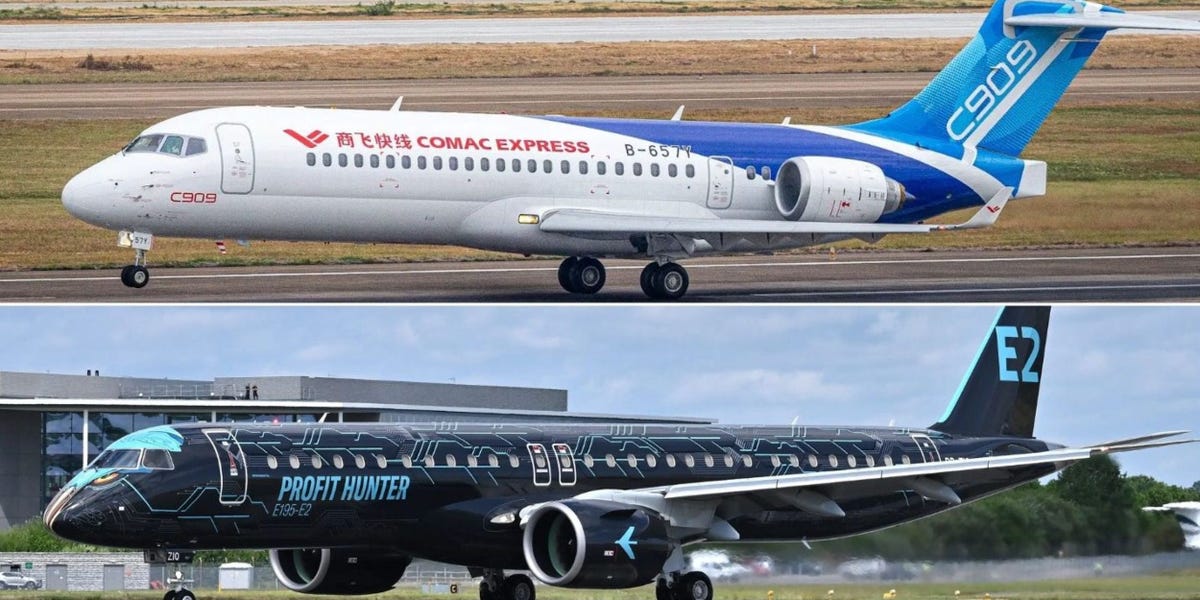
Redefining China's Regional Airliner: C909 vs. Embraer E2 Jets
The Commercial Aircraft Corporation of China (Comac), China's publicly owned aircraft manufacturer, has taken steps to strengthen its market position alongside industry giants Airbus, Boeing, and Embraer. Central to this strategy is the rebranding of its regional aircraft.
Competing with the E2 Series
Without a regional jet from Boeing and with Airbus' A220 serving a unique role in regular and regional operations, Comac's newly renamed C909 is positioned as a competitor against Embraer's E2 lineup.
Embraer's E190-E2 and E195-E2, designed as advanced replacements for the earlier E-Jets, entered passenger service in 2018 and 2019. While they come with a higher price tag than the C909, they surpass it in terms of size and engine potency.
The Popularity of E195-E2
Among Embraer's offerings, the E195-E2 has garnered greater favor, with 282 orders and deliveries reaching 110. Meanwhile, the E190-E2 has achieved 52 orders and 25 deliveries.
Since its introduction in 2016, Comac has delivered approximately 150 units of the C909, predominantly to domestic Chinese airlines, and has about 60 more on order. Nevertheless, international sales remain a hurdle.
Certification and International Sales Challenges
A major challenge for Comac is achieving certification in the United States and Europe, though it has managed to sell to Indonesia's TransNusa airline. Conversely, despite Embraer's strong order numbers, its E2 jets haven't cracked the U.S. due to pilot union issues nor penetrated the Chinese market.
Comac's five-abreast seating accommodates 78 passengers across two classes, extendable to 97 in a denser setup. In contrast, its competitors, the E190-E2 and E195-E2, measure roughly 119 and 136 feet, respectively, offering more spacious seating in three classes.
Capacity Differences
The E190-E2 can hold 97 passengers in a multi-class arrangement or up to 114 when configured for economy. The larger E195-E2 handles between 120 in multiple classes to a maximum of 146 seats. Despite their capacity, the narrower 2×2 seating layout might feel cramped compared to the C909's setup.
Performance and Range: Engine Comparison
While Comac's C909 sports two General Electric CF34-10A engines allowing for a flight range of 1,382 to 2,300 miles, newer planes with upgraded engines outperform it in power and efficiency.
Embraer's jetliners, fitted with Pratt and Whitney PW1900G engines, expand their range substantially, from 3,280 to 3,450 miles. Although the E190-E2 travels less than its sibling E195-E2, it still outdistances the C909 by around 1,000 miles.
Utilization in Various Markets
The C909 is primarily utilized for China's domestic travel within a 1,000-mile radius, with TransNusa deploying it on a lengthy route from Guangzhou to Manado. The E2 jets, however, facilitate longer-range connections, such as Royal Jordanian routes spanning 2,000 miles and Porter Airlines' extended flights from Toronto to Los Angeles.
Pricing: Economic Challenges
An advantage Comac holds could be pricing. Estimates and sales hints suggest Hainan Airlines negotiated a favorable $38 million per C909 at recent airshows. Meanwhile, Embraer's E195-E2 had an average list price inclined toward $84 million.
The cost for Embraer's smaller E190-E2, following negotiations, stands at roughly $37.5 million—indicative of the potentially higher financial burden of opting for Embraer versus the less costly C909 model.
Leave a Reply