


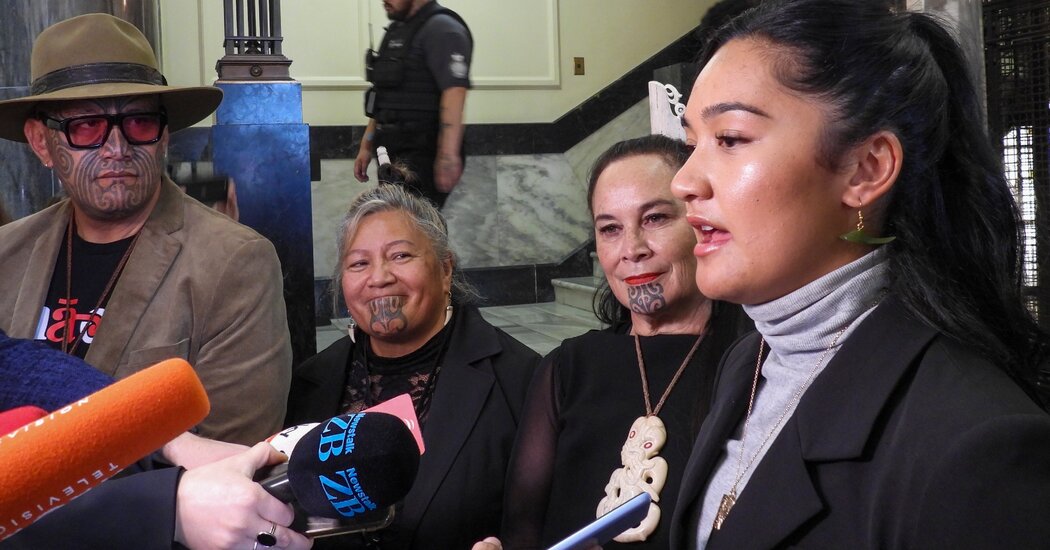
The Significance of Maori Haka in New Zealand Parliamentary Protests
During a parliamentary session, opposition lawmakers dramatically showcased their cultural heritage by performing a haka. This traditional dance was enacted during the bill discussion aiming to alter the interpretation of New Zealand’s founding agreement with its Indigenous population.
A Political Statement Through Māori Cultural Expression
Hana-Rawhiti Maipi-Clarke's Leadership in Cultural Protest
Hana-Rawhiti Maipi-Clarke, a Member of Parliament, took the lead in displaying this cultural protest. She provocatively ripped up a legislative document, vocally opposing a bill that has sparked significant controversy.
Upon witnessing the display on the parliamentary floor, Speaker Gerry Brownlee opted to temporarily halt proceedings. This performance by Ms. Maipi-Clarke is not her first, having used the haka to express political dissent previously.
Historical Context of the Treaty of Waitangi
The Treaty of Waitangi, established in 1840 between Maori leaders and the British Crown, is a foundational document. It has been integral in shaping legislative measures that aim to address historical injustices inflicted on the Māori community.
However, the right-wing political faction known as Act criticizes these policies, labeling them as causes of division within New Zealand by advocating for equal rights rather than ethnic-based provisions.
Potential Impact on Race Relations
Introduced recently, the controversial bill might reverse years of effort towards racial harmony and healing past grievances. It has already incited racial discord across the social fabric of the nation.
The Māori community, which forms about one-fifth of New Zealand’s populace, continues to face economic challenges, poorer health outcomes, and higher imprisonment rates compared to the general population.
Nationwide Opposition to Legislative Changes
A wave of protestors traversed the country to gather in Wellington, united against the bill that threatens to unravel established rights and remedial actions for the Māori.
Despite the National Party's attempts to detach from this legislation, it had previously consented to its introduction as part of a coalition agreement with Act.
Although the bill managed to pass its initial voting stage, it is anticipated to encounter significant obstacles before it can become law.
Prime Minister Christopher Luxon emphasized his disapproval, stressing the necessity for the bill to be rejected in subsequent discussions, to preserve the lengthy history of dialogue associated with the treaty.
Leave a Reply