


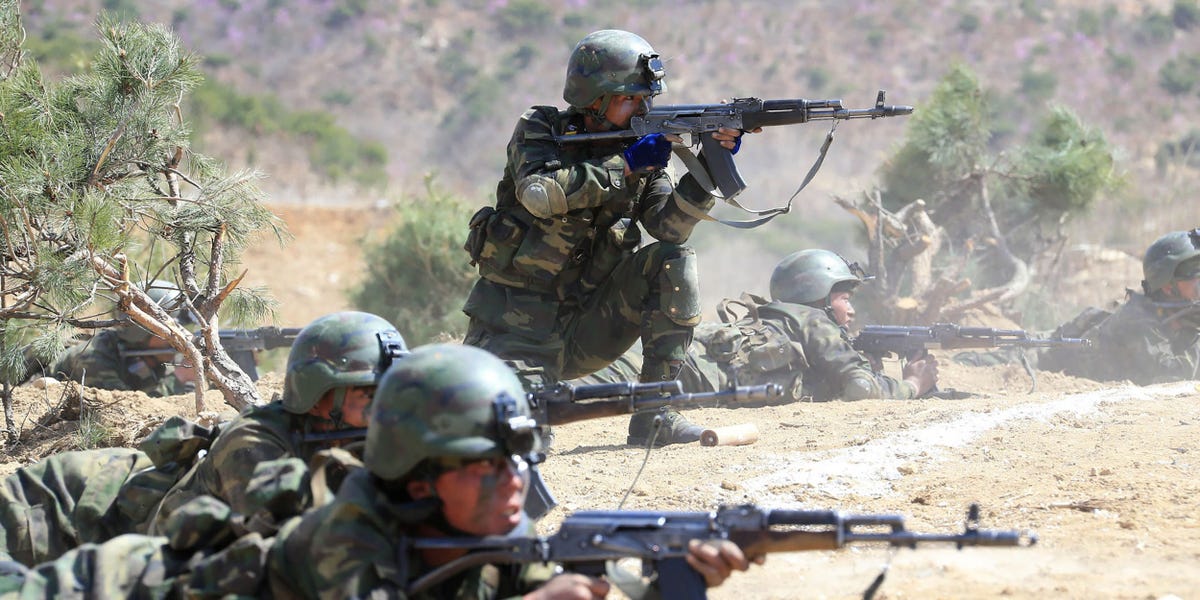
Kim Jong Un's 'Storm Corps' in Russia: Are They Truly Elite?
Speculation is growing about the caliber of North Korean soldiers reportedly operating in Russia. A defector who once served in North Korea's special forces suggests the troops are indeed part of an elite unit.
Lee Woong-gil, who fled to South Korea in 2007, conveyed to The Korea Times his belief that the North Korean personnel identified in Russia are special forces, albeit not the top tier.
Estimates from Washington and Kyiv suggest North Korea has dispatched approximately 11,000 soldiers to bolster Russia's efforts in Ukraine, with around 8,000 positioned in the Kursk area.
The composition of this military presence remains somewhat ambiguous, though they are frequently attributed to North Korea's esteemed 'Storm Corps,' colloquially known as the 'Black Berets.' In initial reports from October, South Korean intelligence noticed a wave of 1,500 special forces entering eastern Russia.
South Korean intelligence postulated that four brigades, totaling 12,000 of North Korea's elite forces, were expected to arrive in Russia.
The Challenge to Elite Reputation
Lee believes those placed in the risky environment of Kursk will inevitably acquire significant combat expertise—an aspect considered advantageous in Kim's strategy to deploy forces against Ukraine.
However, Lee, who served in the Storm Corps from 1998 to 2003, mentioned that the forces currently in Russia do not seem to be the top-ranking members usually designated for international and perilous assignments.
Claims of Inferior Standards
There remains ongoing discussion about the proficiency of these troops in comparison to contemporary special forces benchmarks, as doubts linger about whether these men are part of North Korea's elite squad.
According to South Korean defense sources, the Storm Corps boasts an impressive 200,000 members, a remarkable count for any special forces unit.
During a visit to a training facility in September, Kim Jong Un praised the unit's capability, suggesting each member's strength is equivalent to 100 regular soldiers. However, Korean authorities describe these troops in Russia as young novices potentially used as expendable resources.
Footage shared on Russian platforms reveals the perceived inadequacies of these soldiers, suggesting they arrived in poor physical condition, afflicted by undernourishment and illness.
Lee recounts his time in the Storm Corps, noting better provisioning than other forces but acknowledging persistent issues like tuberculosis and malnutrition.
A former South Korean defense expert, James JB Park, proposed that Kim Jong Un may have intentionally sent less crucial soldiers initially to gauge the Ukrainian conflict environment before deploying more experienced personnel.
Ukrainian forces have already asserted they initiated military action against North Korean soldiers positioned in Kursk, underscoring the tense ongoing engagements.
Potential Consequences and Global Reactions
While the infusion of 11,000 North Korean soldiers may not significantly alter the military balance in favor of Russia, it contributes additional manpower for the Kremlin's attrition tactics against Ukraine.
North Korea's direct involvement raises fears of the conflict expanding internationally, prompting Seoul to reconsider its stance on exporting weaponry to Ukraine.
Concurrently, South Korea is positioning itself as a global arms supplier, aspiring to become the fourth largest defense exporter by 2027, reflecting its rapid growth in the defense sector in recent years.
Leave a Reply