


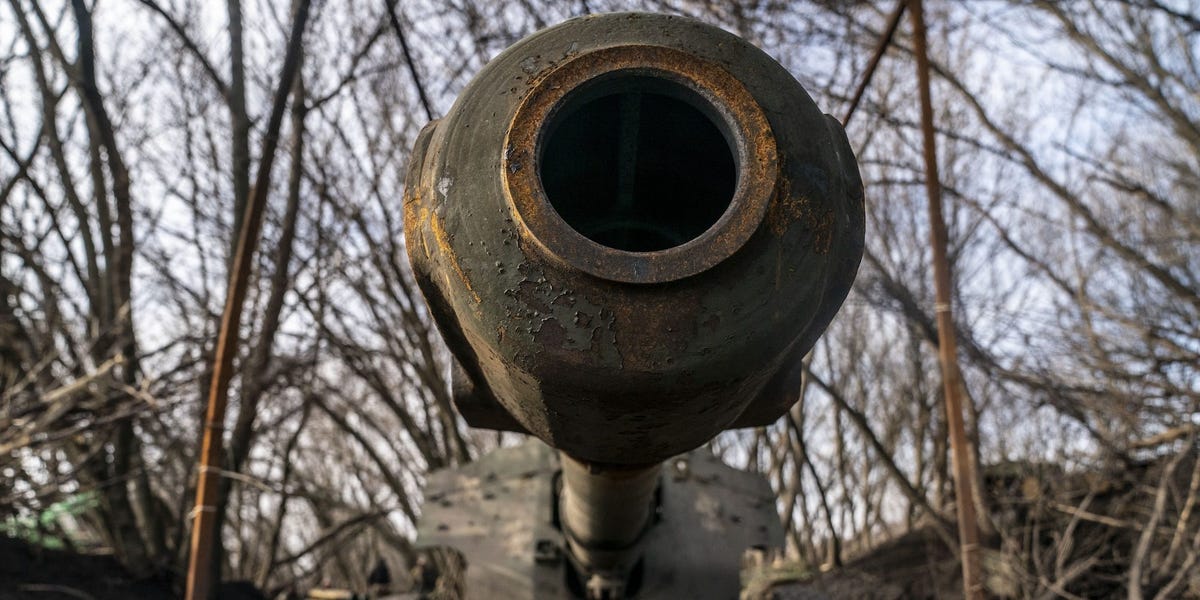
Russian troops are improving at quickly detecting and neutralizing enemy artillery
Traditionally seen as a blunt force, Russia's military is infamous for its raw power, especially in the realm of artillery. However, the ongoing conflict in Ukraine has pushed Russian forces to refine their tactics, particularly in the realm of counterbattery fire, where artillery is used to incapacitate enemy artillery.
Recent observations indicate that Russian artillery has transformed from a quantity-driven machine to one that prioritizes precision and efficiency, adapting in response to experiences in Ukraine. This evolution poses a potential risk to NATO troops in possible future engagements.
Previously, Russia's artillery strategy was a relic of the Soviet era, focusing on overwhelming enemy positions with sheer volume. Entire squads of howitzers and rocket launchers were earmarked solely for counterbattery roles. Such a strategy presumed that outmatching the adversary's firepower was key to success.
Initially, these strategies sufficed because Ukraine's military employed familiar large-scale bombardment tactics typical of Soviet-style warfare. However, as Ukraine dispersed its artillery units, the efficacy of Russia's approach diminished. Targeting solitary guns hidden within terrain proved inefficient and ammunition-consuming.
To overcome these challenges, Russia turned to technology. In 2014, drones became a pivotal tool, providing live targeting data that enabled artillery to effectively strike Ukrainian positions, demonstrating an early version of Russia's 'reconnaissance fire complex.' This system integrates drones and other intelligence assets to deliver real-time data, thereby enhancing artillery accuracy and timing.
This approach includes counterbattery radars and acoustic sensors, along with advanced drones like the Orlan series. Specifically, the Orlan-30 drone can locate Ukrainian artillery by identifying muzzle blasts and heat signatures, while also guiding precision artillery shells with its laser designator.
Drones Transform Battlefield Dynamics
In the event that Ukrainian artillery is detected, Russian forces may deploy Lancet loitering munitions. These drones can send live video feeds to a controller who determines the optimal time to launch a strike. This creates a tactical challenge for Ukrainian artillery teams, as staying on the move to evade detection also increases their visibility to these drones.
A pro-Russian website reports that by early 2025, Russian Lancet drones had executed over 2,700 strikes, including a significant number targeting Ukrainian artillery. Such reports highlight the Lancet's role in countering artillery and suggest its growing impact.
Ample Artillery Resources Bolster Russian Strategy
The extensive arsenal available to Russian forces helps maintain robust counterbattery capabilities without compromising large-scale artillery bombardments against Ukrainian forces. This is evident with weapons like the 2S19 Msta-SM2 howitzer and various MLRS models capable of launching guided rockets over significant distances.
Moreover, the integration of automation and data networks is accelerating Russian artillery response times, showcasing an evolution in tactical artillery warfare marked by synergizing aerial and ground-based systems.
Despite these advancements, certain vulnerabilities exist within Russia's counterbattery strategies, such as the reliance on large radars, which Ukraine has effectively targeted, prompting Russia to deploy more compact and potentially less effective alternatives.
The prospect of NATO forces facing these enhanced Russian artillery tactics raises questions about how effective Western countermeasures would be, especially given the scale of drone operations Russia might employ.
With NATO's substantial air capabilities, there is potential to suppress Russian artillery, but the effectiveness of NATO's counter-drone technology remains uncertain when faced with the sophisticated and numerous Russian drones like those currently challenging Ukraine.
Leave a Reply