


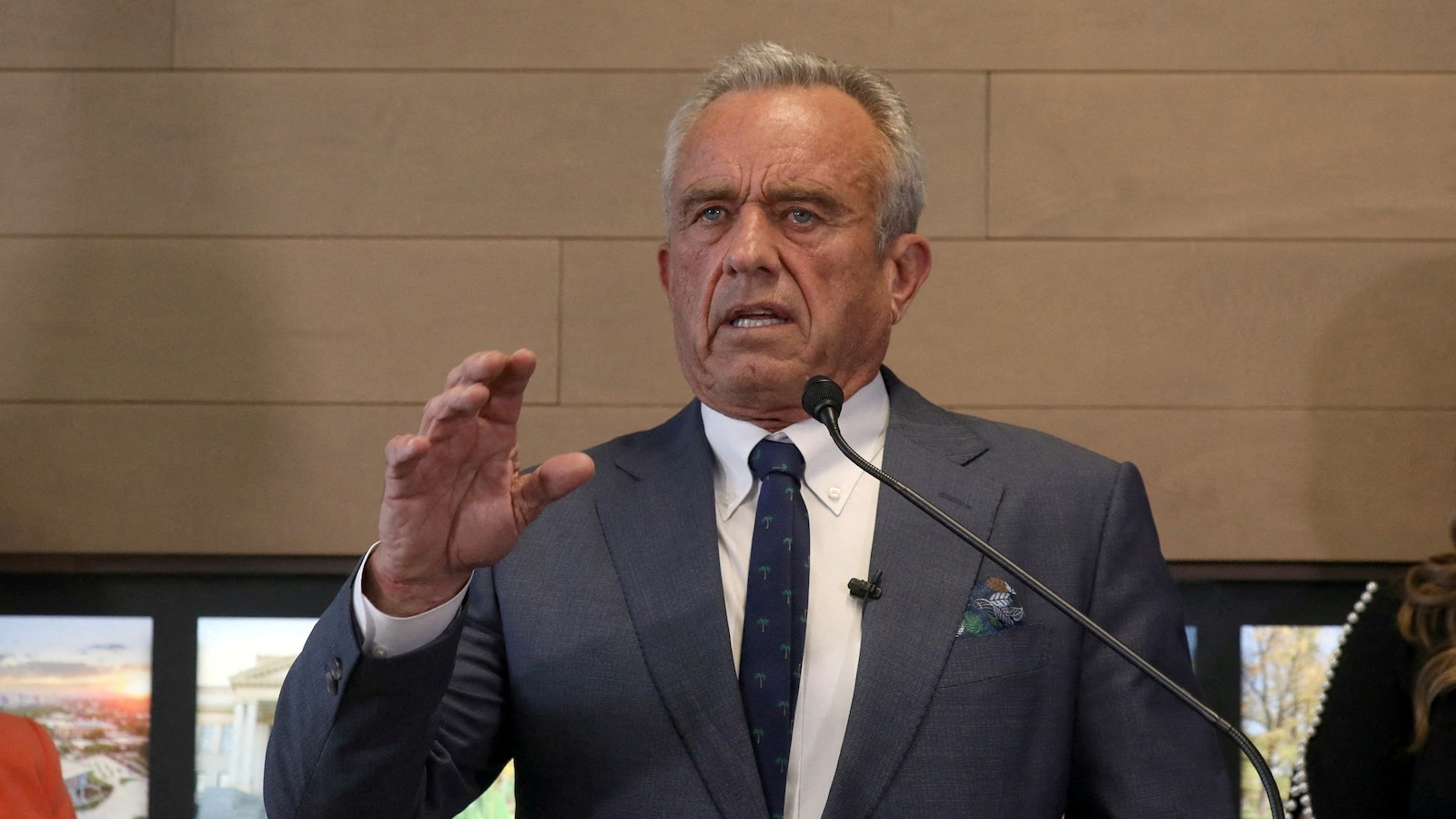
RFK Jr. Highlights U.S. Measles Response as Exemplary
During a recent press event, Robert F. Kennedy Jr., the Secretary of Health and Human Services, lauded the United States’ handling of the measles outbreaks as an exemplary model that the international community should follow.
Kennedy pointed out that while Europe has seen a significant increase in cases, he chose not to delve into the particulars of the U.S. strategy’s success.
"Looking at Europe," he stated, "they reported 127,000 measles cases, resulting in 37 fatalities. What we've achieved in the U.S. offers a blueprint for other nations."
Comparative Analysis of U.S. and Europe Measles Data
Though Kennedy's numbers on Europe align closely with 2024 data from the region, a direct comparison between the entire European area and the U.S. is riddled with complexity.
The U.S. has reported over 600 measles cases this year, predominantly due to an ongoing outbreak in Texas.
Dr. John Brownstein from Boston Children's Hospital stressed that comparing such geographically and administratively diverse regions is misleading due to significant variations in healthcare infrastructure and vaccination efforts.
Brownstein noted that outbreaks in countries like Romania and Kazakhstan have skewed the statistics, whereas in EU nations resembling the U.S., the scenario is either similar or occasionally more favorable than Texas.
European Measles Statistics
Analyzing the 53 nations in Europe and central Asia, data from March 6, 2024, reveals they had over 127,350 cases and 38 measles-related deaths. This doubled the numbers reported in 2023.
Romania emerged at the forefront with 30,692 cases in 2024, trailed by 28,147 cases in Kazakhstan, marking a peak in regional cases not seen in nearly three decades.
Within the EU and EAA countries, which are demographically and systemically closer to the U.S., there was a sharp rise from 3,973 measles cases in 2023 to 28,791 by early 2025.
Romania accounted for the bulk, followed by Italy, Germany, France, and Belgium with substantial case counts.
A significant portion of cases in EU/EAA countries were among unvaccinated individuals, half affecting children under five, and a third affecting those aged 15 and above.
Vaccine Compliance and Outbreaks
Brownstein highlighted that comparing the U.S. with countries having similar healthcare frameworks, like Germany or France, reveals that Texas's outbreak isn't notably less severe.
Concerns linger among health experts regarding potential underreporting of U.S. measles-related deaths, contradicting RFK Jr.'s comments on stabilized case growth.
Dr. Amesh Adalja from Johns Hopkins warned the public at a Texas press briefing about possible underestimation in official counts, suggesting a longer outbreak duration than anticipated.
Considering statistical averages, Dr. Craig Spencer from Brown University School of Public Health intimated a higher case count than reported, with the current death toll indicating potentially thousands of actual cases.
The CDC documented 600 measles instances in the U.S. with a 0.5% fatality rate, surpassing Romania’s lower death rate of about 0.06% and the European region’s average of 0.03%.
These findings underscore the lethal potential of smaller outbreaks when vaccination uptake is low, as observed in the U.S. situation.
Romania's outbreaks were fueled by suboptimal vaccine coverage, exacerbated by mobility trends, growing vaccine skepticism, and dwindling healthcare provider numbers.
Variability exists across Europe regarding vaccination standards, with four countries achieving a 95% rate for MMR vaccination. Meanwhile, in a broader context, one-dose compliance hovers between 85% and 95% across Europe.
In contrast, in the U.S., the majority of young children have received at least one dose of MMR by age two, and teenagers have typically completed the two-dose series.
Countries like Germany, France, and Italy require documentation of measles immunity for school admission, whereas in other regions, the MMR vaccine is strongly encouraged but not mandatory.
Leave a Reply