


Ukrainian Forces Engage Russian Drones with Innovative Weaponry
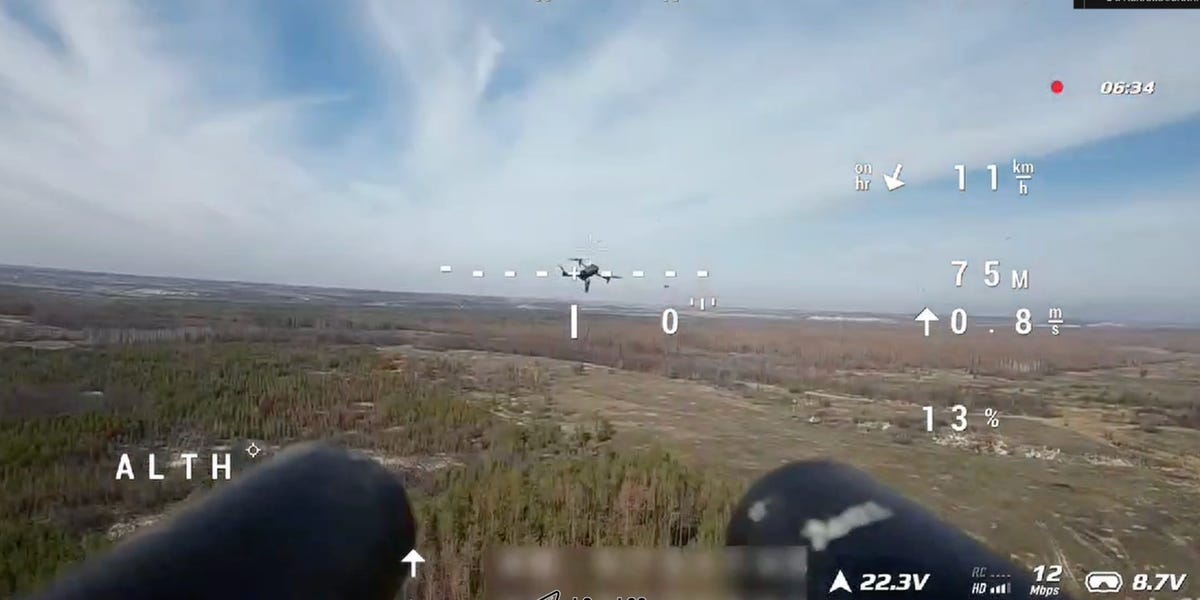
As propellers buzz through the chilly air, a Ukrainian drone advances with twin shotgun barrels poised to strike its aerial target.
The attached camera captures a burst of light as the gun fires, resulting in the destruction of a DJI Mavic drone mid-air.
Numerous such engagements unfold one after another, each scene showcasing the dual-barrel firing mechanism effectively disabling Mavic drones.
This footage was shared on a recent Sunday by the 2nd Motorized Battalion of Ukraine’s 30th Mechanized Brigade, active around Bakhmut. Their message was direct: eliminating hostile drones is a top task for the 2nd Battalion in their ongoing operations.
These videos build one of the most extensive publicly available archives of a novel wartime strategy — drones neutralizing other drones.
This approach signifies a shift in military technological advancements, as both Ukrainian and Russian forces explore new ways to enhance drones with firearms or incendiary devices, creating what are essentially airborne weapons platforms.
Historical Inspirations and Modern Adaptations
In March, Ukraine’s Presidential Brigade, engaged in Luhansk, showcased a similar drone design, echoing early 20th-century military innovations.
The footage illustrates a drone equipped with extended barrels that fire from both ends, stabilizing the drone by counteracting recoil.
This method relies on impact over precision, where the expansive spread of the shot is crucial, as explained by a brigade representative.
A clip exhibits the drone in action against a stationary target, its barrels emitting a powerful discharge. The absence of an automatic reloading system suggests the need for manual intervention post-firing.
Earlier, in December, similar technology was highlighted by the Ukrainian charity LesiaUA, which demonstrated shotgun-equipped drones, similar to those employed by the 30th Mechanized Brigade.
Russian innovators were also exploring this concept around September, as reported by RIA Novosti. Their approach used a single barrel that fires bidirectionally, drawing from the design of a World War I-era cannon.
The original concept was developed by U.S. Navy Commander Cleland Davis in 1910 to manage recoil, though it was not widely adopted due to reloading challenges during WWI.
The Pace of Innovation in Ukrainian Drone Technology
Ukraine’s drone technology has seen rapid progress, driven by a decentralized and collaborative approach across the defense industry. Teams across the country develop and share novel technologies, enhancing their warfare capabilities.
This includes adaptations of older technology, such as fiber optic drones, which continue to outmaneuver more advanced systems. In the West, there are debates about the NATO alliance's focus on high-tech weapons, which may overlook the advantages of simpler, more plentiful options.
Leave a Reply