


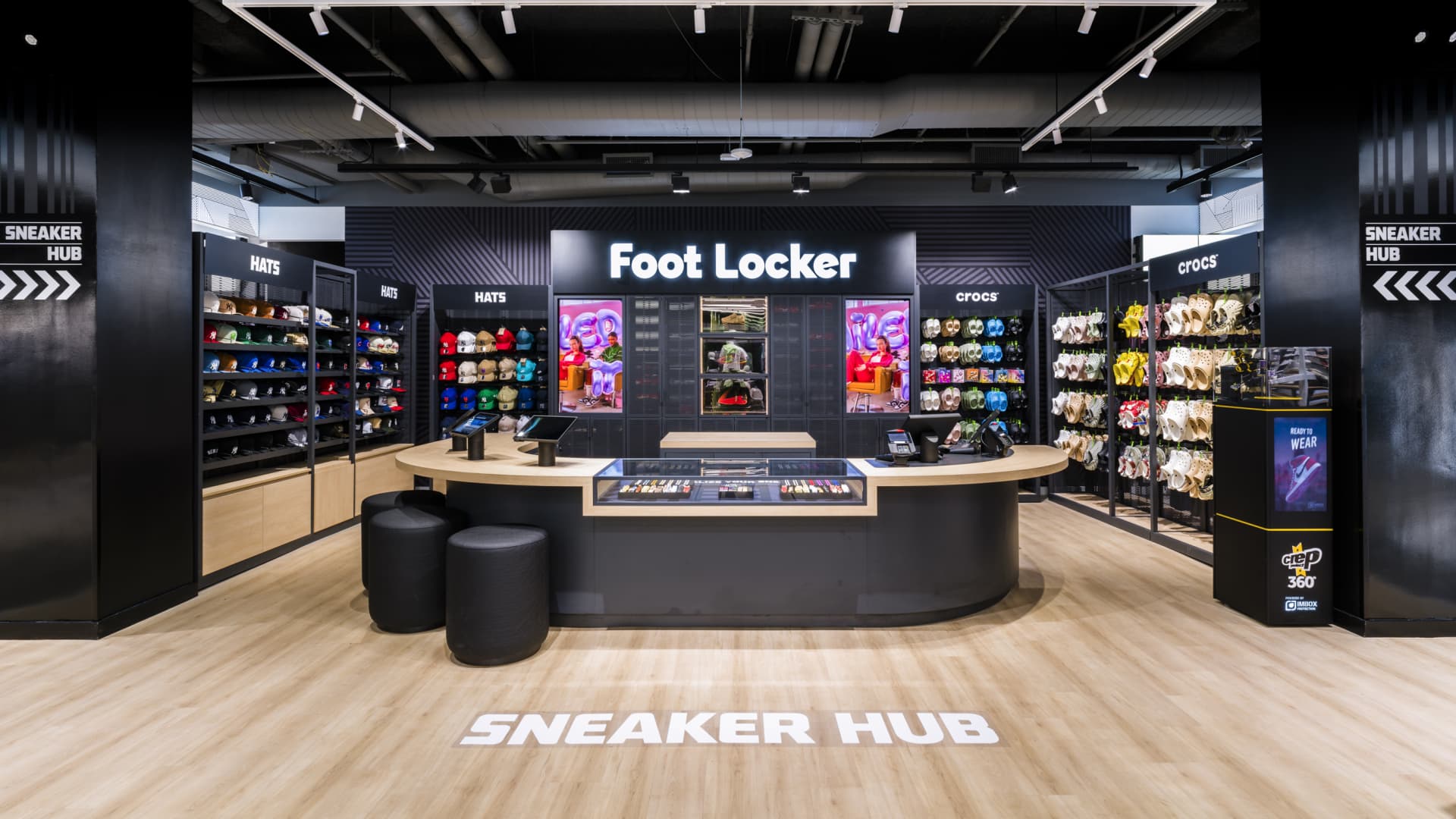
Future Challenges for Foot Locker and Nike in the Sneaker Market
Foot Locker foresees a continuation of substantial markdowns in the sneaker market as it strives to address outdated stock alongside its primary brand partner.
In its most recent holiday quarter, Foot Locker presented mixed outcomes, exceeding Wall Street's earnings forecasts but failing to meet sales expectations. Looking forward, the retailer anticipates that fiscal 2025 will bring lower profit margins than analysts have predicted, despite higher-than-expected comparable sales forecasts, as noted by LSEG and StreetAccount projections.
Analyzing Foot Locker's fiscal fourth quarter outcomes against Wall Street projections, the company's net income for the quarter, which concluded on February 1, achieved $49 million or 51 cents per share. This compares to a prior-year loss of $389 million or $4.13 per share. Adjusting for one-off items like depreciation and losses from discontinued operations, Foot Locker recorded earnings of $82 million, or 86 cents a share.
Revenue slipped to $2.25 billion, marking a decrease of almost 6% from $2.38 billion in the previous year, partially due to an extra week in last year's accounting period skewing comparisons.
Even after a more than 100% profit increase from the previous quarter, Foot Locker does not predict this improvement will persist into the current fiscal year, largely because of extensive promotional efforts saturating the sneaker industry. Predicted adjusted earnings per share are between $1.35 and $1.65, which lags behind the $1.77 estimate from Wall Street, as per LSEG reports.
On a brighter note, there is an expected increase in comparable sales between 1% and 2.5%, surpassing the projected 1.9% increase forecasted by StreetAccount at the higher end.
CEO Mary Dillon emphasized, "We anticipate persistent promotional and consumer pressures into 2025, particularly during the initial half of the year. Nevertheless, our Lace Up Plan continues to gain traction with customers and partners." Dillon indicated that a return to growth in comparable sales, improvements in gross margin, and cash flow in fiscal 2024 confirm the effectiveness of this strategy.
The Nike Influence and Promotional Strategies
Foot Locker's forecast of promotional challenges affecting margins signifies ongoing issues with Nike, its predominant partner. As Nike navigates changes under new leadership with CEO Elliott Hill, it has relied on substantial discounts to manage inventory buildup, which directly influences Foot Locker's operations due to its extensive reliance on Nike.
CEO Hill's strategy, revealed in December, focuses on revitalizing Nike's growth trajectory, attributing previous revenue declines to lingering inventory. The game plan involves prioritizing direct full-price sales but clearing older stock through less profitable avenues first.
Notably, Nike merchandise available at reduced prices on its site doesn't guarantee identical offers on Foot Locker's platform. For instance, a Nike Air Force 1 '07 model, part of Nike's legacy styles, witnesses discounts up to 39% on Nike's portal, whereas identical versions in alternate colors are listed at full price on Foot Locker's website for $115.
This pricing disparity underscores a significant challenge for Foot Locker as consumers might choose to purchase directly from Nike, highlighting the complexities of operating a multi-brand business amidst the rise of direct-to-consumer sales.
Strategic Adjustments and the Path Forward
Under Dillon's leadership, Foot Locker is diversifying its brand offerings by including popular newcomers like On Running and Hoka, alongside established names such as Ugg. Additionally, they are working towards refreshing and strategically relocating their retail outlets outside traditional mall spaces, which contribute to 80% of their sales.
Refreshing store locations is integral to Dillon’s plan. Foot Locker plans an investment exceeding $270 million in consumer-focused capital expenditures over the coming year. Despite this, the company anticipates a reduction in store count by 4% and a contraction in retail space by 2% in the 2025 fiscal year.
In the last quarter, Foot Locker improved its comparable sales by 2.6%, surpassing StreetAccount's expected 2.3% rise. The Champs Sports division, which had been a performance drag, showed promise with a 1.8% sales increase, while the Foot Locker chain rose by 5.5%. Yet, the WSS banner saw a 3.3% decline, tempering overall results.
A major weakness was noted in the Asia Pacific market where sales plunged by 14.1%, primarily driven by a 24% drop associated with its atmos brand.
Attempts to streamline operations include reducing presence in South Korea, Denmark, Norway, and Sweden, partnering with third parties for operations in Greece and Romania, and potentially closing or reallocating 30 out of 140 Asia-Pacific stores and 629 European outlets.
Leave a Reply