


Understanding Trump's Perspective on the Ukraine Conflict
Occasionally, it's important to approach Donald Trump’s actions with an open mind.
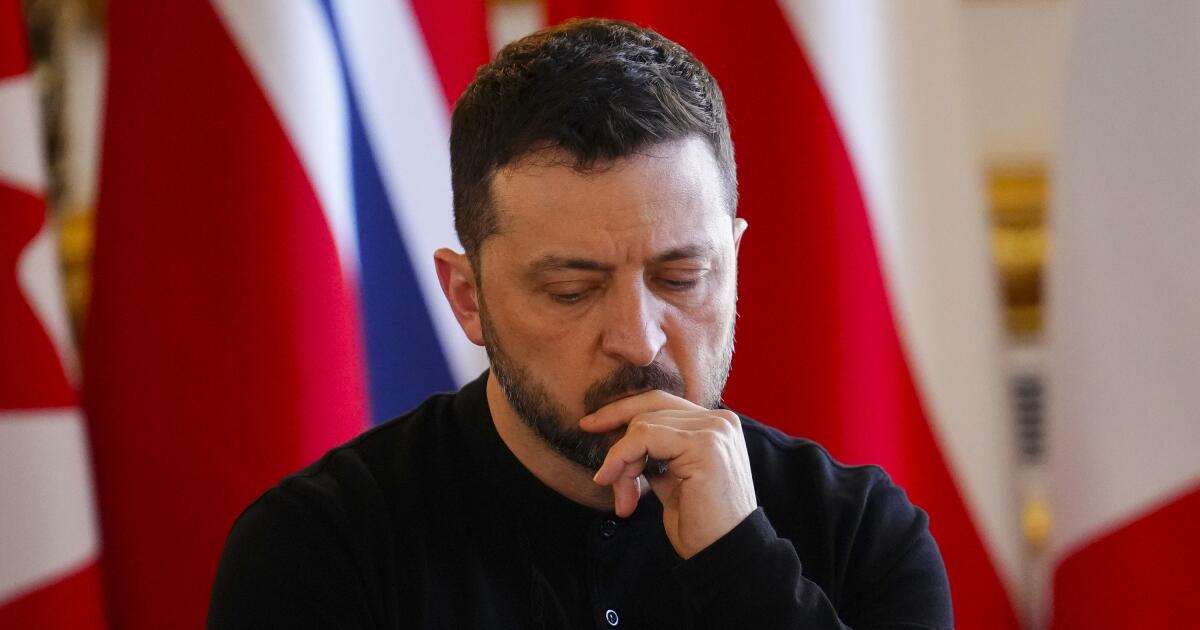
In a recent notable encounter during an Oval Office meeting with Ukraine's President Volodymyr Zelensky, the Ukrainian leader had a strong message: Russian President Vladimir Putin cannot be trusted. Zelensky emphasized repeatedly that Putin often reneges on agreements, stating in broken English that the Russian leader has violated cease-fires numerous times.
Zelensky's insistence arises from a belief that Putin's commitments are unreliable. Putin has made his intentions clear—he aims to recapture as much of the former Soviet territory as feasible. This ambition has led to actions such as the invasion of Georgia, the domination over Belarus, the military presence in Moldova, the annexation of Crimea, and the recent full-scale invasion of Ukraine.
Despite these historical instances, Trump’s defenders, including Secretary of Defense Pete Hegseth, avoid acknowledging the straightforward reality of the ongoing conflict, often due to political motives that obscure truth.
During interactions with Zelensky, Trump remarked that during his presidency, Putin did not break any agreements.
This view encapsulates Trump’s entire perspective on the Ukraine conflict: under his leadership, he claims the war could have been avoided entirely.
Let us hypothesize that Trump is correct, and Putin would not breach any deals during Trump’s tenure. Yet, international security strategies extend beyond the lifespan of any single presidency.
Long-term security planning mirrors the logic behind integrating Germany into NATO and the EU post-World War II, aiming to prevent future continental threats and Soviet expansion, with timelines spanning indefinitely beyond specific leadership tenures.
European nations today are concerned with adjusting to an international scene where U.S. reliability is uncertain, fearing strategic isolation rather than immediate invasion threats.
Putin might indeed favor an arrangement allowing him to retain his territorial gains, banking on future opportunities to claim further Ukrainian territory, serving his long-term objectives.
In contrast, Trump prioritizes the immediate narrative of achieving peace, indifferent to long-term consequences. Potential future conflicts, such as a new invasion, hold no bearing on his past administrations, potentially serving to validate his leadership era’s perceived stability.
This approach reflects Trump’s broader political methodologies, focused more on immediate recognition than substantive, enduring policy outcomes.
Some theorize Trump’s adversarial stance towards Zelensky stems from a prior refusal to assist in undermining Joe Biden politically in 2019, an issue pivotal to Trump’s first impeachment trial.
Trump’s impeachment proceedings twice tackled his strategies of prioritizing political gains over established truths, exploiting narratives over substantive fact.
This aligns with his motivations concerning the Ukraine war: clinching the title of peacemaker, irrespective of whether the peace is fleeting or substantial.
The administration’s foreign policy team seems in sync with this vision, often demonstrating reluctance towards significant security commitments in Ukraine.
Senator Marco Rubio, referring to world affairs, has pointed out that despite losing confidence in America’s deterrence strategies, there remains a dependence on its role as a global peacekeeper.
Rubio’s current stance appears to serve the interest of helping Trump position himself as a purveyor of peace without delivering genuine stability.
In this light, Zelensky emerges not as a hurdle to peace, but as an obstruction to Trump’s desired narrative, making him a target of the administration's frustration.
Leave a Reply