


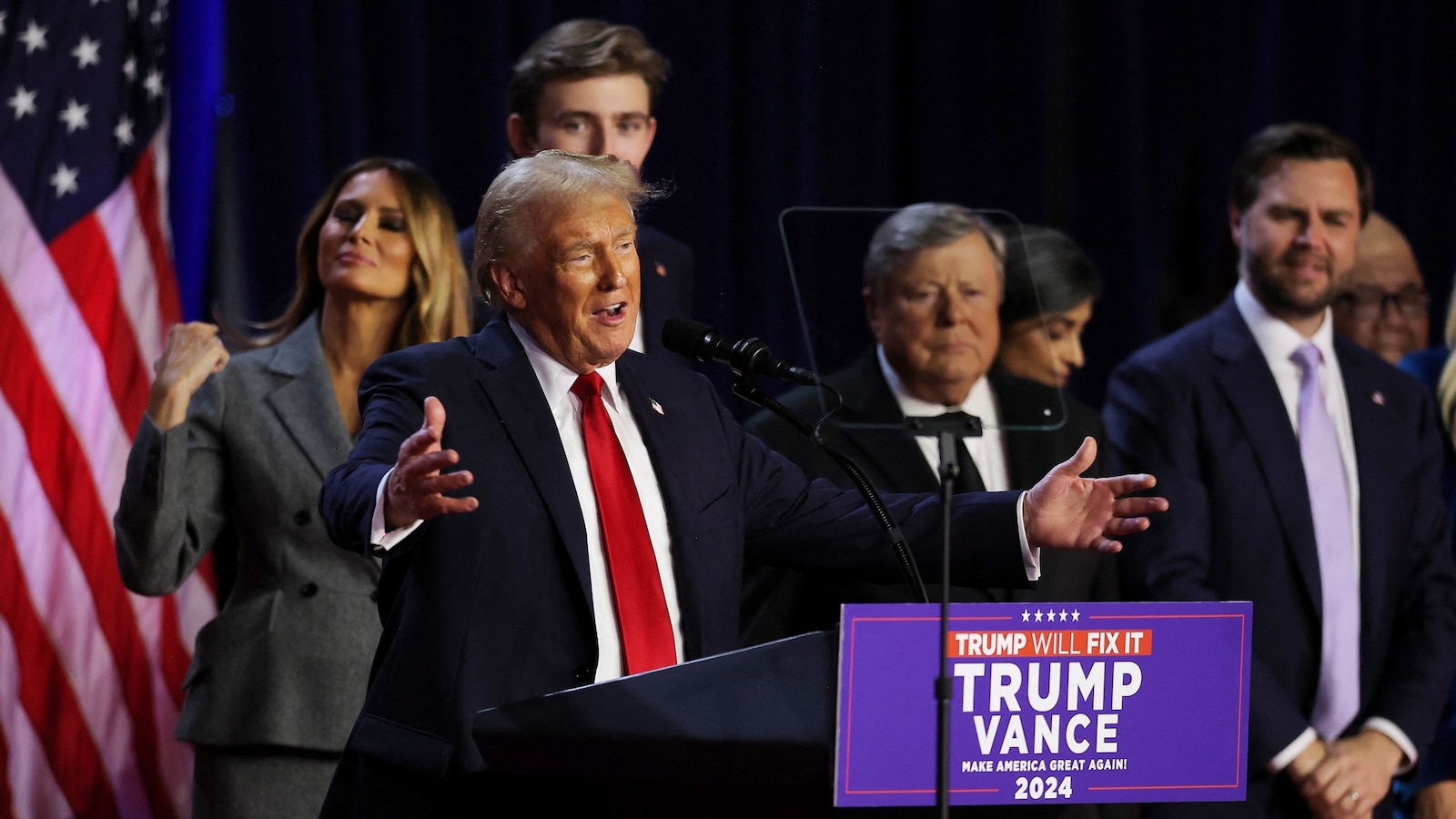
Trump Challenges Political Norms Amid Economic Unease
In the 2024 presidential election, Donald Trump capitalized on economic frustrations, widening his reach beyond his typical supporters and disrupting longstanding political patterns as he made a significant return to the political scene.
While ABC News had not declared a definitive winner by Wednesday morning, Trump's performance managed to defy expectations across numerous metrics.
One notable shift occurred among Hispanic voters, traditionally a Democratic stronghold, as they favored Vice President Kamala Harris over Trump by a narrow margin of 53-45%. This 8-point victory for Harris marks the closest the gap has been since 1976 exit polling began, contrasting sharply with President Joe Biden's 33-point advantage with Hispanic voters in the previous election cycle.
ALSO: With Trump's self-declared victory, Harris faces a shrinking path to success
Trump's success was especially notable among Hispanic men, where he secured a 10-point lead after losing by 23 points in 2020. As the U.S. population becomes more diverse, the Republican Party's increasing competitiveness with Hispanic voters could signify a pivotal change in the country's political dynamics.
Despite this, the level of diversity in this election cycle decreased: For the first time since 1996, there was no increase in the proportion of racial and ethnic minority voters. They accounted for 29% of the electorate, down from 33% in 2020, while white voters made up 71%, a rise of 4 percentage points.
Among white voters, those without a four-year college degree accounted for the majority of Trump's increased support, gaining 4 points as a share of the electorate.
Overall, white voters supported Trump by 55-43%. Comparatively, Harris won Hispanic voters by the historically narrow margin mentioned earlier, triumphed among Asian voters by 56-38%, and achieved the usual Democratic dominance among Black voters with an 86-12% lead.
The election also diverged from historical partisan affiliations. Republican identification matched that of Democrats for the first time in national exit polls, each at approximately 34%, with independents also at 34%.
A distinct difference between young men and women was observed: young men were nearly evenly divided between Harris and Trump, 49-47%, while young women favored Harris by a significant 27 points, 63-36%. However, Harris' support among young women was 4 points lower than Biden's in 2020.
Harris secured the majority of women voters by 54-44%, while Trump won men by an identical margin. This 20-point gender difference aligns with the typical pattern since 1996. Notably, though, Harris' support among women was 3 points less than Biden's.
A dramatic shift was observed among first-time voters; they leaned towards Trump by 54-45%, in stark contrast to Biden's previous 64-32% lead. Trump's support among this group doubled.
Those with college degrees generally supported Harris similarly to Biden, but Trump improved his standing by 4 points among non-college voters compared to four years ago, who are generally more economically vulnerable. Over half of these voters reported being worse off financially under Biden; only a third of college graduates felt the same.
Another notable point was Harris' win among independent voters, 50-45%, even amid negative overall outcomes. Independents often lean towards the election winner.
The economic dissatisfaction was profound, with 45% of voters indicating they were in a worse financial situation under the current administration—the highest proportion recorded in exit polls for this question.
Conversely, only 24% felt their financial situation had improved during Biden's term, a point repeatedly highlighted by Trump at campaign events.
Biden's job approval rating hit a low, with 40% approval and 58% disapproval, paralleling the record low approval rates for outgoing President George W. Bush in 2008. Harris also shouldered part of this burden.
State-level Insights
Individual state exit polls offered further insights into the election dynamics:
Arizona
Despite Biden's previous victory, buoyed by college-educated white voters and independents, Harris maintained a similar lead among educated white voters, but independents split almost evenly, 49-45%, favoring Trump slightly.
Maricopa County was pivotal, with voters narrowly split 50-47% between Trump and Harris, compared to 2020's 50-48% Biden advantage.
Georgia
Harris struggled to replicate Biden's success among independents—which had helped him capture Georgia in 2020. This year, independents shifted significantly toward Trump.
Trump's lead among college-educated white men expanded to 30 points, and he dramatically reduced his deficit among moderates to 18 points from a 32-point gap in 2020.
Michigan
Harris encountered significant challenges in Michigan, where under-30 voters showed a strong preference for Trump compared to Biden's substantial lead with the demographic in 2020. The share identifying as Democrats decreased to a record low.
Nevada
Trump saw atypically strong results among Hispanic voters in Nevada, splitting votes evenly with Harris. Historically, Democrats enjoyed broad advantages with this group.
In Washoe County, Harris achieved the largest Democratic margin in recent years, but Trump minimized Democratic leads in key areas such as Clark County.
North Carolina
Trump's economic messaging resonated in North Carolina, where voters critical of the economy favored him heavily. Despite gains among white voters, Harris couldn't counterbalance losses in groups such as young voters and Black voters.
Pennsylvania and Wisconsin
In Pennsylvania, Harris maintained a strong lead among college-educated voters but faced a considerable challenge from Trump among non-college voters. Similarly, Wisconsin showed a sharper educational divide and generational shifts favoring Trump among younger voters.
Leave a Reply