


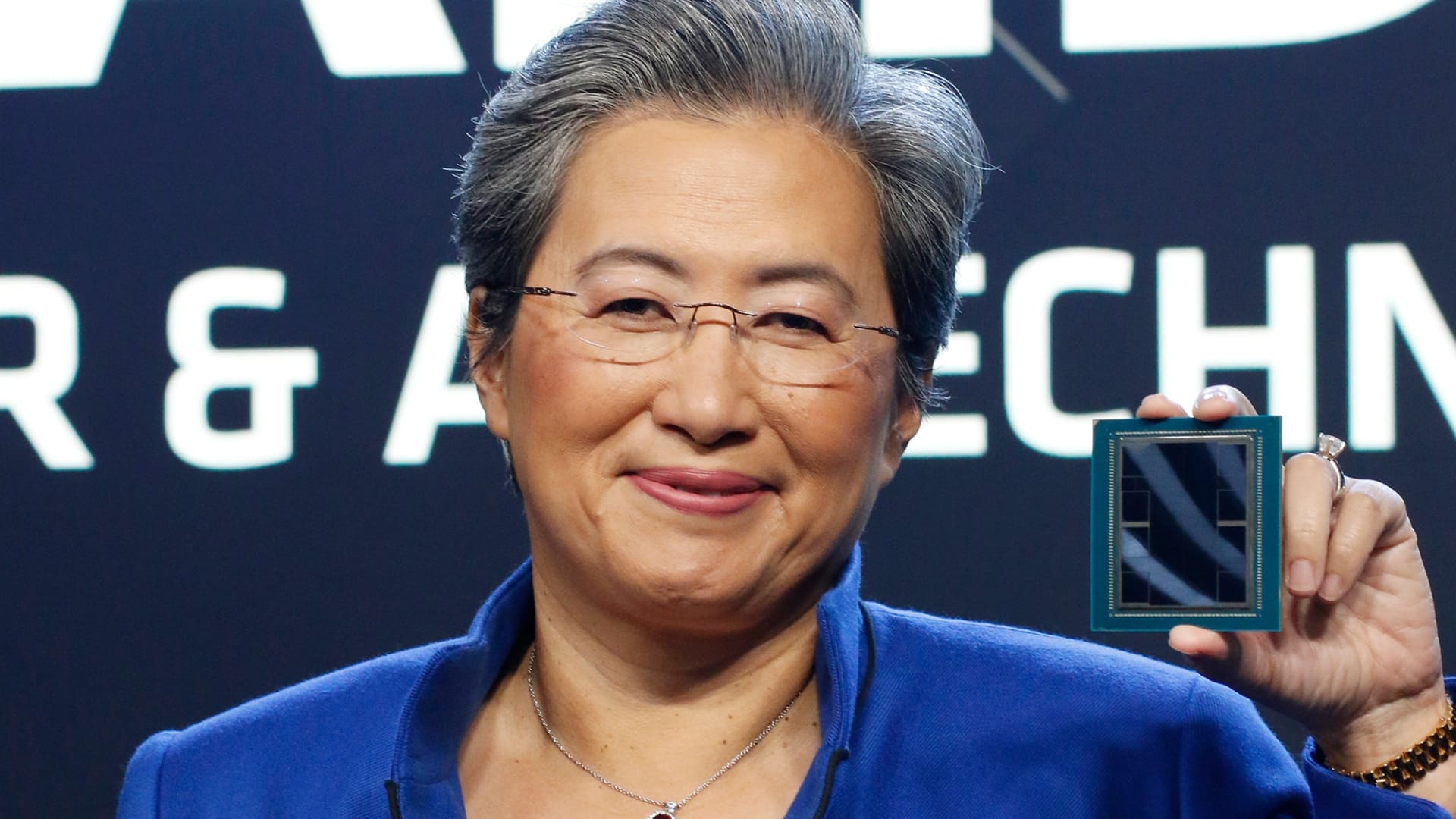
AMD Financial Triumph: A Look at Surging Data Center Revenue
Recently, AMD disclosed its financial performance for the fourth quarter, outperforming market forecasts in terms of revenue and profit. Nevertheless, shares dropped by around 5% during after-hours trading because data center results did not meet the projections.
For the quarter concluding on December 28, here's how AMD's figures matched up against LSEG analysts' collective predictions:
The semiconductor giant anticipates its first-quarter earnings to circulate around $7.1 billion, subject to a variance of $300 million, with projected gross margin hovering near 54%. Such expectations were slightly above the $7 billion revenue analysts had predicted.
AMD witnessed a net income of $482 million, equating to 29 cents per share in the last quarter, a decrease from the previous year's $667 million, or 41 cents per share.
Central to AMD's business strategy is its chip sales for data centers, a sector showing substantial growth due to heightened demand for its graphics processing units (GPUs) within artificial intelligence endeavors.
The company reported an impressive $3.86 billion in data center sales, marking a 69% increase compared to the previous year. This surge is largely attributed to both its Instinct GPUs and EPYC CPUs, which stand in competition with other major processors.
However, FactSet analysts anticipated data center earnings to be around $4.14 billion for that quarter.
Over the span of the entire year, AMD's data center segment experienced a boost in revenue by 94%, reaching $12.6 billion. Within this, $5 billion was tied to the company's Instinct GPUs designed for AI applications.
Despite trailing the market lead, AMD has rolled out formidable data center GPUs that have been adopted by significant infrastructure purchasers in recent efforts.
In terms of its computing chip sales for PCs and laptops, these are categorized under client revenue, which rose by 58% annually to $2.3 billion. Demand remains strong for chips in both traditional desktops and portable devices like laptops.
As the second-largest supplier of gaming GPUs, following Nvidia, AMD experienced a dip in this segment by 59%, down to $563 million. The embedded chip division saw $923 million in sales, depicting a year-on-year reduction of 13%.
Leave a Reply