


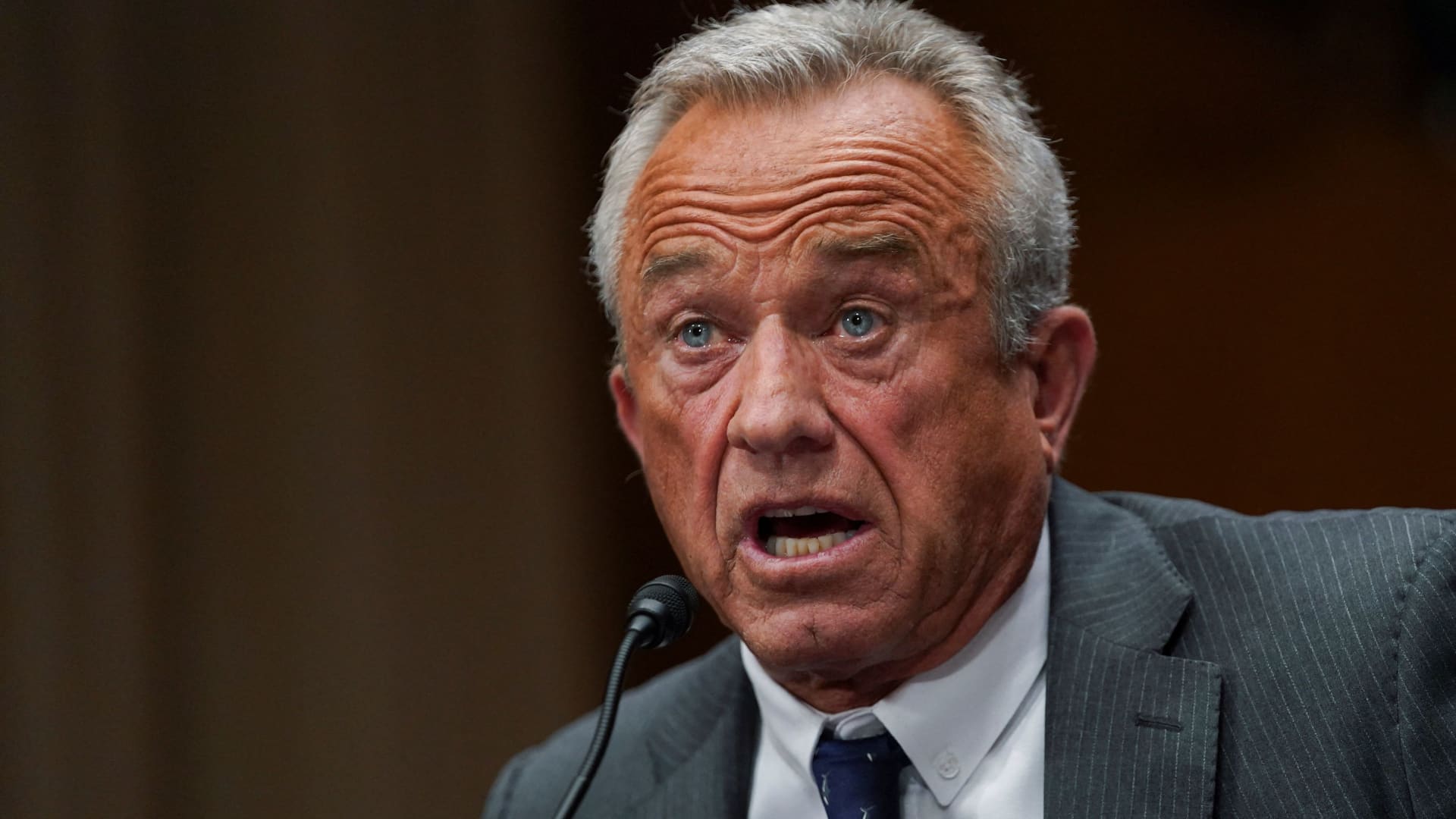
RFK Jr. Faces Challenges Explaining Basics of Medicare and Medicaid in Senate Hearings
RFK Jr., nominated by the President to head a significant department, seemed to lack a foundational understanding of Medicare and Medicaid during his second round of Senate hearings on Thursday.
"You're seeking confirmation to oversee Medicare, yet it appears you're unfamiliar with the program's fundamentals," observed Senator Maggie Hassan, a Democrat from New Hampshire, after Robert F. Kennedy Jr. struggled to tackle questions about Medicare during the Senate Health, Education, Labor, and Pensions Committee hearing.
If confirmed, Kennedy would lead an expansive $1.7 trillion department that includes oversight of the Centers for Medicare & Medicaid Services. This agency administers government-backed health programs for millions, including older adults, individuals with disabilities, and those with lower incomes who depend on Medicare, Medicaid, and the health markets established by the Affordable Care Act.
During his confirmation hearings, Kennedy, aged 71, stumbled with queries related to Medicare and Medicaid. He appeared before another Senate committee on Wednesday as well.
On Thursday, Senator Hassan, who is a member of both committees, prompted Kennedy to outline the various components of Medicare. However, he faltered in explaining the crucial parts of a program that caters to older and disabled individuals.
When queried about the purpose of Medicare Part A, Kennedy mistakenly stated it was primarily for primary care physicians. In reality, it covers seniors requiring inpatient hospital care, a fact clarified by Senator Hassan.
Kennedy also incorrectly described Medicare Part B as catering only to physicians and doctors. This part actually covers a variety of medical services including outpatient care, physician visits, home-based health care, certain medical supplies, and preventive services.
When asked to describe Medicare Part C, he mistakenly labeled it as an amalgamation of services—A, B, C, and D. In truth, Part C refers to Medicare Advantage plans, which are managed privately under Medicare contracts, offering an alternative to traditional Medicare plans.
Despite his assertions, Kennedy was pointedly reminded by Hassan that multiple corrections were necessary for his explanations.
Senator Hassan further interrogated Kennedy about his comments from the Wednesday hearing, where he seemed to interchangeably use Medicare and Medicaid wrongly.
Medicaid is a joint federal and state program assisting approximately 76 million individuals, primarily low-income families. However, Kennedy inaccurately described it as entirely financed by the federal government.
On Thursday, Kennedy corrected his earlier statement by acknowledging the shared funding responsibility between states and the federal government, admitting a misstatement in the prior hearing.
Concluding the Wednesday hearing, Senator Ron Wyden of Oregon, the Finance Committee's ranking minority member, criticized Kennedy as ill-prepared, citing that Kennedy appeared unable to distinguish adequately between Medicare and Medicaid.
"My colleagues have witnessed the confusion between Medicare and Medicaid, and there seems to be uncertainty on your part as to which program you're describing," Wyden remarked.
Leave a Reply