


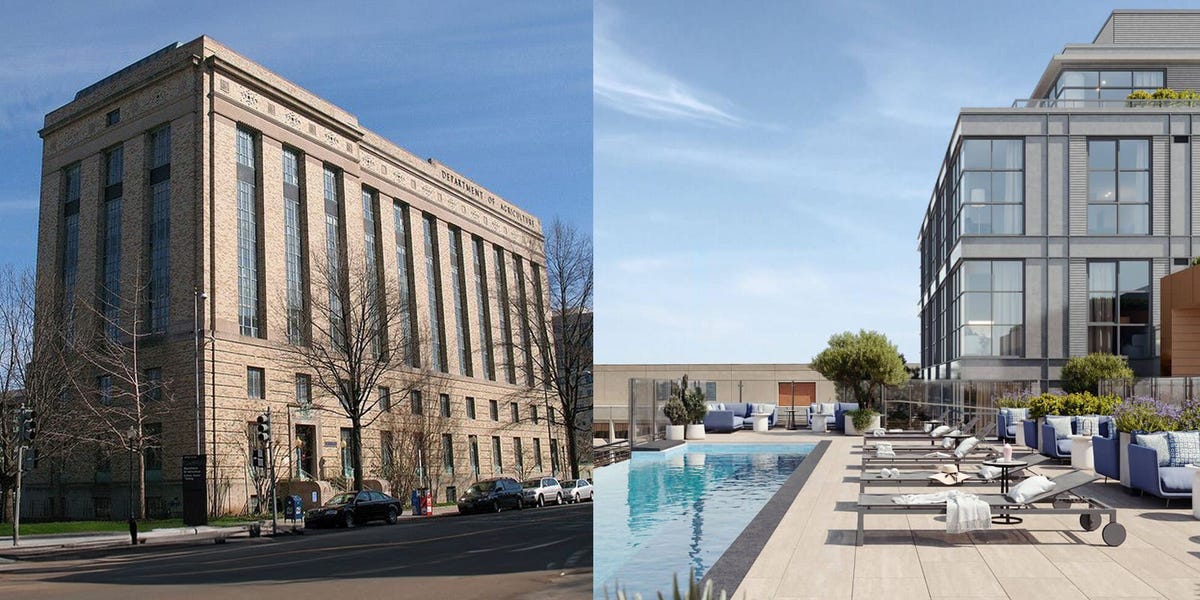
Transformation of a Historic Government Building into Luxury Apartments
Washington D.C. is setting the stage for a massive shift from office spaces to residential apartments, leading the U.S. with a staggering 88% increase compared to 2023. In 2024, it's anticipated over 5,800 conversions will be underway.
One notable example of this transformation is the Cotton Annex. Erected in 1937, this federal landmark, found a short walk from the Washington Monument, first served as a space for the U.S. Department of Agriculture. The government phased out its use by the early 2000s.
Recognizing the inefficiencies of maintaining half-empty government buildings, an entity known as the Public Buildings Reform Board initiated the sale of underutilized structures like the Cotton Annex. Their March report to Congress warned of the unsustainable nature of the status quo.
In 2017, the Cotton Annex was sold at a government-led auction. By 2021, developers Carmel Partners took hold of the property for $45 million, embarking on a redesign into a luxury residence with 562 apartments.
A Slice of History: The Cotton Annex's Origins
Situated close to the National Mall, the Cotton Annex was originally part of the U.S. Department of Agriculture's Bureau of Agricultural Economics. The structure reflects the architectural influence of Louis A. Simon, who oversaw its design while serving as the Department of Treasury's supervising architect.
A Rapid Build Amidst New Deal Policies
Construction began under the impetus of the Works Progress Administration, aimed at job creation post-World War I. Federal buildings like the Cotton Annex sprung up quickly during this era thanks to these initiatives.
Adapting to Wartime Needs
As World War II loomed, priorities shifted drastically away from civil projects in Washington D.C., directing construction efforts predominantly to the Pentagon, noted Kim Daileader, a historic preservation expert involved in the building's renovation.
From Cotton to Tobacco: Mid-Century Transitions
Post-war growth in cotton production necessitated a standardization for various economic purposes, facilitated by the Cotton Annex. However, by the 1950s, the building transitioned its focus to the USDA's tobacco division, although operations eventually relocated primarily to North Carolina.
During this time, the Cotton Annex shifted into a temporary space for USDA employees whose offices were undergoing changes, a need which eventually dissipated by the 1980s.
Abandonment and Resale
As the new millennium approached, the building's use dwindled, and it was put up for online auction by the government in 2016, fetching approximately $30 million. A few years later, the Cotton Annex changed hands again, sold to Carmel Partners for further development.
A Modern Incarnation: Annex on 12th
The new iteration, Annex on 12th, is characterized by its thoughtful blend of old and new designs. It expands upon the building's original footprint with an added structure, creating a unique doughnut-like layout.
The ground floors of this 13-story addition reflect the original Art Deco styling, boasting vertical window columns in sync with the past aesthetic.
Welcome Home: A Fresh Start for Future Residents
Scheduled for a December opening, the building will house a spectrum of apartments, from studio spaces to two-bedroom layouts, with prices ranging from $1,637 to over $4,600.
Community and Conveniences
Nestled within, a courtyard offers a social setting with a fire pit and BBQ elements. Further communal spaces include facilities like a media lounge with kitchen, designed to foster connections among residents.
Preserving Legacy in Modern Luxury
Central to the new development is the retention of historic architectural features like the sixth-floor skylight, once key to cotton inspections. This, along with other large windows, stands preserved as a nod to the building's past.
The rooftop, however, offers a contemporary touch with an infinity pool poised above views of the National Mall, complementing additional amenities like a coworking space.
A Carefully Balanced Redesign
Through detailed design choices, Carmel Partners have strived to maintain the site's historical significance, summarizing the effort as 'contemporary but compatible,' blending original elements with modern construction seamlessly.
Leave a Reply