


America's Middle East Strategy and Post-Assad Syria
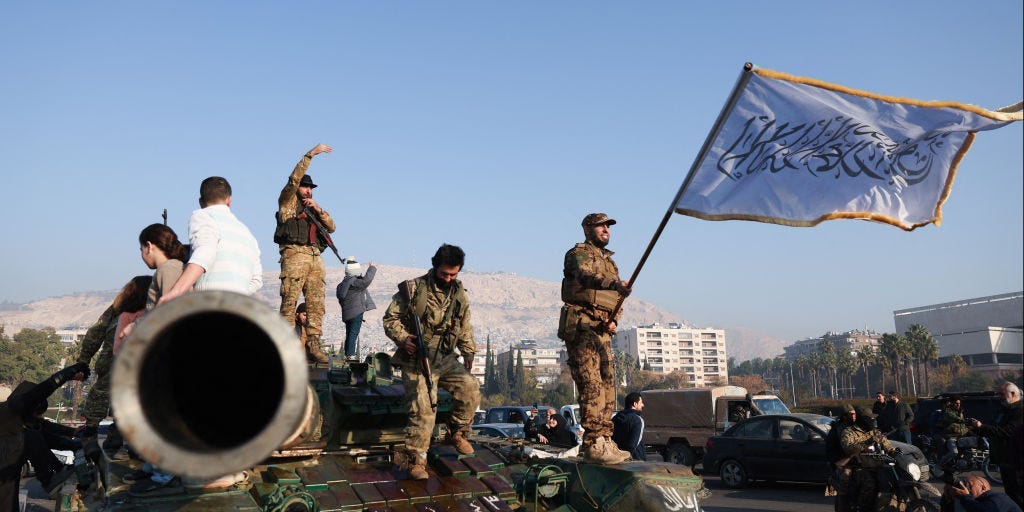
In a swift and unexpected operation lasting just two weeks, Syrian rebels, spearheaded by the Islamist group Hayat Tahrir Al-Sham, successfully ousted Bashar Assad, the enduring leader of Syria.
On Sunday, President Joe Biden expressed cautious optimism towards Assad’s removal, describing it as "a historic moment full of possibilities."
Assad's departure has opened a range of possibilities for the United States, according to analysts who emphasize the need for strategic planning to ensure progress and avert further chaos.
Burcu Ozcelik, a senior researcher specializing in Middle East security at the UK-based Royal United Services Institute, stated that Assad’s fall offers the U.S. an opportunity to weaken Iran's influence in the region further.
She mentioned that Iran has experienced a significant strategic loss, aligning with U.S. ambitions to weaken Iran's so-called resistance network.
A Complex Landscape
The onset of the Syrian civil war in 2011 marked a fierce contest for power involving rebel groups, the government, and their formidable global supporters, such as the U.S., Turkey, Iran, and Russia.
While the U.S. supported certain factions, particularly Kurdish and moderate groups, it refrained from becoming directly embroiled in the conflict.
In 2014, when ISIS took over vast regions of northeastern Syria, launching attacks against the West, the U.S. spearheaded a global effort to wipe out the group.
However, the U.S. has primarily limited its presence in Syria, maintaining about 900 troops focused on suppressing IS incursions and protecting Kurdish allies, which may constrain its ability to take on a broader role now.
Strategic Engagements
According to Andreas Krieg, an expert on Gulf affairs at King's College London's Middle Eastern Studies Institute, the U.S. may continue a limited "low-intensity campaign" against ISIS until Syria establishes a stable government.
An essential objective for the U.S. is to facilitate a return to stability, safeguard its allies, and avert renewed violent power clashes between militias and religious sects that might extend to nearby nations.
Mohammed Albasha, who founded the Middle East-focused consultancy Basha Report in Virginia, notes that Assad's exit has left a "major security gap" that radical factions could exploit.
Faced with this scenario, the provisional government might lag in providing essential services amid an already grave humanitarian crisis.
In addition, the U.S. may face challenges from Iran and Russia, who are vying to reassert their influence rapidly and negotiate beneficial terms with new power players in Syria.
Impact on Iran and Russia
Iran has long sustained the Assad regime with essential economic and military aid throughout the conflict.
The fall of Assad’s regime has weakened Iran's alliance of states and militias intent on diminishing U.S. power and annihilating Israel, as Burcu Ozcelik observed from the Royal United Services Institute.
She noted that while Iran will aim to redefine its role in Syria after Assad, its current regional policy ambitions and reputation have been severely compromised.
The downfall of Assad signifies a loss for Russia as well, which had significantly moved to counter rebel advances when it joined the Syrian civil war in 2015. It's reported that Assad and his family have fled to Moscow.
Assad's removal may result in Russia losing key military installations in Syria that are strategically important.
The Future of Governance
With Assad’s departure, there is uncertainty over who will assume control in Syria.
Abu Mohammad al-Jolani, who leads the Hayat Tahrir al-Sham group that was instrumental in toppling Assad, is a prominent figure in this power vacuum. Amidst this, his connections to an Al Qaeda affiliate during Iraq’s U.S. occupation highlight his controversial background.
The HTS, labeled a terrorist entity by both the U.S. and the UN, has exercised power over Syria's Idlib Province, where it has attempted to reshape its image and entrench its power, though its history with al-Qaeda remains worrying for U.S. policymakers.
Debates are ongoing over potentially lifting the $10 million bounty on al-Jolani as the U.S. considers new strategies.
President-elect Donald Trump recently advised that the U.S. should not intervene in Syria's ongoing affairs.
Edmund Fitton-Brown, an advisor with the Counter Extremism Project, expressed concern over whether the HTS seeks genuine governance or aims to continue its insurgency.
Yaniv Voller, a lecturer in Middle East Politics, mentioned the potential difficulty in the U.S. engaging directly with al-Jolani unless he fully renounces his extremist views and hostility towards Israel.
A major risk, Voller warns, lies in Syria fracturing into areas dominated by rival factions, possibly becoming a base for terrorism, which, for the U.S., presents a far graver threat.
Leave a Reply