


Florida's Movement Towards Storm-Ready Homes Advances
As Hurricane Milton approached with growing intensity, William Fulford stayed firm. At 76, this retired builder wasn't swayed by the Tampa mayor's TV warnings urging evacuation. "Some folks might call me reckless," Fulford remarked to Business Insider in early October, noting his confidence in his home amidst the storm.
In the previous year, Fulford invested $1.25 million in Hunters Point, a high-elevation community in Cortez, Florida. Properties here are securely anchored with steel straps, a strategy Fulford credits for his home's resilience against Hurricane Milton.
Rising Demand for Resilient Housing
Developers in Florida are increasingly focusing on hurricane-resistant housing initiatives such as Fulford's. As hurricane season officially draws to a close in late November, the momentum for building robust homes grows, driven by climate change and escalating storm intensities.
The idea of durable homes resonates strongly with Floridians facing rising insurance premiums and HOA fees amidst escalating storm-related risks. With recent hurricanes causing significant damage estimated between $21 to $34 billion, demand for secure housing is clear.
Pioneering Projects in Storm Preparedness
Located southeast of Hunters Point is Babcock Ranch, positioned as "The Hometown of Tomorrow." Builders here have focused on weatherproofing more than 4,000 homes with measures including underground utility installations and respecting natural watercourse paths.
Interest in such developments swells before major storms, as evidenced by Babcock Ranch's spike in online visits pre-Hurricane Milton. Hunters Point also noted increased traction with recent home sales.
Expert Opinion on Resiliency
Although no dwelling can be completely hurricane-proof, experts like Leslie Chapman-Henderson, head of the Federal Alliance for Safe Homes, commend projects like Hunters Point and Babcock Ranch for demonstrating effective storm resistance practices.
These communities, built with integrated protections rather than isolated solutions, safeguard neighborhoods and their value against Florida's unpredictable climate future.
"We hope more developers adopt these leading-edge techniques," Chapman-Henderson said.
Architectural Strategies in Hunters Point
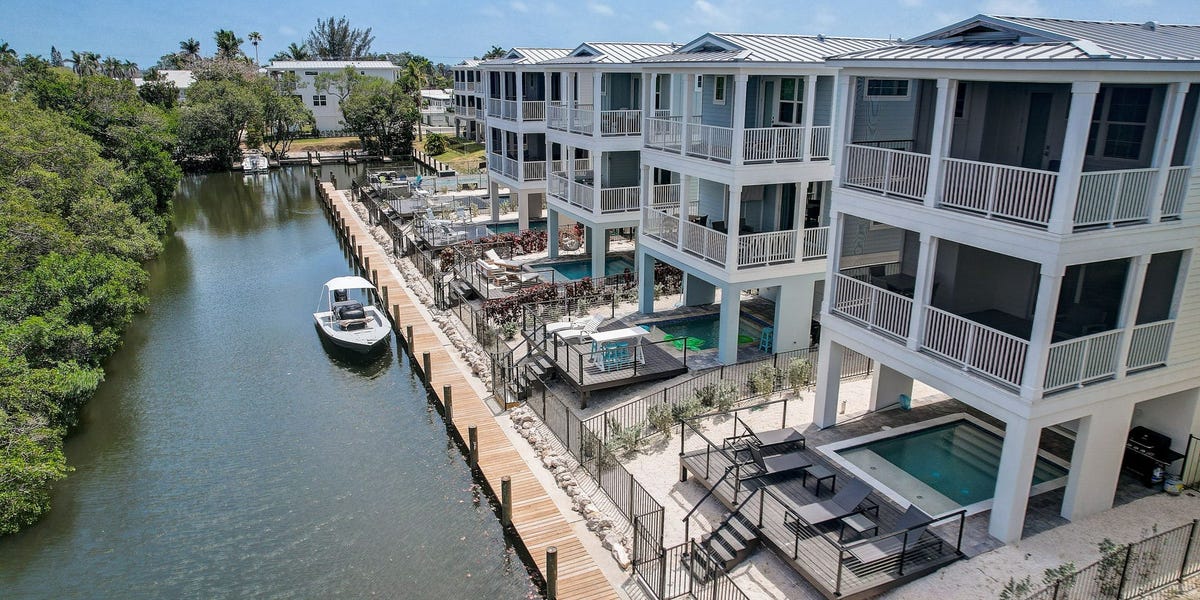
Hunters Point, situated just south of Tampa in Florida's last active fishing village, features homes elevated significantly to mitigate storm surge risks. Located close to Sarasota Bay, these properties are strategically protected, having been extensively developed and quality-checked over 18 months.
Here, the ground level serves as storage, with livable space beginning only above the 16-feet flood danger height, all interconnected by elevators.
At Hunter's Point, 31 of an intended 86 units are now complete, with properties priced between $1.45 to $1.69 million. Designed with an integral fortified base, these homes feature robust wall structures for added protection.
Advanced Structural Design Techniques
Homes here are strengthened by steel straps that tie the roofs to the foundation, preventing structural separation during hurricanes. As Chapman-Henderson observed, the advanced wind fortifications and construction using dense lumber significantly boost the homes' durability.
"Often, roofs fail first due to inadequate attachment to walls, leading to complete structure failure," said Mike O'Reilly, a construction instructor. In contrast, Hunters Point properties boast seamless structural integrity akin to a Yeti cooler.
Babcock Ranch's Water Management Innovations
Standing 30 feet above sea level and distanced from the coast, Babcock Ranch integrates community features like schools and commercial areas with extensive resiliency in mind.
Developer Syd Kitson focused on maintaining the natural hydrological patterns when planning the 19,500-home site, a decision that involved preserving natural drainage pathways.
Safety and Utility Management
The inclusion of 'smart lakes' equipped with predictive analytics and solar-powered pumps allows for proactive flood management. These man-made lakes adjust their levels when storms are imminent to accommodate additional rainfall.
Additionally, all essential utilities are buried underground to shield them from powerful storms, offering a functional design that contains concrete-encased wiring resistant to formidable winds.
Innovation in Community Resilience
Babcock Ranch has become a model for safe living, its facilities doubling as regional evacuation centers during emergencies.
Although the infrastructure is designed for maximum resiliency, Chapman-Henderson stresses the importance of remaining vigilant and evacuating when necessary. "Absolute safety can't be guaranteed," she insists, echoing the caution against complacency.
Despite no official standards for storm-resilient buildings, initiatives like Fortified—assessing roof robustness—highlight growing interest in durable housing solutions.
Though not part of such programs, Hunters Point and Babcock Ranch's initiatives reflect smart judgment. "Labels like 'proof' can be misleading," noted Fred Malik of Fortified, yet he admires the sound building strategies employed within these communities.
Leave a Reply