


Decades-Old Beach Bones Identified as Ship Captain from the 1800s
The skeletal remains discovered on New Jersey beaches several decades ago have finally been identified by college researchers as belonging to the captain of a 19th-century schooner.
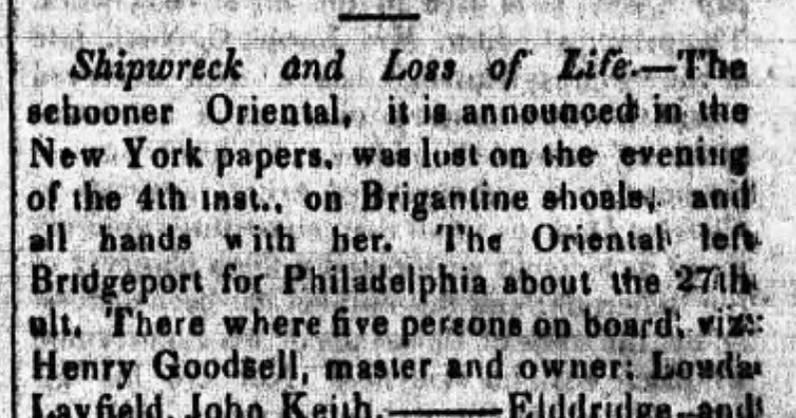
The vessel, named the Oriental, met its fate in the year 1844. While ferrying 60 tons of marble from Connecticut bound for Philadelphia, meant for the construction of Girard College, it likely encountered a leak causing it to sink near Brigantine Shoal. Tragically, this disaster claimed the lives of all five crew members aboard.
The Journey of Identity
Between the years 1995 and 2013, several parts of a skeleton, including a skull, were uncovered on various beaches along South Jersey. These remains earned the moniker 'Scattered Man John Doe' after police investigations failed to identify them.
Fast forward to 2023, a collaboration between the New Jersey State Police and Ramapo College's Investigative Genetic Genealogy Center finally provided answers. Using a bone sample, which was submitted to genetic genealogy platforms like Intermountain Forensics in February 2024, students used the genetic profile to delve deeper.
Connecting the Genetic Dots
The students discovered ancestral links stretching back to the 1600s. They found connections to families from Connecticut, compelling them to investigate historical shipwrecks along New Jersey's coastline. Their research uncovered two historical accounts detailing the Oriental's sinking, including crew information.
A contemporary article from December 1844, published by the Boston Daily Bee, recounted how the storm that led to the ship's sinking was too severe for any nearby assistance. It mentioned that one body was respectfuly buried following its wash ashore, but no others were immediately found.
Unraveling the Mystery
Compelling circumstantial evidence combined with genetic lineage led the students to hypothesize that 'Scattered Man John Doe' could indeed be Captain Henry Goodsell. At the time of his untimely death, Goodsell was just 29 years old, leaving behind his wife and three children, as detailed by the Boston Daily Bee. A reference sample from his descendant was obtained in March 2025.
By April 2025, the NJ State Police had confirmed the identity: the remains indeed belonged to Goodsell. Ramapo College notes this as one of the eldest unsolved cases cracked using investigative genetic genealogy.
A Solemn Duty Fulfilled
"Detecting human remains is among the gravest duties of our law enforcement," remarked Patrick Snyder, Chief of County Detectives at the Atlantic County Prosecutor's Office. "Officers work tirelessly, ensuring that victims are not forgotten and that families eventually receive closure."
Ramapo College's IGG Center has played a pivotal role in solving historical mysteries like this. Notably, two months earlier, its program helped to identify the remains of another individual from a cold case decades old, underlining the center's significant contribution to historical and genealogical research.
Leave a Reply