


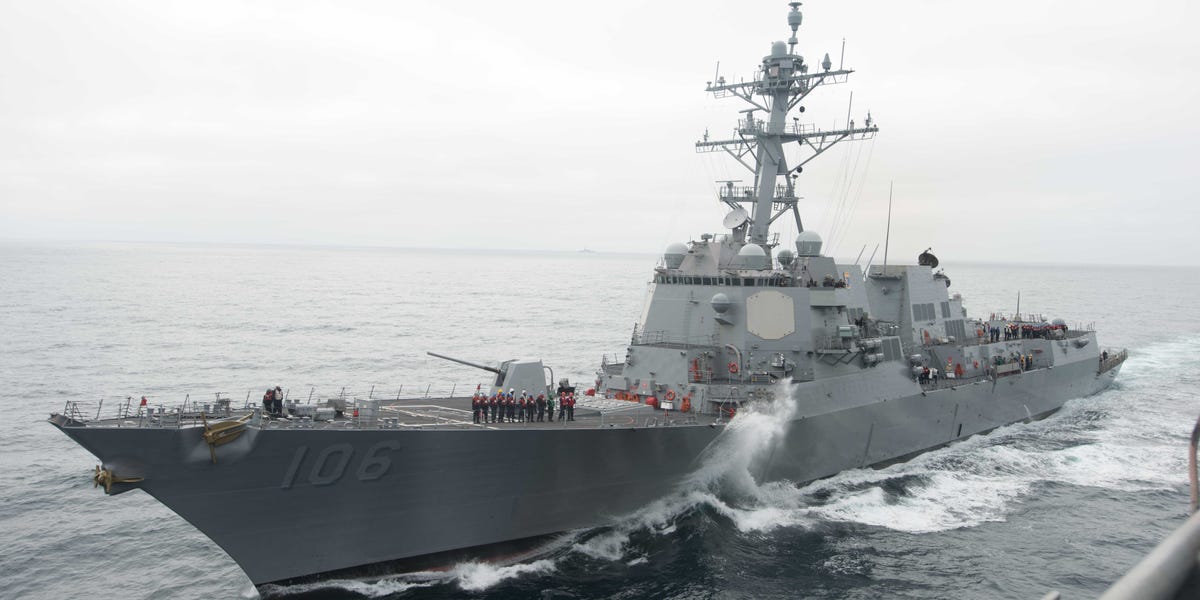
Navy Destroyer's Role Transition from Red Sea Conflicts to U.S. Border Patrol
The captain of one of the three U.S. Navy destroyers that set sail this spring, following months of conflict against the Iran-supported Houthis in the Red Sea, shared that his vessel was aptly equipped for both duties.
Although some queried whether deploying destroyers to the southern border was excessive, military officials conceded it was somewhat unconventional to use such advanced capabilities for this purpose. However, this action conveyed a strong, undeniable statement.
Unlike the Red Sea operations, at the southern border, the primary advantage of these combat ships is not their weaponry but their unmatched communication technologies, sensor systems, and resilience—features other vessels lack.
Commander Jacob Beckelhymer, leader of the USS Stockdale, told Business Insider that these maritime security missions are a familiar endeavor, fitting within the wide spectrum of naval destroyer activities.
Recently, the Stockdale docked back at its base in San Diego after spending weeks stationed near southern California, bolstering U.S. military efforts at the southern border.
According to the 2025 Annual Threat Assessment of the U.S. intelligence community, criminal activities arising from Mexico are of significant concern, aligning with the Trump administration's focus on curbing maritime crime, including illegal immigration and drug smuggling.
The government strategically deployed various military resources to the border area, including the trio of destroyers known for their previous engagements with the Houthis.
For their missions along the southern border, vessels like the Stockdale accompanied by the USS Spruance and USS Gravely were outfitted with the U.S. Coast Guard Law Enforcement Detachment. These expert Coast Guard units excel in at-sea law enforcement, tackling issues like counterterrorism, piracy prevention, and immigration containment.
Arleigh Burke-class destroyers such as the Stockdale come armed with a combination of surface-to-air and ground-attack ordnance, as well as an arsenal of guns like a hefty deck gun, automatic weapons, and a close-in weapons system.
While this heavy armament was necessary for dealing with Houthi aggressions, primarily involving missile and drone threats, at the southern border, the situation necessitated a shift in focus away from combat readiness.
"The ship’s sensor technologies are exceptional," Beckelhymer noted. "Our radar capabilities greatly surpass what is common on smaller Coast Guard cutters. Additionally, we benefit from a significantly larger crew."
He highlighted the advanced combat information center, a multi-function space filled with screens for tracking maps and radar signals, crucial for assessing smuggling threats and advising subsequent actions.
Henry Ziemer from the Center for Strategic and International Studies commented on a destroyer's "strong sensors and electronics that serve as valuable tools for identifying small vessels and semi-submersibles used in illegal activities."
Operational Insights
These naval ships are designed to coordinate other resources, acting as force multipliers that amplify operational effectiveness.
Beckelhymer praised the MH-60R Seahawk helicopter onboard the Stockdale for its superior air coverage, as it offers real-time data and video transmission back to the destroyer while boasting advanced radar and communication technology.
The Stockdale is described as a vessel of great endurance, capable of remaining operational on-site for extended periods, thanks to its ample fuel and supplies.
During its deployment, the stock dale provided command and control functions, boosting maritime monitoring and examination for Coast Guard operations in the region, assisting in intercepting suspect smuggling crafts, and even providing life-saving assistance to marooned mariners.
Reflecting on the missions, Beckelhymer expressed admiration for witnessing the dedication and efforts of young sailors as they execute complex naval operations in support of significant mission objectives directed by two different fleet commanders.
Leave a Reply