


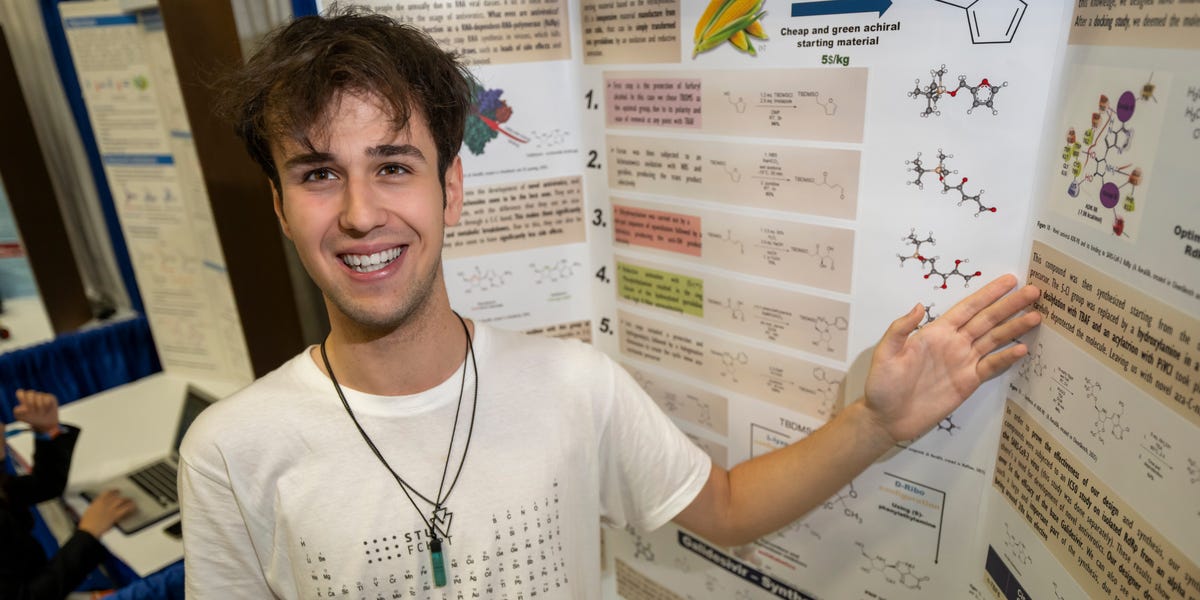
Teenager Wins $100,000 for Innovating Antiviral Drug Production from Corn Waste
In an unexpected turn of events, Adam Kovalčík journeyed to Ohio for a global science contest, only to return home with a prize of $100,000.
This accomplishment was due to his groundbreaking work in creating an economical and rapid method to synthesize galidesivir, an experimental antiviral targeting RNA viruses such as Ebola, Zika, and COVID-19.
Renowned chemist Chris RoDee remarked, "This innovation signifies a potentially significant preventative measure against some RNA viruses."
Although preliminary research indicates galidesivir's effectiveness against RNA viruses, it has yet to undergo comprehensive clinical evaluation. Kovalčík intended to incentivize further studies by drastically reducing production costs—from $75 to roughly $12.50 per gram.
Revolutionizing Drug Synthesis with Corn By-products
By employing corn husks, Kovalčík managed to significantly lower drug manufacturing expenses, producing double the output with merely 10 procedural steps compared to the conventional 15.
In addition, he innovatively devised a new antiviral agent using this methodology.
At the ISEF in Columbus, Ohio, Kovalčík showcased this research. The judges, led by RoDee, awarded him the prestigious George D. Yancopoulos Innovator Award.
Reflecting on his win, Kovalčík shared, "It’s an indescribable emotion. Coming from a small Slovakian village, winning at such a grand international level is astonishing."
A Leap from Agricultural Waste to Pharmaceutical Advancements
Kovalčík’s innovative approach began with corn husks, leveraging furfuryl alcohol as an accessible and cost-effective starting compound.
Adding chemicals systematically, he transformed furfuryl alcohol into aza-saccharide, a vital sugar, in just seven steps.
Completing the synthesis of galidesivir demanded only three additional steps, halving the usual procedural complexity.
According to RoDee, "He revolutionized the procedure by adopting a completely new approach, achieving the same outcome in half the steps."
This innovative process reduces the synthesis period from nine days to five.
Additionally, Kovalčík developed another drug that computational models suggest might be significantly more potent against COVID-19 compared to galidesivir, owing to its superior enzyme-binding capabilities.
Future Aspirations: Enhancing Drug Production and Venturing into Perfumery
Kovalčík has submitted a provisional patent for his novel drug-synthesis technique.
He also intends to collaborate further with Bratislava's Slovak University of Technology, which has been integral to his project's development.
For commercial viability, his drug production needs scaling up; currently, increasing production beyond 200 liters of galidesivir presents a challenge.
He envisions expanding his research scope to other drug synthesis improvements, facilitated by university research teams.
His ambitions extend beyond pharmaceuticals; Kovalčík aims to leverage his chemical expertise and winnings to launch an eco-conscious perfume company utilizing corn derivatives.
"From my first lab experience, chemistry has always been my calling," he declares. His achievements in the field have been nothing short of a dream come true, offering him immense satisfaction.
Leave a Reply