


President-elect Aims to Mold the Judiciary for Future Generations
Trump's Second Effort at Judicial Appointment
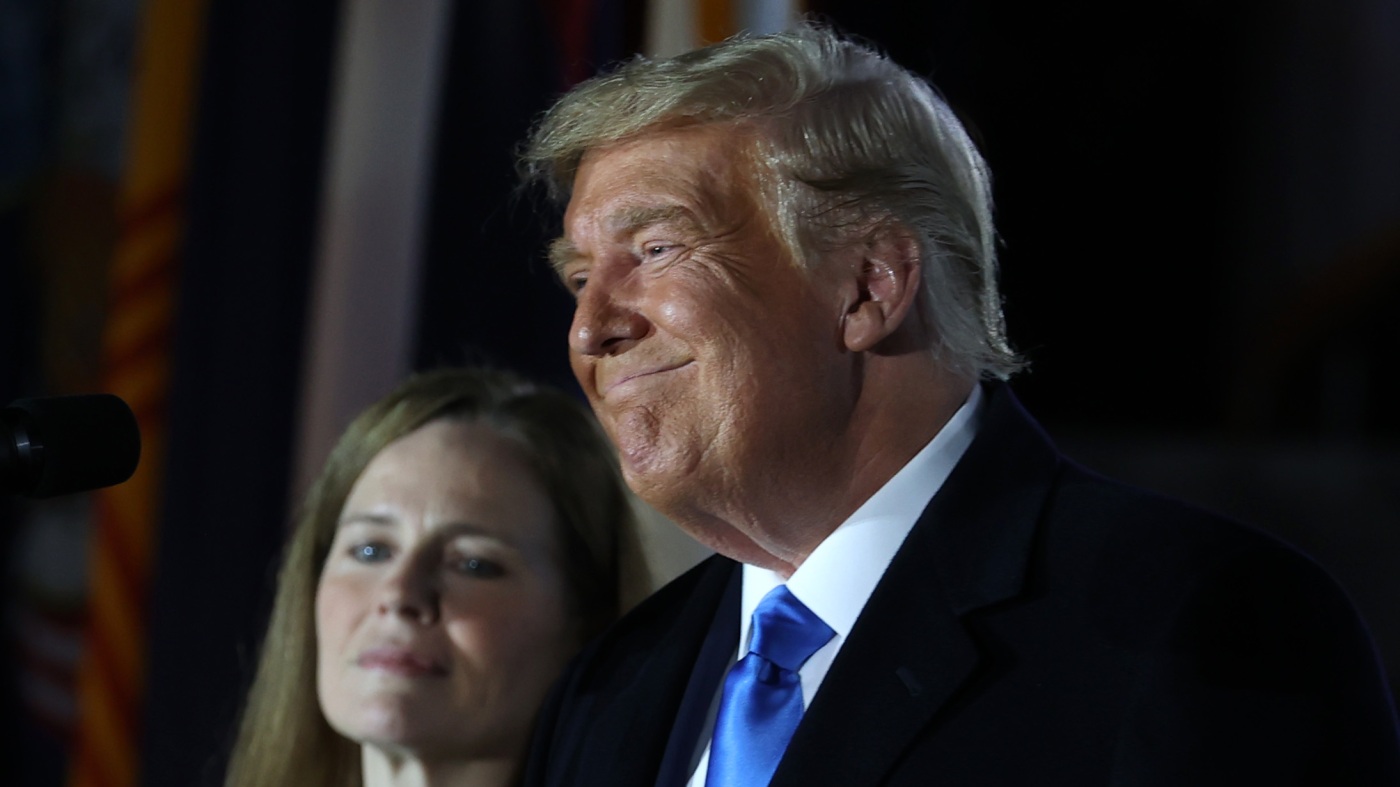
In 2020, Donald Trump, then President, participated in the ceremonial swearing-in of Justice Amy Coney Barrett to the Supreme Court.
Throughout his initial tenure as president, one of Trump's notable achievements was the appointment of federal judges.
Legal specialists anticipate that Trump will act swiftly in the upcoming year to solidify this legacy, benefiting from insights into how his previous appointees have functioned.
"The president has a familiar pool of potential nominees," remarked Jesse Panuccio, erstwhile senior figure in the Trump Department of Justice, now in private practice.
Panuccio noted that Trump stands out as the first U.S. president since 1893 to serve nonconsecutive terms.
"Similar to Grover Cleveland's era, Trump will have the chance to evaluate the performance of his judicial appointees over time," Panuccio added.
Presidential appointees may not always align with their appointer's expectations once in a lifetime position; hence, Trump may scrutinize potential nominees’ legal records and writings more closely.
The Republican majority in the Senate with 53 seats provides the Trump administration ample capacity to ratify nominees.
According to Russell Wheeler, a scholar at the Brookings Institution, if the Senate continues confirming judges as zealously as during Trump's first term, there could be a significant shift in federal court composition.
Over his first four years, Trump successfully saw 234 judicial nominations confirmed by the Senate, including Supreme Court Justices Gorsuch, Kavanaugh, and Barrett.
Focus on Fidelity
During Biden's administration, there was a concerted drive for varied judicial nominees, with nearly two-thirds being women and many from diverse backgrounds.
Wheeler observed that a large portion of Biden's judicial appointees were not white men.
Conversely, Trump might prioritize loyalty in his judicial nominations, drawing from his track record in key Cabinet appointments.
A pressing question is whether Trump's loyalty-focused nominations could deter some Republican senators.
Edward Whelan from the Ethics and Public Policy Center reminisced about the 2005 conservative backlash when President Bush nominated Harriet Miers for the Supreme Court, an appointment withdrawn due to perceived inexperience.
"The lesson here is that pushing a nominee based solely on allegiance could be problematic," Whelan stated.
Skye Perryman, leading Democracy Forward, anticipates Trump will propose candidates with extreme stances on issues like reproductive rights, but hopes for oversight from Republican senators.
"There is a chance to hold senators accountable, especially if they endorse judges misaligned with American values," Perryman commented.
The question for senators remains: Is loyalty to Trump worth the potential pushback from voters in the 2026 midterms?
Leave a Reply